Renewed Apprehension
pp. 7-8 · Read in the full issue
About The Future Of New Guinea
From Judy Tudor, in Port Moresby Despite all the shots in the arm reputed to have been given itely by the Australian Minister for Territories, Mr. Paul lasluck, there have been new factors and new fears bedevilling lis already frustrated country. They were crystallised in seeches by two European members of the P-NG Legislative buncil at its February meeting.
dERE is a growing belief in this country,” said Mr. Lloyd •ell, elected member for NG iland, “that Australia would like et rid of us, if it could do so jnably. The pressure seems to late from the Australian Depart ; of External Affairs and Osmar e’s recent exaggeration of this put into words the widespread that does exist.” r. Hurrell was referring to les and the following denials on Guinea’s future, written by (ourne journalist Osmar White irted on pp. 21 and 75 this )• he Department of External rs,” said Mr. lan Downs, elected ber for NG Highlands, speaking he same subject, “has . . . and continue to exercise pressure for her Australian widthdrawal from a-New Guinea.” ter his opening gambit, Mr. ell probed more deeply into what ralia really meant when it had iised Papua-New Guinea the t to self-determination”.
Did self-determination include the possibility of union with Australia?
Because, if so, it was becoming abundantly clear that the possibility that this is what P-NG would choose was already making Australian politicians “recoil in fear”.
“Labour Party leaders,” he said, “can no longer come here happily and face our people, for they are terribly afraid that to encourage them, or to agree to union, would be committing political suicide. Even the Minister for Territories, whom I believe would favour a union, was unable [recently] to answer questions reasonably asked by Stanis Boromilat at Rabaul.
"Colonialism"
“Our control of New Guinea, it seems, will always be regarded as colonialism ... it is a source of irritation between Australia and her Asian neighbours, especially Indo nesia. In short, it is a trouble spot.
However, if we don’t stick to our guns in this area, where next will the trouble spot develop?
“No one fought for West New Guinea, and no one would fight for us.”
During the course of the rest of his speech, in which he developed some of the old fire-and-brimstone that had shaken the chamber to its foundations in his maiden appearance a couple of years ago, Mr. Hurrell accused the Australian Government of “wilfully neglecting” its own in vestors in the Territory; and said that some of the utterances of Mr.
Whitlam, Deputy Leader of the Federal Labour Party, during his recent visit to P-NG had “made him sick”.
Throughout Mr. Whitlam’s visit, said Mr. Hurrell, he showed a com pletely superficial knowledge of Ter ritory affairs and an utter disregard for the rights of European residents.
In Mr. Hurrell’s estimation it would be a case of only Heaven being able to help P-NG if Labour won the next Australian elections.
What was needed from Australia at this moment, he said, was a clear statement as to what was meant by self-determination, in terms of pos sible union with Australia—and a guarantee by the Australian Govern ment of private enterprise in the Ter ritory.
Mr. Downs said that the pressure on members on both sides of the Federal Parliament for Australia to withdraw quickly from New Guinea was very real.
Australian representatives overseas get “worn down” by having to de fend Australia’s continued presence in the Territory— to such an extent that they felt that they must be rid of it at any price. (Over)
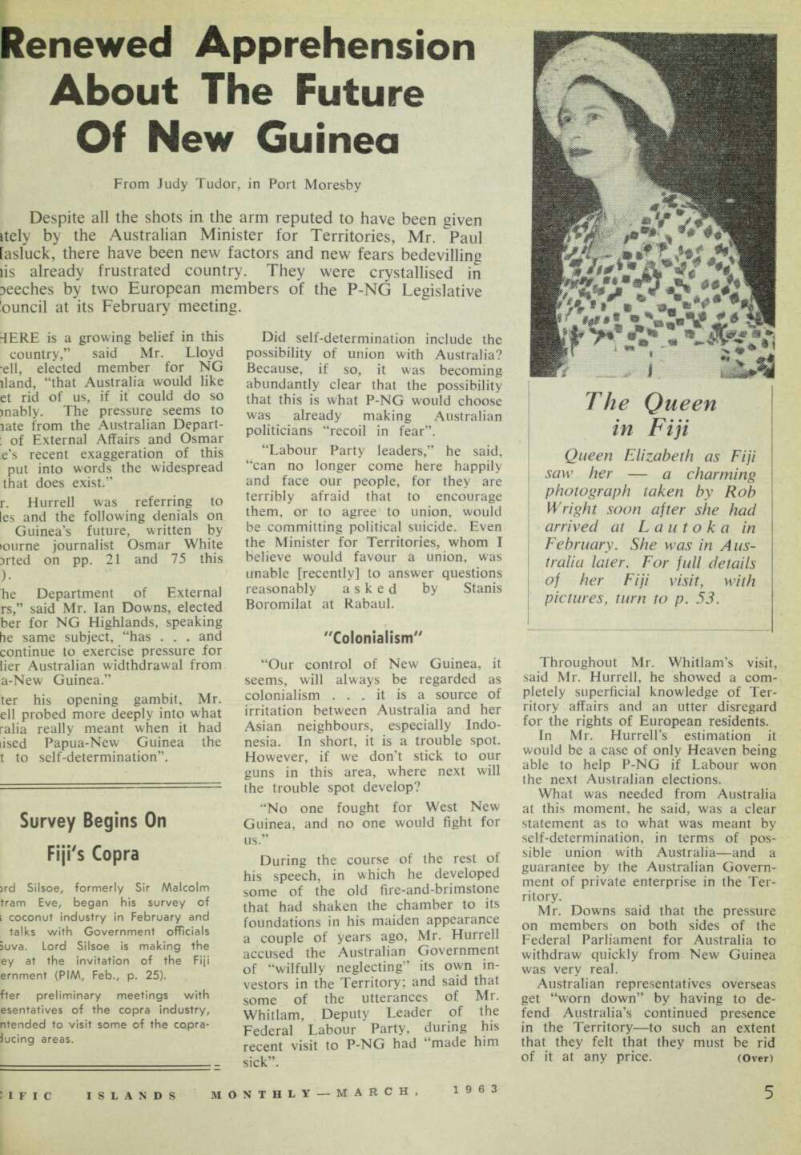
The Queen
in Fiji
Queen Elizabeth as Fiji saw her - a charming photograph taken by Rob Wright soon after she had arrived at Lautoka in February. She was in Aus tralia later. For full details of her Fiji visit, with pictures, turn to p. 53.
At the same time, it was said in other quarters that Australia’s pre sence in the Territory embarrasses Australian trade in SE Asia. Others feel that P-NG is a liability in the matter of defence and that Australia should concentrate on “continental defence”. Again, others imagine that the cost of maintaining P-NG could run into £5O million a year within five years and that the “Australian taxpayer is fed-up of having to foot the bill”.
But, he said, it might cost Aus tralia a great deal more if it did withdraw completely. Economically the Territory could not be free—if Australia didn’t help, someone else had to. And what reasonable Australian would be happy knowing that some other country occupied New Guinea?
Some people had suggested that the World Bank would give develop mental loans but the World Bank, or anyone else, would quickly come to the conclusion that P-NG was not a proposition in itself, although in conjunction with Australia it was.
The Territory’s only economic hope was to be linked with an in dustrial country like Australia.
Suggestions made by Mr. Whitlam, and others before him, that P-NG should become part of a federation of Melanesia (linking perhaps the Solomons and the New Hebrides), were highly impractical. It would simply add vast problems of com
munications, hundreds of new language groups and people with new customs, to the complex that already existed within the Territory, and would drag P-NG down, not assist it.
The whole New Guinea situation was misunderstood in Australia, said Downs. Australia could not just give the Territory away and be done with it. It was “physically, defensively and economically impossible”.