Pacific Commerce and Produce
pp. 163-164 · Read in the full issue
Little Experiment The Undeveloped [?]pik Area
Mthough the Sepik District of
iv Guinea, which adjoins West
w Guinea in the north of the inland, is the largest in the
stralian territory (with 28,000
miles area), it is still largely
leveloped.
5 European industries comprise a few Mission coconut plantations some crocodile shooting enter es. The New Guineans are being imaged to grow more coconuts go in for cocoa, coffee, rice and nuts. b determine whether the grass 1s of the Sepik hold sufficient rishment to support a cattle-raising istry, an experiment will begin month by the animal husbandry sion of the P-NG Agriculture De ment when for the first time it send cattle to the district, fine crossbred Zebu-Angus cattle be flown from Port Moresby, i trucked 30 miles to the Sepik’s nbi plant industry station. The nals will be run on natural pasture md the station. fo supplementary feed will be n—a check on whether the cross 1s could thrive on natural Sepik ses. gricultural officers report also that v Guineans in the Central Righ ts are taking a greater interest in :ding cattle to provide more meat milk for their diet. Over 30 ige groups in the Highlands now >ess 98 head of cattle. Villagers i bought cattle have been first n a training course at an animal istry station to teach them how to 1 and care for the animals, wo village groups at Kup and lar, in the Chimbu Valley, have ded to buy four cows and will ?iven a bull by the Department of iculture.
an Negotiating For
v Britain's Timber ie loss of Japanese timber leases in t New Guinea may bring to Australian Guinea huge timber contracts with in with an annual turnover exceed £l Va million. igging companies in Rabaul confirmed aid- January that negotiations for the ;racts were almost complete.
One timber official said that the negotiations were started because of anticipated Indonesian refusal to continue West New Guinea contracts and because the United Nations had frozen Japanese logging assets in West New Guinea.
The new contracts will be on the island of New Britain and will be shared by at least five major operators.
Japanese interests made the initial approaches and talks were held between representatives in New Britain, Japan and Australia.
Sangara Plantation Dev. Co.
Under Receivership
The latest move in the complicated financial tangle involving the affairs in Papua-New Guinea of Sangara (Holdings) Ltd. and a number of other Territory companies (see “PIM”, Nov., p. 166 and Oct., p. 165) was announced in Sydney in mid-January. The Australia and New Zealand Bank Ltd. reported it had appointed a receiver for Sangara Planta tion Development Co. Ltd., effective December 13.
The company, registered in Port Moresby and a subsidiary of Sangara (Holdings) Ltd., operates a rubber planta tion near Popondetta, Papua. The receiver (Mr. R. Lord, of Martin and Lord, Port Moresby accountants) will carry on the work and affairs of the company as manager.
Sangara, making the announcement, said that because of a misunderstanding and the illness of the secretary, Mr. S.
Fox, of E. A. James & Co,, no public announcement was made in December.
Union SS Co.'s Profit
Down Again
Union Steam Ship Co. of New Zealand Ltd., which owns and operates the two main Central Pacific passenger vessels, “Matua” and “Tofua”, and several other trans-Pacific cargo vessels, among its wide shipping activities, discloses reduced profit for the second successive year.
In the year ended September 30, 1962, profit dropped £424,480 to only £74,881.
The preceding year profit fell 37 per cent.
Latest result is £280.119 short of the £300,000 reduced dividend requirement to P & O Co. Ltd. (of which it is a wholly-owned subsidiary). Dividend is cut back from eight to five per cent.
The result is, however, after allowing £55,000 dividend on the £1 million publicly held preference shares.
Depreciation was £24,214 higher at £1,278,798 and tax absorbed £159,970 less at £248,597. Income from invest ments rose from £106,579 to £261,626.
However, gross profit from shipping and ancillary interests was almost halved from £2,088,573 to £1,372,977.
Directors report keen competition in overseas trade. NZ manned vessels, with high wages and conditions, have difficulty
in competing with ships operating and manned under less onerous conditions, they add.
Progress of Pacific Islands
Mines Ltd. in Papua
The January report by Pacific Islands Mines Ltd. on its operations at Misima Is., Eastern Papua, showed that Umuna adit had advanced another 114 ft dur ing the four weeks to December 31, 1962.
At that date, the face of the adit was 242 ft from the portal, and the forma tion encountered was described as “contorted graphitic schists containing pyrites”.
The company is seeking to relocate the old lode that proved so valuable for Cuthbert’s Misima Gold Mine Ltd. pre war. The present adit is not expected to enter any zone of interest until at least 900 ft from the portal.
The extraordinary general meeting of shareholders to be held on January 7 to consider altering the method of trans ferring shares in the company was adjourned until January 14; and the con firming extraordinary general meeting was consequently postponed from January 21 to 28.
BSI and Fiji To
Launch New Loans
Both the British Solomon Islands Protectorate and the Crown Colony of Fiji will raise loan money shortly to finance their development programmes.
A bill will be introduced into BSI Legislative Council in February to
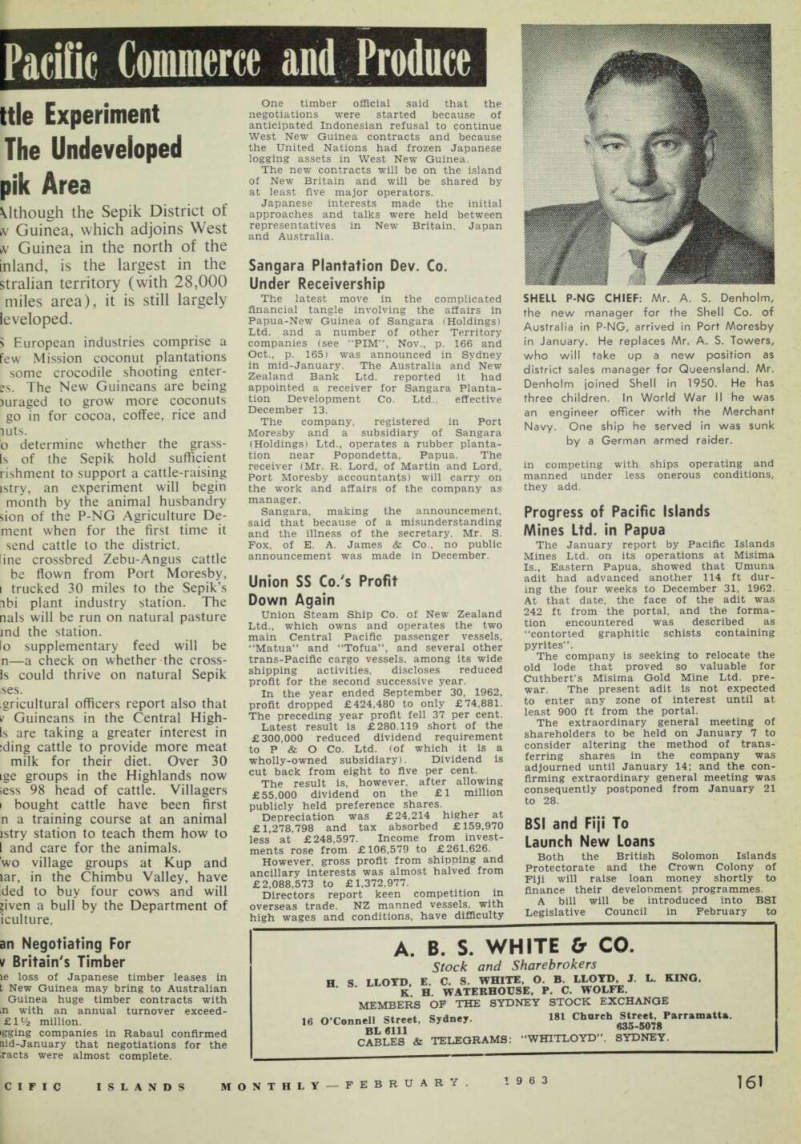
SHELL P-NG CHIEF: Mr. A. S. Denholm, the new manager for the Shell Co. of Australia in P-NG, arrived in Port Moresby in January. He replaces Mr. A. S. Towers, who will take up a new position as district sales manager for Queensland. Mr.
Denholm joined Shell in 1950. He has three children. In World War II he was an engineer officer with the Merchant Navy. One ship he served in was sunk by a German armed raider.
authorise the raising of a £15,500 loan from the Commonwealth Trading Bank of Australia. The money will provide an automatic telephone exchange for Honiara, and provide extensions to the system in 1963. This will be the first loan ever raised by the BSIP Government, and has been approved by the UK Secretary of State on the grounds that public utilities such as telephone services should pay their way.
Fiji’s local loan will be launched in the second half of the year, probably in August. Terms have not yet been decided.
The Colony plans to spend £3 million on capital development projects this year —about £lVa million will be provided by Britain in Colonial Development & Welfare grants, about £250,000 will be borrowed for telecommunications development and a further £250,000 will be provided from general revenue, and the gap of £1 million will be financed from the loan.
The last local development loan, in 1961, was for £1,750,000 and was fully subscribed.
Bulolo and Placer Show
6-Months Profit Rises
For the six months ended November 30, 1962, Bulolo Gold Dredging Ltd.’s profit was $U5309,300, an increase of $76,800 on the previous comparable period, directors announced on January 14.
It includes an unstated amount of dividend from Commonwealth-New Guinea Timbers Ltd. and also “other dividend and interest” $88,600 (up $17,700).
Placer Development Ltd., which owns a large share of BGD Ltd. and which is still negotiating to take-over the company completely, reported consolidated net profit of $1,383,796 Canadian for the half year ended October 31, 1962.
This is $69,352 higher than in the corresponding period last year. Total income was $138,066 higher at $3,106,705.
Malayan High-Yield Rubber
Seeds for Papua
Rubber production in Papua has been growing steadily, despite some wide fluctuations in price in the last decade and the threat of synthetics. All the Territory’s rubber goes to Australia and the yield of over 4,000 tons per year normally boosts export earnings by over a million pounds a year.
To increase the acreage, and eventually replace old trees, the P-NG Agriculture Dept, between January and March is importing 200,000 rubber seeds from high yielding trees from Prang Besar Estate in Malaya. The seeds cost 2/- each.
The seeds will be planted in nurseries and their care supervised by agricultural officers for 12 months. Seedlings will then be sold to Papuans already growing rubber trees, and others who wish to start rubber plantations.
Some 24,000 seeds were air-freighted to Kabuna, in Kairuku Sub-District, then taken to Bakoiudu village for planting in a rubber tree nursery. The Bakoiudu villagers formerly lived in Kuni area, a very mountainous region between Mekeo and Goilala districts. Patrol officers had taken up to 30 days to visit them, as they then lived in scattered hamlets. Last year, the entire 2,000 population decided to group in a single settlement at Bakoiudu. After asricultural officers ex plained the economic value of rubber trees, they cleared 100 acres of land for planting rubber. Seedlings from the nursery will be ready for field planting in a year’s time.
Other seeds will be sent to nurseries
at Cape Rodney (Central District), Murua Agricultural Extension Station (Gulf District) and to Popondetta.
Rattan Cane industry
Has Good Prospects
During 1962 nearly 50 tons of rattan cane were exported to Europe and Hong kong from Papua-New Guinea, and a recent survey of world markets indicates that a regular export trade can be developed.
The business at present is mainly in the hands of two Port Moresby business men, Mr. R. Prior, who has been in terested in rattan cane prospects for some years, and Mr. N. E. Barnes, of N. E.
Barnes Trading Co. Ltd.
The P-NG Director of Trade and In dustry says an extensive check has shown that on a cost and quality basis Terri tory rattan for furniture making can compete on world markets. There is an expanding market in P-NG for locally made cane furniture and the rising living standards of the native people will materially increase this demand.
Australia, which buys over £130,000 worth of rattan yearly, also represents a potential market and buyers in Europe annually import cane worth £1,875,000.
Other possible markets are USA with £300,000 yearly imports and UK ( £400,000).
A wide range of canes grow in the Territory, even at altitudes as high as 8,000 ft, with the more accessible stands in the foothills and lowland areas. Canes from these latter areas contain varieties that could command premium prices on world markets, depending on careful drying and processing.