Original Island In
pp. 152-153 · Read in the full issue
The Sun
Like Tahiti and Fiji in the Pacific, the islands of the Caribbean have also benefited, in the tourist sense, since the dawn of the jet-age in flying—but none as much as Barbados.
FORMERLY Barbados was way out near the end of the line, not quite as far as Trinidad, but far enough. Now it is only four jet hours from New York, and little more than half that time from Miami. Tourists are reacting ac cordingly.
Barbados is an atoll, 90 miles from the north coast of South America, 21 miles by 14 miles in size and has been growing sugar for Britain since 1625, Lately independent, it is still doing the same thing but is also trying to boost its tourist industry as a second string to its bow.
Its new Seawell Airport specialises in floral patios and duty-free shops that are, in themselves, an attraction for tourists; and in addition the new deep-water harbour at Bridgetown, the capital, is also attracting more and more cruise ships, and more and more cruising yachtsmen.
Hotels range all the way from modern, plate-glass and ferro concrete to the more exotic variety that include “Palladian style, dream like confections”, like the Sandy Lane Hotel on the St. James Coast that was built by a British millionaire, Mr. Ronald Tree, formerly an MP; and the Regency castle, built way back by an early buccaneer who made a fortune luring ships onto adjacent reefs. Restored in recent days by another financier it now has everything the discerning could want—including works of art and a swimming pool.
High season rates at the best
hotels can run as high as £l3 per day but for more modest purses, there are good guest houses which charge about a quarter that sum.
The high season—corresponding to the drier, Northern winter months— is short. During the wetter months, from April to December, hotel rates are very much less and most tourists (being American), go there in the northern summer months, taking advantage of excursion air fares as well as lower living expenses.
Although rain can come any time, it is usually in heavy, but brief, showers.
It was on Barbados that the successful film from the best-selling Waugh novel, Island in the Sun, was made and some of the props are still reported to be in place.
Although Barbados is now self governing there is still much that is English about it. Traffic moves on the left, the police look like London Bobbies; the water police look like Jack Tars from Nelson’s Navy; and everything stops for tea—and for cricket.
Entertainment is, however, strictly West Indian—calypso, steel bands, limbo dancers—the lot. Some res
taurants specialise in local Cre» dishes and the local drink is, course, rum either straight disguised. ( Based on informat supplied by Pan American Airwi who run 14 flights a week to island from New York and Mies and DC6 link services from Barbas to Trinidad, San Juan, Martiniq Guadaloupe, Antigua and St. Cra New Way to See the East SO new that the Sydney agents s haven’t yet got all the det) will be the Dominion Line serv from Sydney to Japan and Hongkt via Manila, Keelung and return; via Guam and Rabaul.
The 7,500 tons vessels Frat Drake and George Anson will used on the service in round voya of from 45-52 days’ duration depending on port loading conditio The ships are modern, British ow;' and each carries 130 first class j sengers.
The vessels are air-conditioned ; apart from two single berth cabc all cabins are two-berth, each w own shower and toilet, etc. round trip is £AS4O per pers single cabins a little extra.
Part of the charm of the p position for most travellers will the four days in Hongkong and see days in Japan. Probably a day 1 be spent in Guam and Rabaul on return voyage.
Francis Drake will begin service ex-Sydney on March George Anson will follow on Ai 20, and sailings will be monti thereafter.
Sydney agents are H. C. Sle Ltd., 115 York Street.
glands Monthly" is a member of the Australian National Travel Association (ANTA) and the Pacific Area Travel Association (RATA), which are pledged to promote tourist travel in their areas.
iations on the iti Theme DST tourists to Tahiti these days [ —and about 80 per cent, of n are American —consider a look it least two of the other islands 7 rench Polynesia a must. The two mrites are Moorea, just a dozen :s across the channel from Tahiti; Bora Bora, to which there is a times a week DC4 service via itea, taking an elapsed flight-time ibout li hours. easons for visiting these outer ids are (a) that they are beauti (b) they are supposed to be less lilt” than highly urbanised Tahiti; (c) they are there, anyway, ome people also visit Raiatea, :h has the second biggest town French Polynesia, Uturoa, ough it is not regarded so much i resort as the other two islands rhaps to its advantage).
Lccommodation is available— ictimes luxurious, sometimes pie—in the three islands, as fol s: Moorea: fotel Aimeo, on Cook’s Bay; galows and rooms, with all the mities, including a good beach; ;s are for room and meals in ;ive, and are from 2,000 to 2,500 . Fes., single, per day; or 2,950 1,500 Pac. Fes., double. fotel Matiehani, bungalows or ms, with restaurant, bar, etc., at harepa; 600 to 900 Pac. Fes., room y- Jotel Tohivea “Chez Pauline”, at reaitu; 1,000 Pac. Fes. per day, ils included.
Bora Bora: fotel Bora Bora Polynesian ury-bungalows on a white sand ch, with all the extras; 2,340 to 30 Pac Fes. single, 3,350 to 3,600 . Fes., double, per day, meals in ied. fotel Polynesia, a somewhat more dest establishment; rates are 1,000 >le and 1,700 Pac, Fes. double, m and meals inclusive.
Raiatea: fina Village Hotel: 1,450 Pac. Fes. fle, 2,900 Pac. Fes. double, room I meals inclusive. lotel Hinano: Room, without als 250 to 600 Pac. Fes.; with als 750 to 1,600 Pac. Fes.
Housekeeping Bungalows
Since the big tourist boom, many people with land on the Tahiti lagoonside have built bungalows for rental, for those who like to do their own housekeeping. Most of the cottages are in colonies, or groups, but in addition there are also single houses that sometimes come up for rental.
The Syndicat d’lnitiative, Papeete, will supply information and rates for these, on request.
Some of the best known of the bungalow colonies are Lagon Bleu at Pirae; Lotus Village, at Punaauia; Vaiete Village, at Patutoa, on the outskirts of Papeete; Moana Studio, at Pirae; Orohena Village, at Punaauia; Tiare Village, at Ante; and Vai Tiare, at Punaauia.
In addition there is, right in Papeete, the Vaiami Studios, furnished modern, self-contained studio apartments that are (rare for Tahiti), sound-proofed and air conditioned. They are in the Avenue Bruat, probably Papeete’s most attractive street with its shade trees, smart specialty shops and apartments.
Hallais-Drollet, building contractors, are the owners.
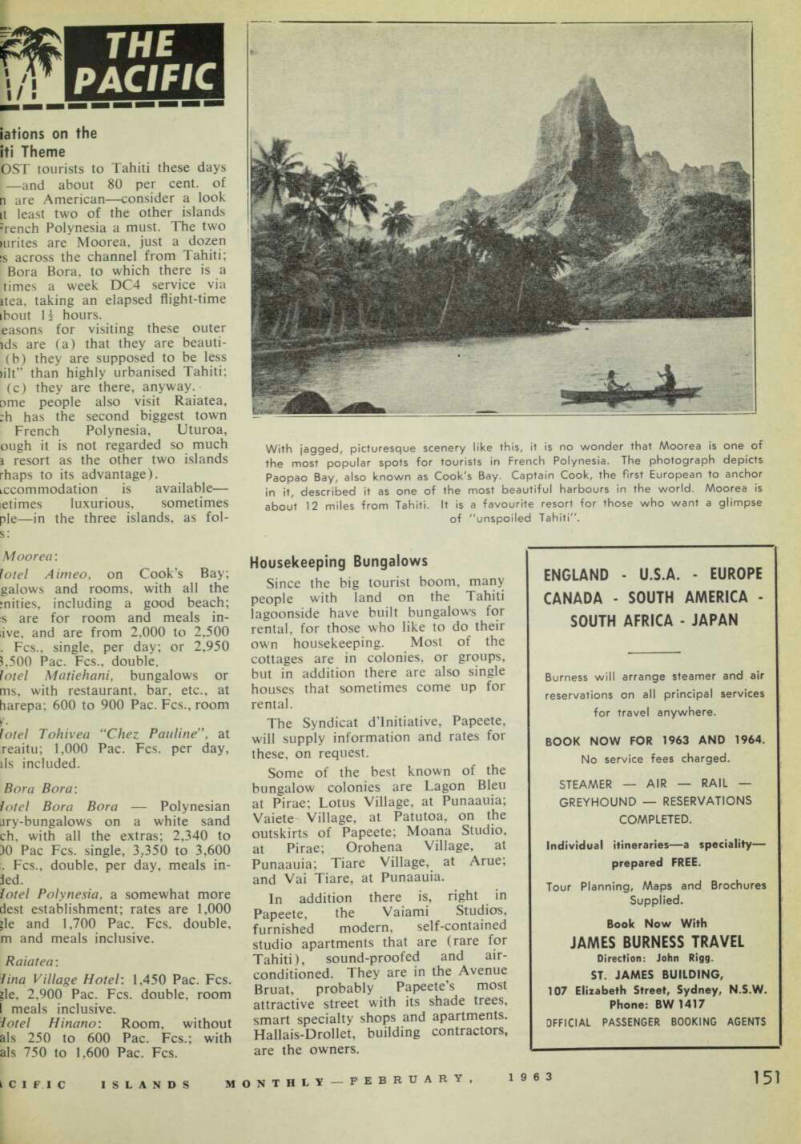
With jagged, picturesque scenery like this, it is no wonder that Moorea is one of the most popular spots for tourists in French Polynesia. The photograph depicts Paopao Bay, also known as Cook's Bay. Captain Cook, the first European to anchor in it, described it as one of the most beautiful harbours in the world. Moorea is about 12 miles from Tahiti. It is a favourite resort for those who want a glimpse of "unspoiled Tahiti".