From the Islands Press
p. 139 · Read in the full issue
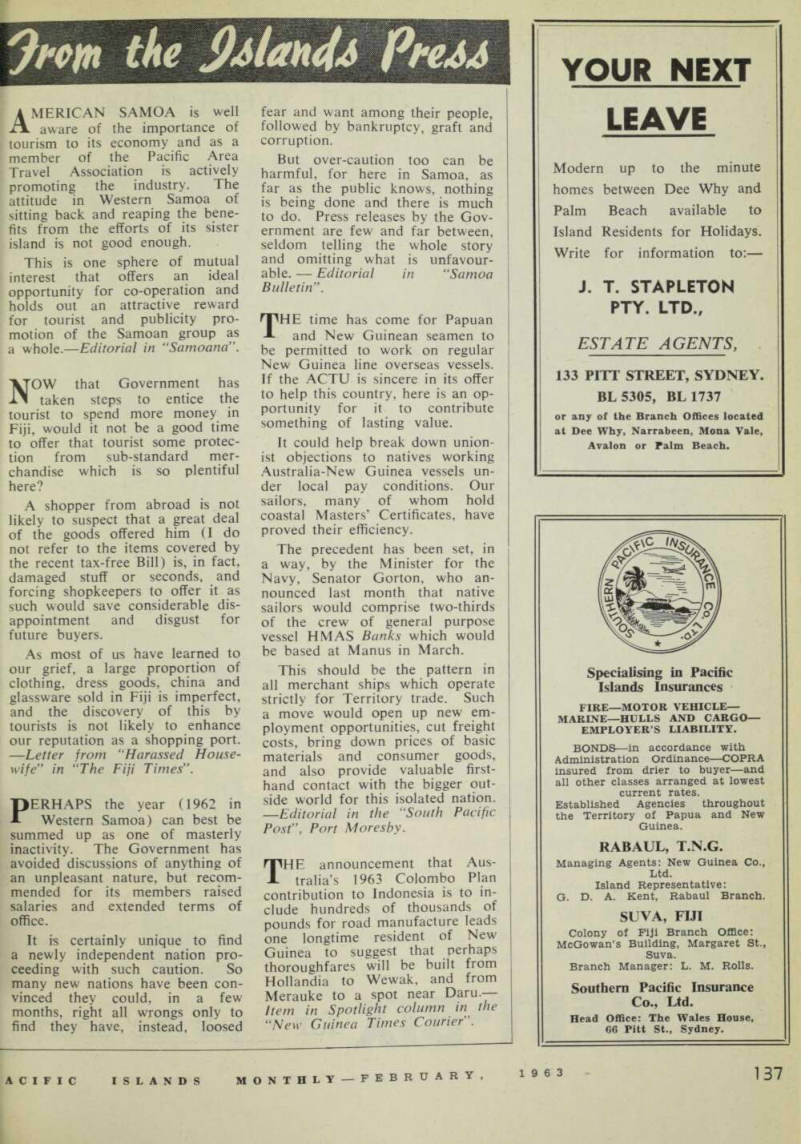
American samoa is well aware of the importance of tourism to its economy and as a member of the Pacific Area Travel Association is actively promoting the industry. The attitude in Western Samoa of sitting back and reaping the bene fits from the efforts of its sister island is not good enough.
This is one sphere of mutual interest that offers an ideal opportunity for co-operation and holds out an attractive reward for tourist and publicity pro motion of the Samoan group as a whole.— Editorial in “Samoana”.
NOW that Government has taken steps to entice the tourist to spend more money in Fiji, would it not be a good time to offer that tourist some protec tion from sub-standard mer chandise which is so plentiful here?
A shopper from abroad is not likely to suspect that a great deal of the goods offered him (I do not refer to the items covered by the recent tax-free Bill) is, in fact, damaged stuff or seconds, and forcing shopkeepers to offer it as such would save considerable dis appointment and disgust for future buyers.
As most of us have learned to our grief, a large proportion of clothing, dress goods, china and glassware sold in Fiji is imperfect, and the discovery of this by tourists is not likely to enhance our reputation as a shopping port. —Letter from “Harassed House wife” in “The Fiji Times”.
PERHAPS the year (1962 in Western Samoa) can best be summed up as one of masterly inactivity. The Government has avoided discussions of anything of an unpleasant nature, but recom mended for its members raised salaries and extended terms of office.
It is certainly unique to find a newly independent nation pro ceeding with such caution. So many new nations have been con vinced they could, in a few months, right all wrongs only to find they have, instead, loosed
fear and want among their people, followed by bankruptcy, graft and corruption.
But over-caution too can be harmful, for here in Samoa, as far as the public knows, nothing is being done and there is much to do. Press releases by the Gov ernment are few and far between, seldom telling the whole story and omitting what is unfavour able. Editorial in “Samoa Bulletin”.
THE time has come for Papuan and New Guinean seamen to be permitted to work on regular New Guinea line overseas vessels.
If the ACTU is sincere in its offer to help this country, here is an op portunity for it to contribute something of lasting value.
It could help break down union ist objections to natives working Australia-New Guinea vessels un der local pay conditions. Our sailors, many of whom hold coastal Masters’ Certificates, have proved their efficiency.
The precedent has been set, in a way, by the Minister for the Navy, Senator Gorton, who an nounced last month that native sailors would comprise two-thirds of the crew of general purpose vessel HMAS Banks which would be based at Manus in March.
This should be the pattern in all merchant ships which operate strictly for Territory trade. Such a move would open up new em ployment opportunities, cut freight costs, bring down prices of basic materials and consumer goods, and also provide valuable first hand contact with the bigger out side world for this isolated nation. —Editorial in the “South Pacific Post”, Port Moresby.
THE announcement that Aus tralia’s 1963 Colombo Plan contribution to Indonesia is to in clude hundreds of thousands of pounds for road manufacture leads one longtime resident of New Guinea to suggest that perhaps thoroughfares will be built from Hollandia to Wewak, and from Merauke to a spot near Daru.— Item in Spotlight column in the “New Guinea Times Courier ”.