Interregnum In West New Guinea
p. 120 · Read in the full issue
West New Guinea
Pacific Report
From a Special Correspondent in Manokwari Although the takeover of Western New Guinea by Indonesia does not take place offically till May, 1963, what might be called “Indo nesiation” was already in operation during November and December, 1962.
THE way was opened for this by the unexpected reluctance of the Dutch civil servants to stay on in West New Guinea after October 1, in spite of big monetary inducements.
The wholesale exodus by the Dutch put a big strain on the ability of UNTEA (United Nations Tem porary Executive Authority) to find r placements, and the Indonesians were not slow to bridge the gap.
Under the terms of the Dutch Agreement, 18 top Dutch officials had to leave by October 1 and it took UNTEA well into November to replace even these men. Already by that time, the Indonesian van guard had already began to pour in and it had come into full action by the end of that month.
Replacement of the remaining Dutch officials was carried out in short order, and a start was made in changing Papua senior officers in almost all branches. Resident Com missioners, who had been appointed by UNTEA, all got Indonesian deputies and Indonesian magistrates were appointed at Hollandia—now called Kota Bar u—and at Manokwari.
It soon was clear, however, that in spite of Indonesian eagerness to fill these top jobs, they were going to have to contend with a shortage of technical specialists, doctors, etc.
"Re-orientation"
The propaganda machine was early in action. Theatrical companies visited the principal coastal towns, free Indonesian films were shown; and there was large-scale intro duction of Indonesian music over the local radio station.
It was announced, also, early in the piece, that a large stadium and a university would be built at Hollandia and at the same time, selected groups of Papuans were sent on free junkets to Indonesia for reorientation.
However, in spite of this activity, the majority of the native inhabitants adopted a wait-and-see policy. A feeling of discontent, frustration and uncertainty was inevitable in view of the way transfer of sovereignty
had been achieved. The sudden departure of the Dutch, the cessation of public works by the Civil Admini stration and the sudden reduction of imports all added to the gloom.
Incidents at Sorong and Merauke towards the end of the year did not improve matters.
On December 12 fighting broke out at Sorong between Papuan police and Indonesian troops from the Pattimura Brigade and it was several hours before it subsided. One Papuan policeman was killed and three others engaged in the fracas were wounded.
In addition, two Dutchmen who were unfortunate enough to get into the field of fire were also wounded.
During the same month, at Moppa airfield near Merauke, a Papuan civilian was shot in another disturbance.
However, in spite of these out breaks a state of relative peace and quite is being maintained.
To prevent further decrease in
public morale due to growing employment, UNTEA resumed sen; public works that had been abruii terminated at end of September.
In Hollandia construction on the New Guinea Legislate Council building resumed; Manokwari there has been expansr in road construction; and work commenced also on some buildb projects at Sorong.
The only remaining Dutch ca struction company, Hollandse Bes Maatschappij, is continuing activir at Hollandia and Fakfak until Ar. 1963, when it will leave.
Private business has continued oo under great difficulties. Transth ment of goods from Hollandia s Manokwari has been difficult dues lack of organisation and supervisih With the withdrawal of 80 per ce: of the Dutch population, who H been the main consumers of i ported goods, imports have decliii and this has resulted in deteriorate in the whole economy.
Importers, who sold to loo! tradesman and distributors, being i certain themselves of their futul have been selling on a cash-n delivery basis and refusing to extet credit. This too has resulted 1 curtailed trading throughout Territory.
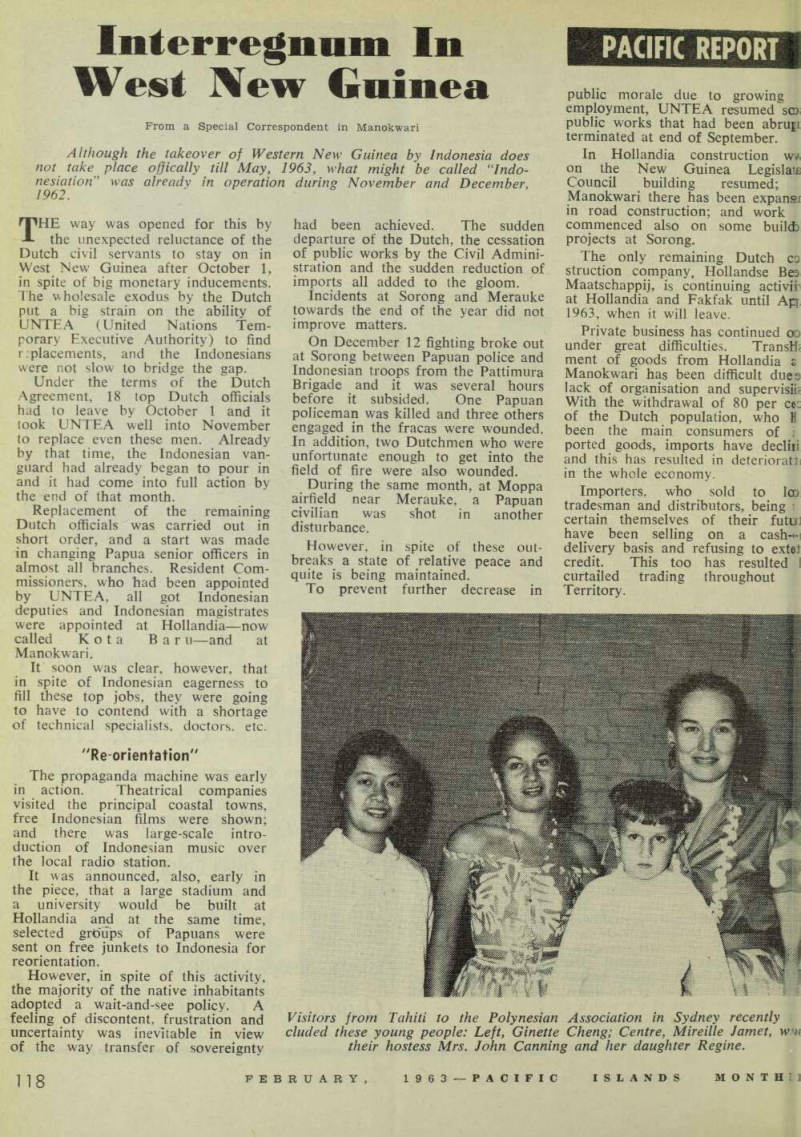
Visitors from Tahiti to the Polynesian Association in Sydney recently eluded these young people: Left, Ginette Cheng; Centre, Mireille Jamet, w.w their hostess Mrs. John Canning and her daughter Regine.