Fiji’s Ku Klux Klansmen
pp. 89-91 · Read in the full issue
Pacific Islands Monthly
Magazine Section
Minister’s Resolute Action Routed Fiji’s Ku Klux Klansmen
From Captain S. B. Brown, in Suva Over the years, the Ku Klux Klan has spread fear and dread throughout the Southern States of the United States. But it is not generally known that an organisation with the same name once tried to make itself feared in Fiji.
IHE attempt was made in the early - 1870’s, a few years after the end ■ the American Civil Wax. The rrorists had the same aim as their merican counterparts white domation. In particular, they tried to rrorise members of the Cakobau overnment which had been formed June 1871 The attempt failed because of the solute action of one of Cakobau’s Sisters and by the refusal of ikohau himself to be dominated ? those who tried to rule by threats [( j f ear Fiii’s Ku Klux Klan was formed Levuka where, among N early tilers, there were many Americans. may have been an American who ought up the name of the organisain, but membership of the Klan is predominantly British.
As in small Southern towns in e U.S., where membership and nk in the Klan was no secret, it is well known in Levuka that the >wer behind the Klan was the f h inSdy H 'o^ r t te ikobau Government Like many associations and organitions before and since, it had its
birth at a noisy meeting of disaffected men, in a house known as Keyse’s Place.
Oaths were sworn and resolutions were passed to oppose and boycott the Government, to refuse to pay taxes, to maintain secrecy and to carry arms.
In addition, Keyse’s Place, a former hotel, which was built on piles over the water on the northern beach at Levuka, was to be fortified and used as headquarters.
Defence positions in the fort were assigned and the call to arms was to be three shots fired from a carronade.
Fer Vent Crusade With the nucleus of the organisation armed and filled with the fervour of their crusade, the first general meeting was called at their new headquarters early in 1872 Again it was a meeting of pledges of secrecy, dramatic oaths and condemnation of the Government Min- “ft Chief Minister, Sydney C.
Burt, who had been Cakobau’s commercial agent, and who had written the constitution of the new Govern
ment, came in for the most invective, while George Austin Woods, Min ister of Lands and Works, who had been a popular member of the com munity when he had surveyed Levuka harbour the year before, was also criticised for his arrogance and domineering manners.
A deputation was formed to wait on Cakobau at Bau, acquaint him with the wishes of the Klan, and demand the dismissal of Burt, These Klansmen, either individu ally or collectively, had already been in conflict with the Government, and had been supported by the British Consul The main complaints were
" gr^TThev
a ca ? e ot sou , r grapes as they con stantly pressed for a new election, obviously hoping to gam seats and some of the Ministries for them se ves. . - , Both they and the consul refused to recognise Cakobau as king and always referred to him as the Chief o . the rebels but he certainly acted as «^"jf P
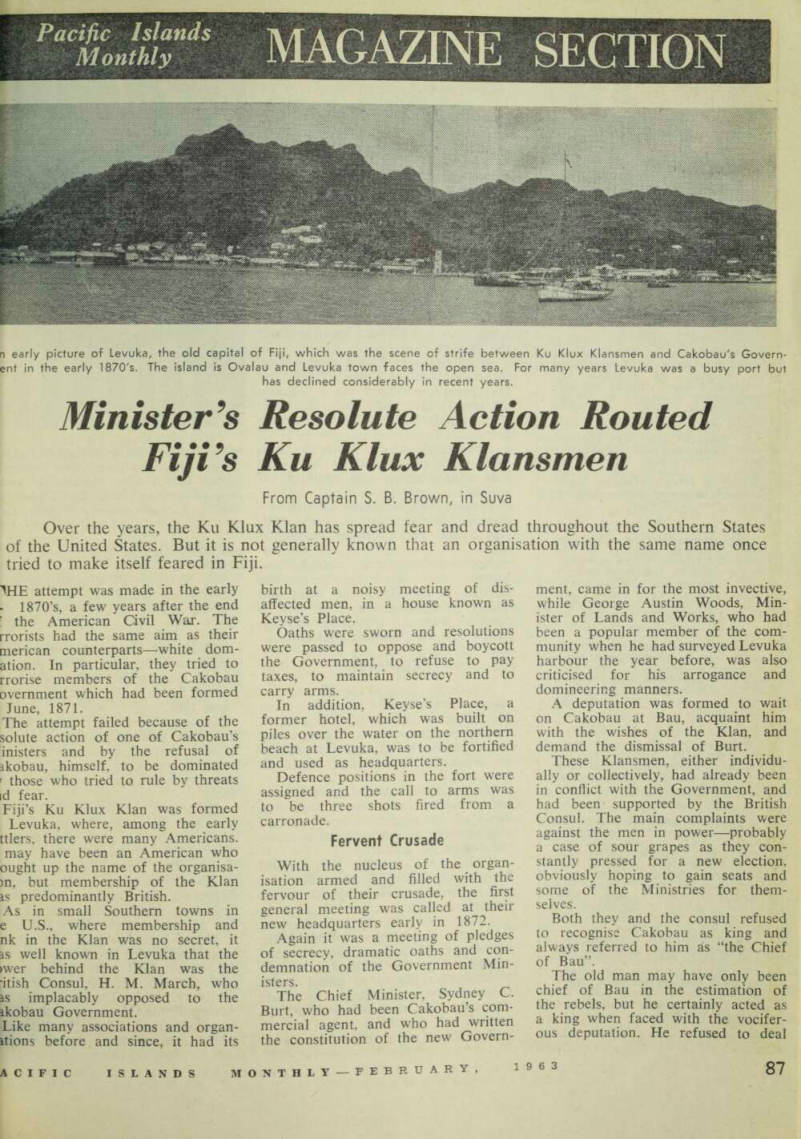
[?] early picture of Levuka, the old capital of Fiji, which was the scene of strife between Ku Klux Klansmen and Cakobau's Govern ent in the early 1870's. The island is Ovalau and Levuka town faces the open sea. For many years Levuka was a busy port but has declined considerably in recent years.
with men he considered to be noth ing more than a rabble and coldly refused their demands.
Momentarily nonplussed at not suc ceeding by bluster and threats, the members of the Klan sought to en list the support of men whose opinions would be regarded more seriously.
They formed the British Planters’
Mutual Protection Society and Volunteer Corps, and thus gained as adherents many of the more sober citizens who joined because of their extreme dislike of Burt.
The support of these respectable citizens soon gave the Klansmen the idea that they were now much more powerful, and their swagger and openly expressed threats made it obvious that, before long, there would be an armed clash between some or all of their members and the Government.
Arms and armed men were always to be seen around Keyse’s Place, and the Government took the precaution of siting carronades on Niukaubi Hill, which overlooked the rebel’s fort.
An uneasy peace followed, with both sides armed and at least one side trigger-happy and spoiling for a fight.
Tension was increased by rumours that civil servants were secretly drill ing Fijian and Tongan troops at night.
Any small incident would have served as a spark to ignite the Levuka tinder box, but what did finally bring about a clash was a colossal piece of effrontery and de fiance of Government authority.
Challenge
A planter, named Smith, against whom a warrant had been issued for the alleged shooting of a Fijian chief, came openly to town, registered at the Criterion Hotel, and sat back to see what the Government would do about it.
Here was the chance for the Klan to interefere in a cause that was close to its professed opinion, and also to show its strength and overawe the forces of authority.
With no attempt to conceal March’s complicity in the affair, the call to arms was made by the British Consulate clerk.
Thirty of the more belligerent Klansmen obeyed the call and after parading and fixing bayonets, they marched to the Criterion, where pickets were placed to guard Smith from arrest. Confident in their strength, the remainder then dis missed.
But there were other citizens in
Levuka who realised that such dif turbances would hamper trade am keep away the ships that were til lifeblood of the port. Whatever th©i feelings about the Government rmr have been, they needed a peaceff port to prosper.
Thirty of these men joined tit police and between them they dif armed and arrested the pickets o duty. Smith was arrested at til same time.
It seemed a defeat for the Klan-f yet their propaganda turned it inin a near victory. The town was in j state of unrest and Cakobau had t come to Levuka and address a meo; ing.
He urged the rebels to keep tHi law and threatened to use Govern ment troops to quell any disorder The rebels translated this into threat of a racial war. As a resm, of the disturbance and consequeie ill-feeling, Burt resigned. This satib tied many of the wiser men and ther did not support the Klan thereafter The Klan, however, had taste! blood and with it the sweet taszj of success. They next wished to and test the strength of the Chidi Secretary, J. B. Thurston, who wjv Acting Prime Minister, until Woooc returned from New South Wales! where, among other duties, he wsv
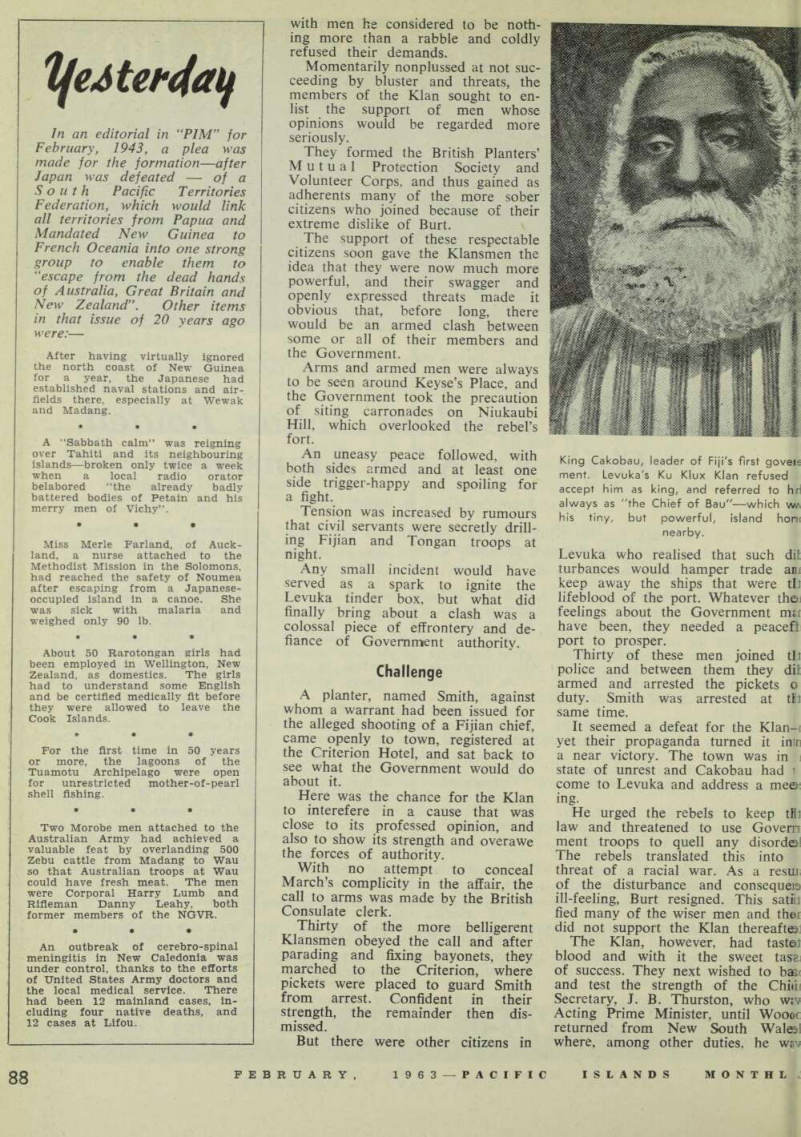
King Cakobau, leader of Fiji's first goveis ment. Levuka's Ku Klux Klan refused accept him as king, and referred to h[?] always as "the Chief of Bau"—which W his tiny, but powerful, island hor[?] nearby.
asy laying complaints about the in- Tference of the British Consul in □mestic matters of Government.
Thurston had been extremely opular when he had previously een in Levuka as Acting British Unsul. The citizens of Levuka had iven him a hearty vote of thanks hen he left that position to become planter.
It was a crucial period when the ;bels chose to oppose the Govern icnt again. Any weakness shown by senior Minister would most likely ave caused the fall of the Govern tent.
In addition, a British warship, r MS Cossack, had recently arrived i Levuka and the Klan saw a tiance to show the captain that the lakobau Government could not laintain law and order.
The defection of the more sober itizens meant nothing to the die ards. Their leader, H. J. Beatson, a aval officer on half-pay, vice resident of the British Planters’ futual Protection Society and a jading member of the Ku Klux dan, took the initiative by writing an isulting letter to the Chief Justice. >n the same day, two members of le Klan, who were brawling in the 3wn, were arrested and charged with ssault, and subsequently gaoled.
The two incidents, coming so close Dgether, gave both sides cause for nger, and so uneasy was the feel ig in town that stores were closed nd the women went to a safer place •utside town.
It was none too soon. Three car onade shots, the call to action at Ceyse’s, rang through the streets md the Klansmen rallied to their
fort taking with them their arms and all available ammunition.
They did not receive as much sup port as at previous meetings because the more timid or thoughtful refused to take part. But the few made up in ardour for the dissident many.
Thurston immediately placed him self at the head of the Government force of civil servants and police of nearly 200 men.
This force occupied the Govern ment buildings and placed guards nearby.
The many neutral elements in town assembled to watch events, as at a present-day rugby match. They congregated mainly around the Gov ernment forces to see what they would do.
Shoot to Kill!
The Acting Prime Minister left them in no doubt as to how he meant to enforce law and order. So that all could hear, he ordered the captain of Constabulary to load with ball and shoot to kill any Klans man or malcontent who resisted arrest. All armed men on the streets were to be arrested and any attempted escapees from the gaol were to be shot down.
When the rebels heard about this they retired into their fort. But Thurston was not prepared to carry out a long and probably argument ative siege.
The artillery of the Government forces was trundled into positions overlooking the fort and plenty of canister and grape ammunition was brought up.
For a time it looked like a bloody and inglorious end to the Klan, which had no artillery.
However, Captain Douglas, of HMS Cossack, had been watching events closely to see whether the Government could control the situa tion.
And as it was now obvious that with Thurston in command, the Gov ernment could, in fact, govern, the captain stepped in.
He sent an officer to call on Thurston to ask him to hold fire until the morning, when he would send an officer to talk to Beatson.
A massacre was averted but the Klan had lost much face and could not brag of its power again.
Besides this, planters from outside Levuka protested at the unruly actions of a minority group that was bringing discredit to the country.
Many, who had been neutral or even pro-Klan, went over to the Govern ment side and pledged themselves to support law and order.
The Ku Klux Klan had one more vociferous meeting at which mem bers complained bitterly that British subjects, to wit, the King’s Min ister, had raised native troops against them.
They sent a deputation to Captain Douglas protesting against Thurston’s action.
The captain’s answer was the knock-out blow to the Klan. He said that when British subjects were domiciled in a foreign country, they must obey the laws of that country.
The Klan never raised its voice again in Fiji. The rebels continued to oppose the government through the Planters’ Protection Society, but never again did they take up arms against it.
This is an artist's npression of the reposed Library and useum to be built Rarotonga on a [?]e given by Makea ui Ariki, CBE. It ill also be the cen al library for the [?]ok Islands. The [?]st of the building id equipment is stimated at £12,000, nd the Cook Islands
[?]gislative Assembly
is offered to pro de half that amount the rest is raised
[?] public subscrip
on. The Secretary, brary and Museum, arotonga. Cook Is nds, will be eased to receive ntributions.