Friendly Samoa Puts Out
pp. 75-79 · Read in the full issue


Sydneysider Goes Walkabout Friendly Samoa Puts Out No Welcome Mats
Neither Western nor American Samoa is in the market for tourists yet, but they are getting them in a thin trickle that may eventually turn into a flood—ready or not.
lITHEREVER there is a means of f» getting there, tourists will use t even if they spend a good deal jf the time thereafter cursing.
The new jet airport at Tafuna, American Samoa, is encouraging more teople to stop off at Pago and hav ng got to Pago, few can resist the ;xtra 45 minutes flight to what American tourists call “British”
Jamoa.
Officially, Western Samoa says it loes not want to encourage tourists vho would “spoil” Samoa and it does his by making entry awkward if not ixactly difficult.
Occasionally, tourists already in American Samoa can get a permit >y radio at reasonably short notice; Tom further afield it is necessary
to write to the W. Samoan Prime Minister’s Department which con siders every application on its merits.
None of this is calculated to make the visitor feel welcome. But once through the entry hoops, Western Samoa has, at present, considerably more to offer the tourist who wants to see unspoiled Samoa, than the American territory.
There are three hotels in Apia that take travellers and Mrs. Aggie Grey and her son, Alan, have made big efforts to provide amenities for their guests and a friendly, helpful atmos phere.
There are individual bungalows, a swimming pool and a bar for the convenience of guests—who have to get an allocation of liquor points from the police station. This permit is almost painless and the allowance is generous —up to 60 points for a week’s stay which will allow the customer 60 bottles of beer or five bottles of whisky or 12 bottles of wine—far more than the average tourist imbibes in four times that distance.
American Samoa is not anti tourist, is in fact planning for them, but can do with very few right now.
In this respect it has managed to get the cart before the horse, in that it has a jet airport which is used by three international air services— and virtually nothing else.
The limiting factor in American Samoa is not entry or exit formal ities but lack of accommodation. The only accommodation is the Govern ment-owned and operated Rainmaker Hotel which can accommodate a score of people in the main build ing and, by various strategems, a great many more in annexes in other parts of town.
All converge on the main build ing at meal times which happen at 7 a.m., noon and 6 precisely, and un like any other tropical territory I’ve ever known (where most people have a thing about eating as late as pos-
sible), the hungry hordes gather at table even before the meal hour.
Bread and Butter Problem Half-a-dozen Samoan maidens labour in the kitchen from early morning until 8 at night and regularly bring forth something that is a de rivative of stew. There is always something frizzling, stewing or boil ing in the kitchen, and with the wind in the right direction it can be detected clear across the adjacent football ground.
It’s served, on the dot, sometimes with rice and sometimes with potato and always with some chopped-up raw vegetable in dressing, on one large plate, with one fork and one knife, no more and no less.
There are piles of bread and butter but no small knives and small plates.
This leaves three possibilities open to the customer: He butters the slice whole and (a) places it on his lap on top of the paper table napkin; (b) he can balance it precariously on the edge of his meat plate; or (c and the most popular), he can chop every thing that needs to be chopped; take his fork in his right hand as a shovel ling instrument and the slice of bread in his left, waving it around to em phasise conversational points.
What kind of cuisine and eating habits they are I know not. American Colonial, perhaps; but judging by the howls of anguish from outraged American tourists, it isn’t Stateside.
The people who complain most about the Rainmaker are Americans who are taking in the Samoas while doing the South Seas. They are furi ous when they are put in to share a
he Goat Island Club, perched at the end f its causeway at top (Goat Island is not ow an island), was mooted as the site if a new hotel to replace The Rainmaker below). But it now seems that a new hotel will be built nearer the airport.
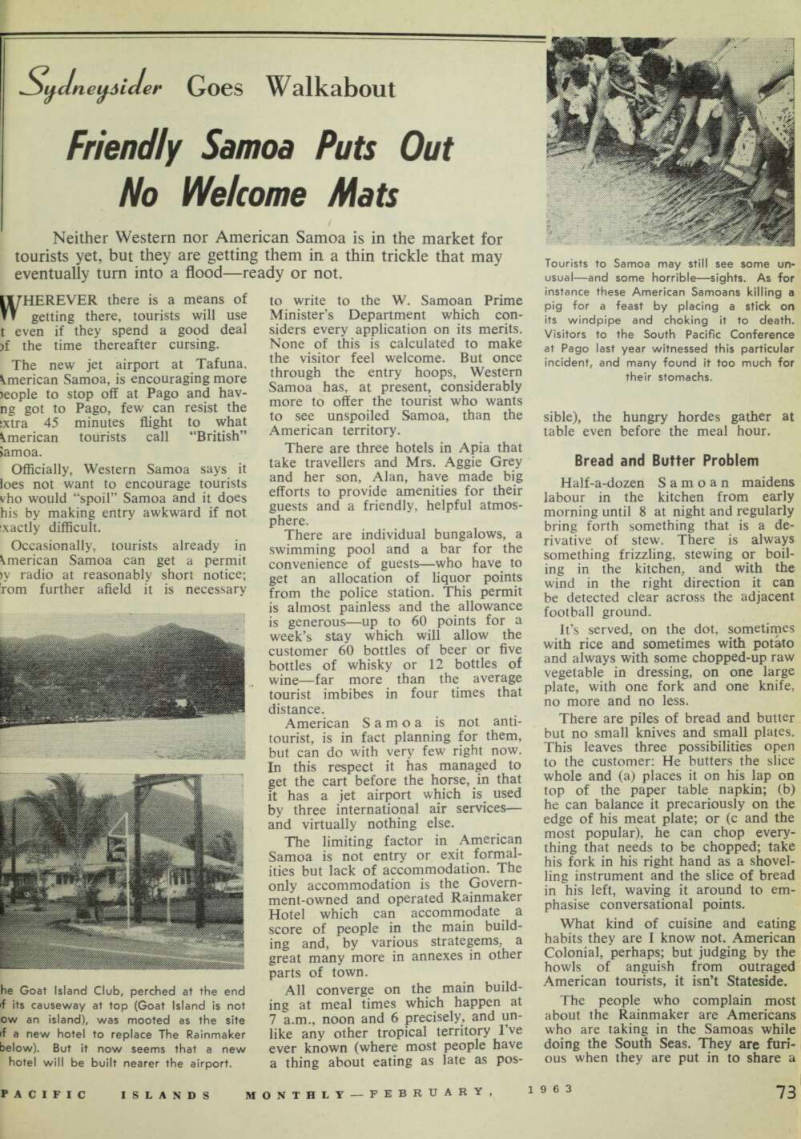
Tourists to Samoa may still see some un usual—and some horrible —sights. As for instance these American Samoans killing a pig for a feast by placing a stick on its windpipe and choking it to death.
Visitors to the South Pacific Conference at Pago last year witnessed this particular incident, and many found it too much for their stomachs.
oom with a stranger—as nine times tut of ten they must.
They cannot understand the total ack of service in all departments; or vhy all there is to drink is coke and eer—and frequently none of that; r why, when they finally fly out and s is inevitable, rise in the small hours, here will be no one to wake them, r brew them a cup of coffee. Or — lost of all—why with Pago’s 200ich annual rainfall, the water supply > turned off at midnight so that they lust go unshaven and unwashed to le airport.
The fact is that the Rainmaker is ot an hotel at all, but a convenience rovided by the government to meet lie accommodation needs of those dio must pass that way, and in its ray it is adequate and quite comfort ble.
Under present circumstances it ould be over-filled by the travelling musts”, without any tourists. Most f the disappointment of the tourists es in the fact that none of the air nes seem to go to the trouble to ex lain this to their customers before hey set out.
American Samoa plans a tourist idustry and a new tourist hotel— icpefully for next year. Several
American hotel organisations were interested in the project but were turned down because there was nowhere in their financial structure for local investment.
The idea is now for the Samoans themselves to build the hotels (and a host of other enterprises ranging from a newspaper to lolly-water factories), through an organisation called the Samoan Development Corporation.
The authorised capital is $500,000 and each share is worth $lO.
In order to be a stockholder you must be at least 50 per cent, of American Samoan blood, and domiciled in the Territory. Something like $204,000 has so far been pro mised, with $45,000 in actual cash.
Others have agreed to pay for their shares with labour.
Doubts are already being expressed in some local quarters as to whether this is going to be the best way of entering the highly specialised busi ness of running a tourist hotel but
few visitors who have had to survive the Rainmaker in its latter days of overcrowding could do anything but wish the Samoans and their hotel the very speediest of godspeed.
One way and another, want it or not, tourism is catching up with the Pacific. Most territories meet it with reluctance but finally accept the in evitable, when they see it for what it is: One of the simplest methods of attempting to balance a budget in an under-developed country.
At the same time it is obvious that the people who sell travel seem much more concerned in disposing of a “package deal” than they are in suit ing the travel to the individual; or conditioning him to the fact that the Pacific is not Europe —or even Honolulu.
All along the line in the Pacific, these days, one meets package-deal tourists mostly elderly women— who have been months on the circuit and who, while still fanatically de termined to cross-off every last item on their itinerary, are so physically and mentally exhausted that they are incapable of appreciating anything.
Shorter, individual tours to each territory is probably the answer to real Pacific travel. But having paid one airfare, most tourists expect to see the lot, even if it kills them.
The oddments next to the man on the wooden bench are not a collec tion of geological specimens or fossils.
It's a game of draughts, all set out, fa'a Samoa.
The "board" is a few rough hollows whittled in the bench; the black draughts men are beach pebbles and the white men are pieces of sun-bleached coral.
The set-up is a permanent part of the fixtures in the Gold Star Transport Co.'s office in Apia, Western Samoa, where the taxi-drivers waiting to go out on jobs fill in a few spare minutes.