Territories TALK-TALK
pp. 53-57 · Read in the full issue
One cannot be blamed for wondering just how far this “bad word” campaign in P-NG will go. Non-natives are “ex patriates”, and “native”, irrespective of dictionary dictum, is to be merely an adjective.
i ND now we have members of the x Rabaul District Advisory ouncil objecting to signs in front [ local residences bearing the word >oi” in conjunction with the warn g “Tambu” (NG T-C, 19/12/62).
This might suggest that people in e less civilised centres like Sydney id Melbourne should take greater ire in regard to the feelings of nerant vacuum-cleaner salesmen, of te vocation, when erecting “No awkers” signs. Be that as it may; is indicative of a trend in present NG.
In the early days, when Wau and her ’dromes were first laid down, was found necessary to warn e natives of the dangers of camp g on them and cooking their food iere planes were about to land at ly moment, and so printed signs jre erected showing a huge red nd and the words “I TAMBU”.
This became a known sign of leep off the grass” to the native ople. Whether they could read it not was another matter in those ys. The message was put over.
Things have got to such a pass w that I feel that this over iphasis on racial integration is feating its own ends. It is tipping i scale too much in the opposite ection and, from what I can hear >m my correspondents of every lour in NG, it is not making the
ijority happier.
New Christmas Spirit Apparently, if one can rely on wspaper reports, the Christmas rit in P-NG urban centres was 11 watered down and the usually ;ognised time for making hoopee” passed without any undue :ident.
Let us hope that this was actually : case. Although when one reads out the Booze Question in the luary, PIM (p. 7) and what ther O’Hanlon has to say about : situation generally, one is in oed to think the whole business is -haps being under-stated by the [ministration —for obvious reasons.
Father O’Hanlon’s remarks co
incide—to a great extent —with re ports which came to me on the same subject. His mention of the natives’
Pyrrhic victory of attaining entry into the pubs only to find them deserted by the non-natives, who go to the private clubs, merely underlines racial segregation instead of eradicat-
With Tolala
ing it as was the main idea of the Liquor Amendment.
It is not the colour so much as the cultural discrimination which must be overcome in these matters.
And that takes time, no matter what UNO, Minister Hasluck or John Gunther says—or desires.
Church Unity
It is pleasing to read that steps have been taken in Papua towards Church Unity. Any movement that may possibly diminish the present day sectarian competitiveness in any native country is a step forward in an effort to reduce the present con fusion about Christianity, which exists in the minds of so many of the indigenes, as the result of the multitude of religious denominations operating throughout the Territory at such high pressure.
Had the “Significant Step” (PIM, Jan., p. 10) been one towards a unity of Christian teaching, instead of Churches, I should have felt happier.
The LMS has done very fine work in Papua. So far as I know it is not operating in NG, so “Papua Ekalesia” is confined solely, I pre sume, to Australia’s own Territory and does not include the Trust Territory.
Incidentally, the word Ekelesia was introduced into the Blanche Bay (Tolai) dialect many, many years ago; the second vowel in the word is an “e” and was brought from Samoa by the pioneer Methodist missionaries. It referred to the “Church” (ra kopono Ekelesia ).
Apparently the LMS prefers the “a”
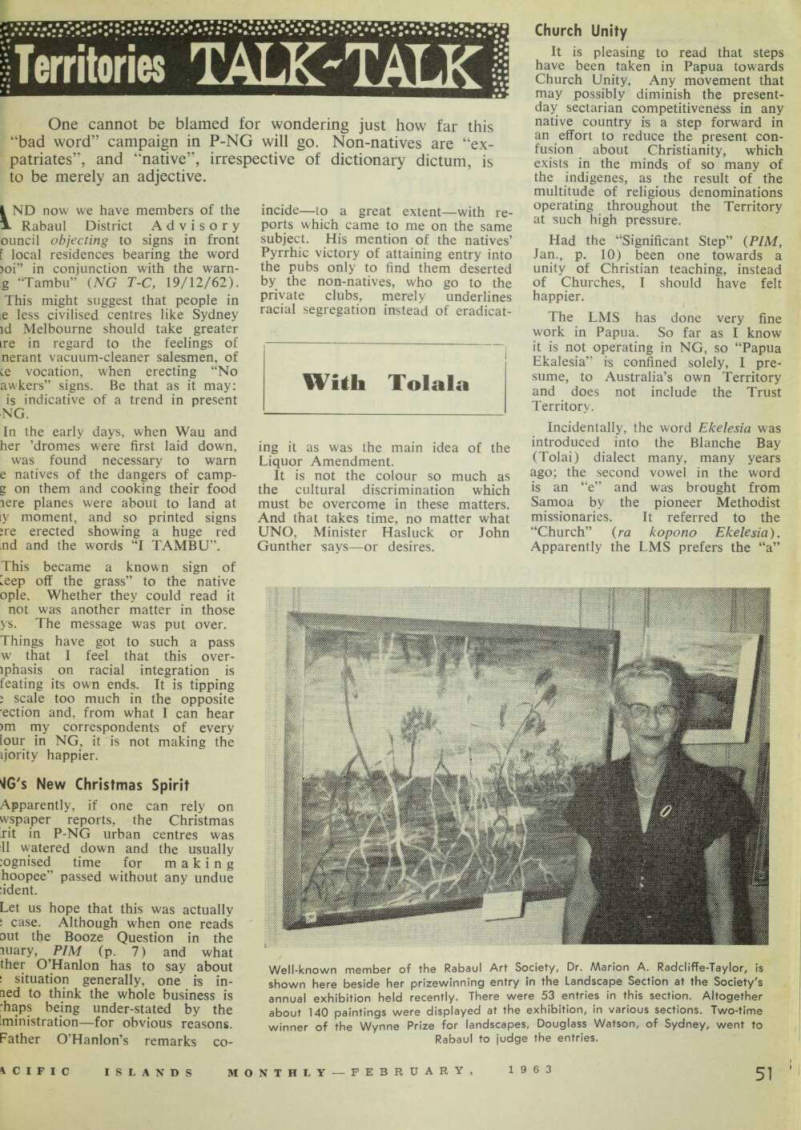
Well-known member of the Rabaul Art Society, Dr. Marion A. Radcliffe-Taylor, is shown here beside her prizewinning entry in the Landscape Section at the Society's annual exhibition held recently. There were 53 entries in this section. Altogether about 140 paintings were displayed at the exhibition, in various sections. Two-time winner of the Wynne Prize for landscapes, Douglass Watson, of Sydney, went to Rabaul to judge the entries.
to the “e”. But then what’s a vowea amongst friends?
A Query About the Past To hand is a letter from an oldfa time reader, “Supercargo”, whor raises a query about the AN&MEI memories of which I wrote iii December TT. He writes: On page 31 you wrote “tM First Reinforcements arriving cue November 29, 191 5”. / now say that what I believe to be the first reinforcements went by thd “Morinda”, voyage 10, which, sailed from the Federal Wharfs Sussex Street, at noon on Feld ruary 3, 1915, and arrived oo Rabaul on February 21, aftes spending two days at Cooktoww helping to get the “Marsina” off R Reef.
“Supercargo” also refers to a rea mark in TT (Oct., ’62, p. 35) about; the old BP Island steamers. H<l writes: “BP bought the Neptun anor Merkur from B. B. Wiltshire, not tbr
Ndl”.
It is always good to have thesiz corrections made and I am pleaseos to know there are still readers whei take enough interest in the Past tot tell me about them. I think, as omr grows older, one realises how less im fallible one becomes.
I would, however, explain that thu: statement regarding the “Firsa- Reinforcements” was based on im formation which appeared in thd Army magazine, Passed by Censorv and published in Rabaul for Christh mas, 1918. The entry in thae journal on page 14 contains a Diaryi of events from September 11, 19U r to November 12, 1918. In the 19111 entries one reads: “January 8. Colonel Pethes bridge succeeds Colonel Holmes ac Administrator.
February 2. Arrival of thim force (‘The Comicals’).
November 29. Arrival of Firs?: Reinforcements (‘The Measlies.’)’( There is the possibility that somm confusion has occurred between thirl appellation of the “third force” anoc the “first reinforcements”. Thd “Diary” was presumably compiled byd an Orderly-Room Sergeant arounoc about Christmas time, 1918, andbi having myself been an Orderly-Room Sergeant, I would be prepared to sayn that is the time when inaccuracies in compiling data from records couloli be at an all-time high.
Anyway, I bow to “Supercargo 5 © who was on the transport at thd time, while I was busy plantinjn coconuts on Arigua, down icr
lougainville, for CPL. There might e some old-timer reader of PIM 'ho was a member of the Force n board and he might know whether e was a Third Force man or merely Reinforcement. . . . Thanks a lot, Supercargo”, for the letter.
Incidentally Passed by Censor was le Rabaul Record's swan song and i a Foreword it gives a somewhat aive summary of the activities of le AN&MEF, and some speculation s to the future of the islands which le Australian Force had captured.
It is our earnest prayer”, it says i part, “that these islands, taken by Australians in 1914 and guarded by Australians ever since shall, as of ight, go to Australia. But that is or the politicians to decide . . .” -ittle did they dream of a League f Nations and UNO then.
That Word "Supercargo"
There was another point raised by the forementioned writer and referred to a remark of mine in TT (Oct., p. 34): “We didn’t call them pursers in those days”, in referring to the Supercargo aboard Matunga.
He writes- * A purser is one of the crew; is on the Articles and virtually a Captain's clerk and when the ship “pays off" gets his discharge through the shipping office in the same manner that everyone of the crew does, whether he be Master or Fireman.
A Supercargo was not on the
Articles. He was a passenger, representing the Owners. His job to goods which he thought I could sell to traders in ex change for copra, sharks' fins, J v ; ory , nuts > turtle w s^ iell other 1 stand produce. Where there were no traders, the Supercargo traded Erectly with the natives. He often had a Power of Attorney from his company This is just a brief out J me of the d between a u P ercar S° and a Purser, He adds: “Incidentally, I was Supercargo of the Titus for four years”. Well, that definitely dates my correspondent (whom I have
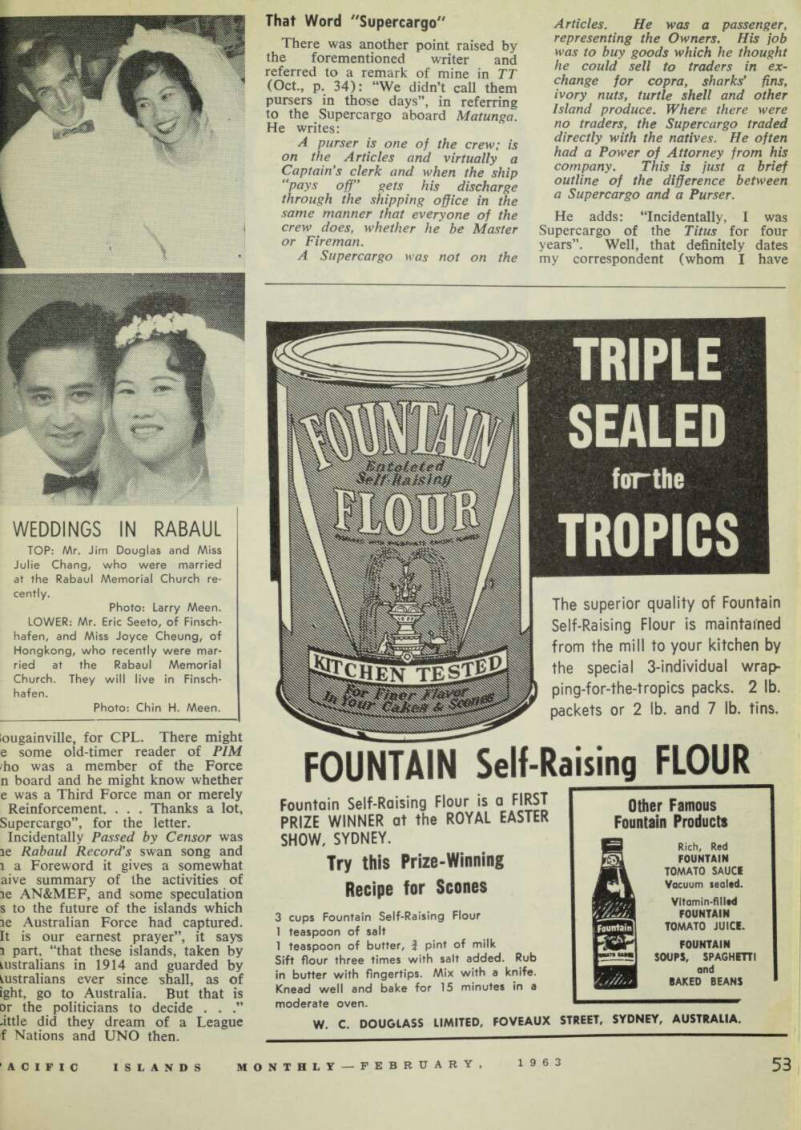
Weddings In Rabaul
TOP: Mr. Jim Douglas and Miss Julie Chang, who were married at the Rabaul Memorial Church re cently.
Photo: Larry Meen.
LOWER: Mr. Eric Seeto, of Finsch hafen, and Miss Joyce Cheung, of Hongkong, who recently were mar ried at the Rabaul Memorial Church. They will live in Finsch hafen.
Photo: Chin H. Meen.
never met). Titus was one of the aid BP Island vessels I have often mentioned in connection with W. H.
Lucas, who also was a Supercargo in that vessel and after being BP’s chief plantation inspector became rechnical Adviser on Pacific Affairs for the Federal government during the First War and later chairman jf the Expropriation Board. It was Lucas who arranged for Moresby, vhich was the last of the BP vessels o call at Simpsonshaven (Rabaul) vhen the NDL inaugurated their ;ervice in the early 1900’s (after vhich BP boats were verboten ). also arranged to have the old Moresby be the first BP vessel to rail again after Rabaul had been :aptured by the Australians.
Jood Lobbying in New York I see where Somu Sigob, elected lative member of the Legislative Council for the NG Coastal Jectorate, on his return from New fork towards the end of December, s reported as saying that he felt he tad done a “worthwhile job back tage”, together with his partner, ohn Guise, of Papua, at the recent JNO conference.
Neither of them spoke in the Assembly, he said, and this must lave been a disappointment for his lartner who has something of a eputation as a speaker.
However, they were able to ex :hange opinions privately with epresentatives of the Afro-Asian ountries and “were able to give hem a better understanding of the :onditions in the Territory. This mproved understanding was re jected”, he is reported as saying, ‘in what the Delegates said in the Assembly itself”.
The attendance of native MFCs at UNO conferences has apparently paid off. A pat on the back to whomsoever originated the idea.
I may be a bit dull—l probably am—but I fail to see why a Papuan Member should be brought into an examination of a Trust Territory re port to the United Nations. Is one to assume that the independence of Papua—an Australian territory—is to be considered coincidental with the Trust Territory of New Guinea?
New Roles for Bob Bunting RSL president in P-NG Bob Bunting had a somewhat confused Press in Australia when he attended meetings in Brisbane and Sydney during November and December. A Melbourne paper reporting the National Congress in Brisbane at the beginning of November referred to Bob as “Mr. R. F. Bunting (PMG branch). . . .” The SMH (12/12/62) reported him addressing a “public meeting at Gordon called to draw attention to ‘deficiencies in Aus tralia’s defence effort’. . . . Further meetings will be organised by Mr.
Bunting’s group throughout the State. . . .”
I have seen no denial of Bob’s connection with the “PMG branch”, but it is hard to imagine him hav ing any connection with this rather leftist section of the Public Service.
On the other hand Bob stoutly denied being a member of the Gordon group, “I was attending the meeting you reported as a guest speaker only and am not a member of the group”, he wrote in a letter to the Editor of SMH on 15/12/62.
How careless can some of these reporters be?
In Sydney in De ember, when those /IP's came to town, [?]uva Mayor, Charles [?]tinson, presented his rain-tree table op to Sydney Lord Mayor, Harry Jensen centre), while Pan American Airways [?]oss, Rush Clark, [?]eld up the other [?]nd.