Setback For New Manganese
pp. 45-47 · Read in the full issue
Mine In The New Hebrides
From Robert Langdon in Vila Hopes that a new manganese mine at Forari, New Hebrides, vould become a healthy source of income for the Condominium lave been temporarily dashed because Japan has insufficient foreign ixchange to buy Forari ore.
l/f ANGANESE, an essential element in steel production, has been mined at Forari since July, 1961.
"he first ore was shipped to Japanese teelworks in January, 1962, and ex torts for that year totalled 14,908 3ns.
Condominium officials expected in November that about 40,000 tons /ould be shipped to Japan this year; ut an exchange crisis in Japan in )ecember has now reduced their stimates to about 24,000 tons.
As a result, about 70 of the 200 mployees at Forari have been laid ff until the Japanese market im roves or until markets can be found Isewhere.
The mine at Forari, which is on le eastern coast of Efate, is operated y the Cie. Francaise des Phosphates e I’Oceanie, This is the company lat exploits the phosphate deposits t Makatea in French Polynesia.
The company’s general managei •om Paris. M. Branthome, was in <ustralia in January trying to negoti te the sale of Forari ore to Broken [ill Pty. Ltd. steelworks and to the ew ferro-manganese plant at Bell ay, Tasmania. He also intended to isit Japan.
Australian Problem At present, Australia imports most f its manganese from South Africa; )me is also imported from Ghana nd India which, being members of le British Commonwealth, enjoy referential tariffs. South Africa gets nost favoured nation treatment.”
This treatment, however, does not pply to the New Hebrides, which, eing jointly administered by Britain nd France, is not classed as part f the Commonwealth.
So unless M. Branthome can make special tariff arrangement with the Australian Government, it seems nlikely that Forari ore could com ete with that from the other Duntries —unless it found favour on ie ground of quality.
The Forari ore, which is mixed and cooked with Australian coke in a process known as “sintering’’, is of well above average quality.
This process is expensive, but it produces a manganese content of about 53 to 54 per cent., whereas the content in Indian ore is only about 45 per cent., and the average content from 46 to 48 per cent.
The Forari ore has been selling to Japan at £2O Australian f.o.b. Forari per long ton. This compares favour ably with the cost of Australia’s im ports from elsewhere.
The Australian Department of Trade records imports of manganese as “battery-grade” and “metallurgical grade”. In 1961-62, 20,000 cwt. of battery grade manganese were im ported from Ghana at an f.o.b. value
of <£A47,690; in the same year 1,970 cwt. valued at <£20,414 were im ported from Japan.
Most manganese imported is metallurgical grade—in all, in 1961- 62, 221,627 cwt., valued at £85,878.
Of this 214,540 cwt. valued at £80,281 came from South Africa; 7,086 cwt. valued at £5,571 came from “other foreign” countries. A negligible amount came from British Commonwealth countries. (All values are f.o.b. values).
The Forari deposit is estimated to contain about one million tons of marketable ore, so that if it were mined at a proposed rate of 60,000 to 70,000 tons a year, it would last nearly 20 years.
About 9,000 tons are in stock ready to be shipped, and the mining and washing of ore is still going on, but the sintering process has been stopped.
Only about 5,000 tons are expected to be exported in the first quarter of 1963.
Meanwhile, the French Bureau de Recherche Geologique et Miniere (BRGM) is continuing to prospect for manganese at Aneityum, in the far south of the New Hebrides Group, and they also intend to work on the northern islands of Pentecost, Male kula and Maewo. (Over)
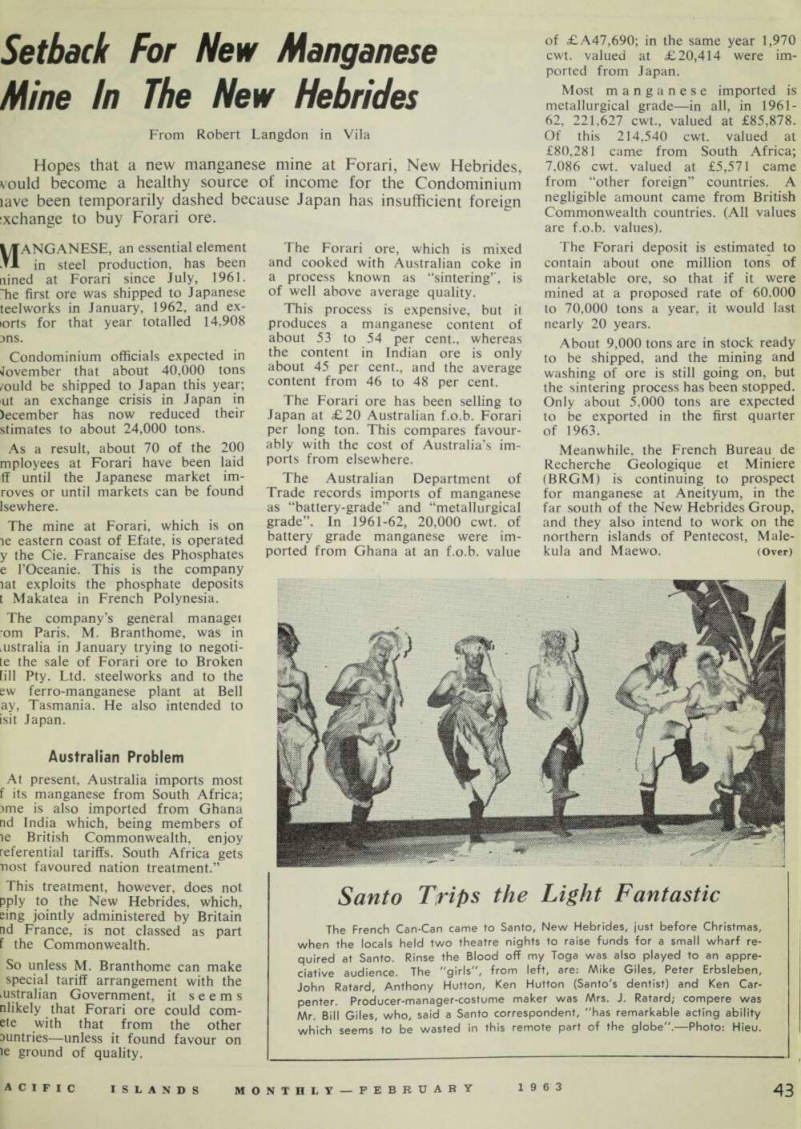
Santo Trips the Light Fantastic
The French Can-Can came to Santo, New Hebrides, just before Christmas, when the locals held two theatre nights to raise funds for a small wharf re quired at Santo. Rinse the Blood off my Toga was also played to an appre ciative audience. The "girls", from left, are: Mike Giles, Peter Erbsleben, John Ratard, Anthony Hutton, Ken Hutton (Santo's dentist) and Ken Car penter. Producer-manager-costume maker was Mrs. J. Ratard; compere was Mr. Bill Giles, who, said a Santo correspondent, "has remarkable acting ability which seems" to be wasted in this remote part of the globe".—Photo: Hieu.
Another organisation headed by Mr. Don Gubbay, of Santo, is prospecting for manganese in the central part of Espiritu Santo. (Mr.
Gubbay is also looking for magnetite and copper in south-west Espiritu Santo in conjunction with the Homestake Mining Co., of America).
At Forari, which has been added to Vila and Santo as a port of entry in the Group, the Cie. Francaise des Phosphate de I’Oceanie has invested about £2i million sterling in mine buildings, plant, a wharf, a loading and a village for its employees.
The employees, before the recent 'ay-offs, comprised about 50 Euro aeans, 70 Wallis Islanders, 25 Fahitians, 15 Tonkinese and the rest Vlelanesians from New Caledonia md the New Hebrides.
Only the labourers—mainly the Wallis Islanders and Melanesians— lave been put off. The others, all ipecialists, have been retained so that iroduction can be stepped up the noment the market improves.
Drop in Duty
The Phosphate Company will pay S per cent., of the f.o.b. price to he Condominium Government in export duty on all ore exported dur ng its first three years of operation 1962-64). After that, it will pay 6 >er cent.
If the export target of 60,000 to r O,OOO tons is eventually reached, his will provide the Government vith 35 to 50 per cent, of its revenue rom export duty.
In November, the Government had xpected to get about £20,000 in xport duty from Forari this year, lut unless something unforeseen lappens the figure will be only about C 10,000.
However, there is at least one Gov ernment official—the Condominium’s enthusiastic young Mines Officer, M.
Roland Priam—who is more than hopeful about the future.
He points out that the US, which produces only 45,000 tons of manganese a year and has to import about two million tons annually, may one day look to the New Hebrides for part of its supplies.
“At present,” M. Priam says, “most of the steelworks in the US are on the east coast, so it suits that country to get its manganese mainly from Brazil, Ghana and South Africa.
“But there is a growing steel in dustry on the west coast of the US, and so the New Hebrides is well placed to supply that market.
“Forari is the biggest producer of manganese in the Pacific area after Japan. But Japan is not a competitor as an exporter as it has to import 200.000 tons a year to supply its annual needs of 500,000 tons.
“As for Fiji, which produced 38.000 tons in 1958 but only 4,000 tons in 1962, it cannot compete with Forari because its manganese is only found in small pockets—usually from 5,000 to 9,000 tons. Fiji has no big deposits like Forari.”