The Individual?
p. 16 · Read in the full issue
Copra Reserve Funds
Should They Protect The Industry Or The Individual?
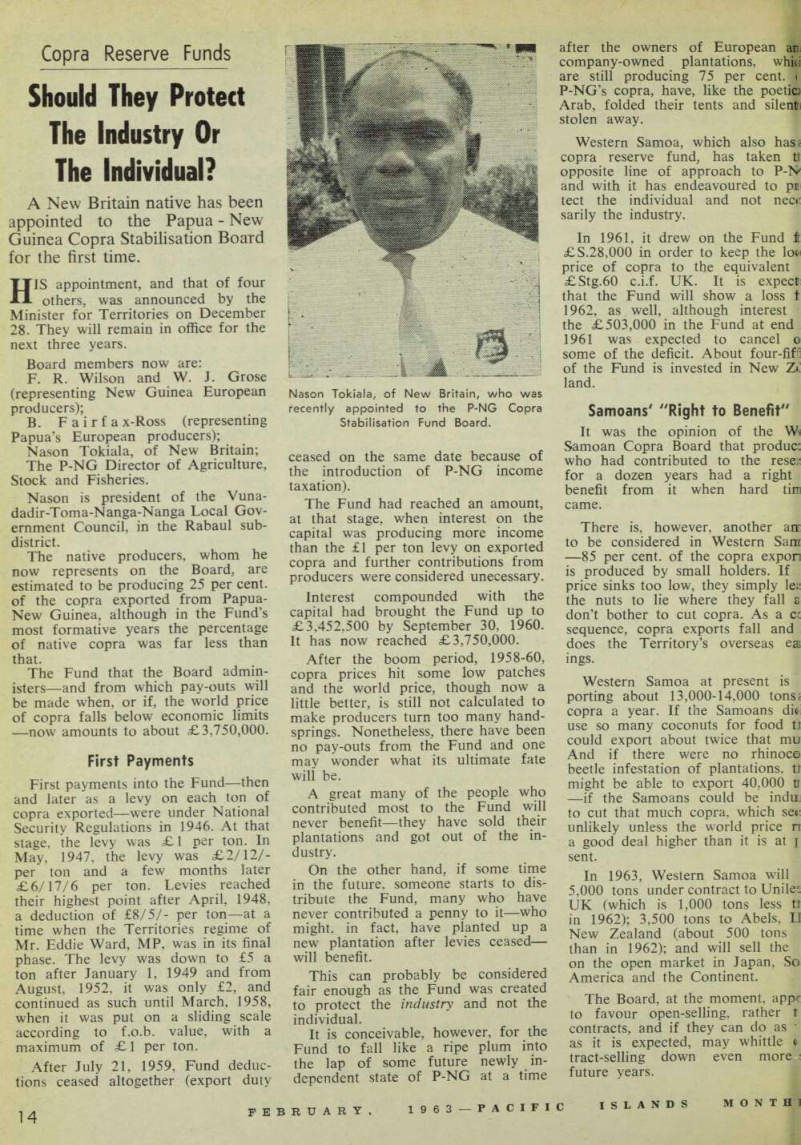
A New Britain native has been appointed to the Papua - New Guinea Copra Stabilisation Board for the first time.
HIS appointment, and that of four others, was announced by the Minister for Territories on December 28. They will remain in office for the next three years.
Board members now are: F. R. Wilson and W. J. Grose (representing New Guinea European producers); B. Fai r f a x-Ross (representing Papua’s European producers); Nason Tokiala, of New Britain; The P-NG Director of Agriculture, Stock and Fisheries.
Nason is president of the Vuna dadir-Toma-Nanga-Nanga Local Gov ernment Council, in the Rabaul sub district.
The native producers, whom he now represents on the Board, are estimated to be producing 25 per cent, of the copra exported from Papua- New Guinea, although in the Fund’s most formative years the percentage of native copra was far less than that.
The Fund that the Board admin isters —and from which pay-outs will be made when, or if, the world price of copra falls below economic limits —now amounts to about £3,750,000.
First Payments
First payments into the Fund—then and later as a levy on each ton of copra exported—were under National Security Regulations in 1946. At that stage, the levy was £1 per ton. In May, 1947, the levy was £2/12/per ton and a few months later £6/17/6 per ton. Levies reached their highest point after April, 1948, a deduction of £B/5/- per ton —at a time when the Territories regime of Mr. Eddie Ward, MP, was in its final phase. The levy was down to £5 a ton after January 1, 1949 and from August, 1952, it was only £2, and continued as such until March, 1958, when it was put on a sliding scale according to f.o.b. value, with a maximum of £1 per ton.
After July 21, 1959, Fund deduc tions ceased altogether (export duty
ceased on the same date because of the introduction of P-NG income taxation).
The Fund had reached an amount, at that stage, when interest on the capital was producing more income than the £1 per ton levy on exported copra and further contributions from producers were considered unecessary.
Interest compounded with the capital had brought the Fund up to £3,452,500 by September 30, 1960.
It has now reached £3,750,000.
After the boom period, 1958-60, copra prices hit some low patches and the world price, though now a little better, is still not calculated to make producers turn too many hand springs. Nonetheless, there have been no pay-outs from the Fund and one may wonder what its ultimate fate will be.
A great many of the people who contributed most to the Fund will never benefit —they have sold their plantations and got out of the in dustry.
On the other hand, if some time in the future, someone starts to dis tribute the Fund, many who have never contributed a penny to it—who might, in fact, have planted up a new plantation after levies ceased— will benefit.
This can probably be considered fair enough as the Fund was created to protect the industry and not the individual.
It is conceivable, however, for the Fund to fall like a ripe plum into the lap of some future newly in dependent state of P-NG at a time
after the owners of European air company-owned plantations, whiu are still producing 75 per cent, i P-NG’s copra, have, like the poetio Arab, folded their tents and silenti stolen away.
Western Samoa, which also has? copra reserve fund, has taken tt opposite line of approach to P-Tv and with it has endeavoured to pi' tect the individual and not necc sarily the industry.
In 1961, it drew on the Fund 1 £8.28,000 in order to keep the lo«< price of copra to the equivalent £Stg.6o c.i.f. UK. It is expect; that the Fund will show a loss t 1962, as well, although interest the £503,000 in the Fund at end 1961 was expected to cancel o some of the deficit. About four-fifti of the Fund is invested in New Zal land.
Samoans 7 "Right to Benefit"
It was the opinion of the Wv Samoan Copra Board that produc: who had contributed to the reseie for a dozen years had a right benefit from it when hard dm came.
There is, however, another anr to be considered in Western Sam —B5 per cent, of the copra expon is produced by small holders. If price sinks too low, they simply le:; the nuts to lie where they fall s don’t bother to cut copra. As a c: sequence, copra exports fall and does the Territory’s overseas es
ings.
Western Samoa at present is porting about 13,000-14,000 tons? copra a year. If the Samoans dioj use so many coconuts for food tt could export about twice that mu And if there were no rhinoc© beetle infestation of plantations, tt might be able to export 40,000 tt —if the Samoans could be indiu to cut that much copra, which se« unlikely unless the world price n a good deal higher than it is at j sent.
In 1963, Western Samoa will 5,000 tons under contract to Unites UK (which is 1,000 tons less tt in 1962); 3,500 tons to Abels, II New Zealand (about 500 tons than in 1962); and will sell the on the open market in Japan, So America and the Continent.
The Board, at the moment, appc to favour open-selling, rather t contracts, and if they can do as ' as it is expected, may whittle o tract-selling down even more ; future years.
Nason Tokiala, of New Britain, who was recently appointed to the P-NG Copra Stabilisation Fund Board.