The Growing Japanese Commercial
pp. 12-145 · Read in the full issue
A Special Pim Survey Of:-
The Growing Japanese Commercial Empire In The South Pacific
Just over 20 years ago, the Japanese Army, Air Force and Navy were moving steadily southwards at the command of the political bosses in Tokyo in an effort to obtain political domination in the South Seas. Allied forces halted them, turned them back and defeated them.
MANY people believe that the end of the war brought an end to Japanese influence in the South Paci fic. But this is not so, for in the past few years Japanese commercial in terests have been moving unobtru sively into the area, and now their sphere of influence is much more ex tensive than that of their military forces ever was —and this is only the beginning.
Direct Japanese enterprise in the South Pacific has been mainly con cerned with tuna fishing but Japanese interests have also participated in mining in New Caledonia and Fiji and have looked into manganese pos sibilities in New Guinea. They could be in the picture, too, if and when the Indonesians decide to try to ex ploit the nickel deposits of West New Guinea.
They have a growing stake in the Pacific timber industry; are now in the market for South Pacific bananas; and are still French Polynesia’s big gest customer for Makatea phosphate.
But it is in trading—and particu larly in selling manufactured goods to the Pacific—that they are chang ing the whole of Islands marketing and look already to be in a fair way to ousting other countries which have, for generations, looked upon the area as their own traditional preserve. Al ready Japan has the market for tran sistor radios, cameras, binoculars and similar goods sewn up; and is whitt ling into bigger items such as the supply of cement, automobiles, tex tiles and bicycles.
Japanese capital and enterprise is now found in almost every island group south of the Equator. No figures are available to show how much capital is involved, but the fol lowing survey of the island groups from east to west gives some idea of the extent of Japanese trading and other interests.
French Polynesia
In July, it was reported—but so far is unconfirmed —that an American
company, Star Kist Foods, was plan ning to build a freezer in Tahiti for the tuna that would be caught in ad jacent waters by a fleet of 16 “chasers”, each of 76 tons, with Jap anese crews.
A specially equipped ship would call periodically at Papeete to pick up the catch to carry it to Japan and America. The company, which pre sumably had some Japanese capital invested, hoped to catch about 30,000 tons of tuna a year.
Problems of foreign investment in Tahiti are not as easy as elsewhere however, and there would be several snags to be overcome.
Japan, while it takes the lion’s share of phosphate from Makatea, sells very little to French Polynesia, which has a high protective tariff against non-French goods.
Cook Islands Details of a joint Japanese-New Zealand tuna fishing venture for the Cook Islands were being worked out last year. The plan was for a canning factory to be built at Rarotonga by Island Foods Ltd., a subsidiary of W. Gregg and Co., Dunedin, and the Japanese were to provide the boats and crews to supply it.
Part of the deal was that the Jap anese would help train Cook Islanders in their boats. Each boat was to train four Cook Islanders a year and use them at the end of their training to replace Japanese crew members. Eventually, full crews would be Maori. But the sale of profits from the catch would still be long to Japan.
However, long before this scheme was envisaged Japanese fishing boats from American Samoa were fishing in Cook Islands waters. One boat, the Taiyo Maru, was wrecked at Pukapuka in October, 1957; a second, the Tsuru Maru, was wrecked at Nas sau in November, 1958. A third, the Iwakuni Maru, was stranded at Muri, on Rarotonga’s south-east coast, in September last year.
American Samoa Van Camp Seafoods, an Amerioi tuna canning company, has hadb factory at Pago Pago since 19?
Japanese fishing boats and crews he supplied the catch.
A second American company, 2 Kist, is planning to build a canm alongside that of Van Camp anefc use Japanese “know-how” in the ss; way.
The Territory still gets the bulW its imports from (a) USA; (b) M Zealand. Hong Kong supplies soma its traditionally Eastern imports.
Western Samoa A Japanese company, Tojin Tokyo Seika Co., now has a I term contract with Western San for the import of bananas. Shipmr were made in the last quarter of ; year after three changes in shipc arrangements had created confuu and disappointment among grow There was a hold-up due to Japat import licences too —which was < pected to be resolved on March 1963.
It was reported in December a Samoan group was considering j ting a vessel built in Japan especa for the carriage of Samoan banc to New Zealand and Japan.
Western Samoa has been expoc copra to the annual value of as £5tg.65,000 to Japan in recent t and imports have been as £Stg. 146,000 —mostly textiles, tt cement (Japan has virtually the tire market), toys, radios, etc.
Tonga
Tonga’s Premier, Prince Tungii: nounced late last year that T 1 hoped to build up a banana • with Japan and to develop a fiif industry with Japanese assist!
Tonga has been interested in tit Japanese for some years now and some tragic luck when a new fist! training vessel, Teiko, with a Jsi ese master, sank with all hand late 1961. They were teaching Tongans long-line methods at! time.
The Tongan tuna industry isi forgotten, but is in abeyance as moment.
At present Tonga does not sell! I much to Japan, but hopes, with and Western Samoa, to develop banana export industry, whem shipping problem has been se; and Japan’s import restrictions! lifted. If Tonga provides coconui the proposed coconut processing! tory in American Samoa, it will,,
(er, probably be unable to develop a gger copra trade with Japan.
Amongst the manufactured goods onga takes from Japan are cement, ad i o receivers, photographies, xtiles, cameras and motor cycles, owever, the trade, at present, is not rge in either direction.
Fiji
A proposal by Japanese interests, th some Fiji capital, to set up a □a fishing industry at Levuka, the rmer capital of Fiji, has been in the : since the end of 1961. The diffi- Ities that have not been ironed out e the Japanese Government’s recent Eusal to allow funds to be used to tablish a cannery and the problem whether Japanese technicians and hermen and their families will be rmitted to live on the island of ralau, of which Levuka is the main Qtre.
Fiji has agreed that essential Jap ese technicians and management icials could be given residential rmits, but has insisted that crews :>uld remain on ships’ articles.
However, the Japanese Govern :nt has made regulations prohibit ; their fishing fleets from operating erseas unless bases are established lore for their crews.
Fiji has been given to understand it between four and five members every crew would expect to have :ir families based in Fiji. If there re 100 ships, this would mean the of between 400 and 500 uses and would bring about 1,000 lanese to Fiji. i\t the moment the Japanese are unsidering their proposal about the mery and are recasting their pro sals about the influx of fishermen J their families.
Meanwhile, many Japanese boats ve been fishing in Fijian waters. At st half a dozen have been wrecked reefs there in the past two years, lapan has been an important market Fiji manganese, which had its )m period 1956-59; but the more :essible deposits have now been rked out and the price has fallen a point where there is not much srest in the industry. Japanese have o been taking an interest in copper >osits at Udu Point, Vanua Levu; (e worked iron ore deposits on Viti vu and done exploratory work on i v on-bearing beach sand at Siga a, Fiji, with Western Samoa and nga, is also expecting to begin ;ular shipments of bananas to )an this year. rhe growth of Japanese imports o Fiji has been phenomenal—from value of £F229,029 in 1957 to
£1,331,262 in 1961. And now that Fiji has decided, in the interest of promoting tourism, to lift import duty on cameras, transistor radios, tape recorders etc. —virtually all of which come from Japan—Japanese imports into Fiji are sure to increase. (In 1961, for the first time, the value of Japanese imports was greater than imports from New Zealand.) New Hebrides A tuna fishing industry, with head quarters at Santo, was established in the New Hebrides in 1955, using British and American capital and Japanese skill. The companies which started the industry were Deichi Bus san Kaisha and Nanyo Boeki Kaisha, of Japan, the Washington Fish and Oyster Corporation, of America, and D. J. Gubbay & Co., of New Hebrides.
After a freezer, ice works, a wharf and other installations had been built, the establishment got into production in 1958 employing 34 Japanese ashore, helped by 35 natives and five local Europeans. Seven Japanese fish ing boats were then being used.
In 1961, a total of 3,673,151 tons of frozen fish worth £5tg.372,915 were exported. In the first nine months of last year, the figures were 2,871,516 tons, worth £5tg.331,103, Trade with Japan in the first nine months of 1962 showed imports valued at £Stglo2,7oo and exports (fish and manganese) valued at £Stg 177,470 Solomon Islands An agreement was concluded in November between the BSIP Gov ernment and Nanpo Ringyo Kaisha
Limited, of Tokyo, granting the com pany timber cutting rights over the major part of Baga Island, in the Western Solomons. The agreement was for five years in the first instance, which would allow the company to cut 15 million super feet of timber annually. Most of the production was expected to be exported as logs to Japan.
It is understood that Japanese in terests would also like to start tuna fishing in the Solomons, possibly using Tulagi as a base.
Of more immediate impact was the sale of the old BSIP Trading Cor poration in 1962 to the D. J. Gubbay- Japanese combination of Santo, New Hebrides. It is understood that Jap anese Mitsubishi have substantial interests in this firm, and it is likely that this will bring more Japanese goods into the BSIP. Nonetheless they will not enjoy the same open-go as in some other territories as BSIP has a British preferential tariff that will continue to give a more favour able deal to the traditional Hong kong market.
New Caledonia It was announced in October that the Taiyo Fishery Company would install a freezing plant for treating tuna caught off New Caledonia on a small bay on the Ducos Peninsula, which forms one limit of Noumea harbour.
The company sought permission to send a refrigeration ship to work in Noumea as soon as possible, pending the erection of the freezing plant and the completion of formalities for the
(Continued on page 143)
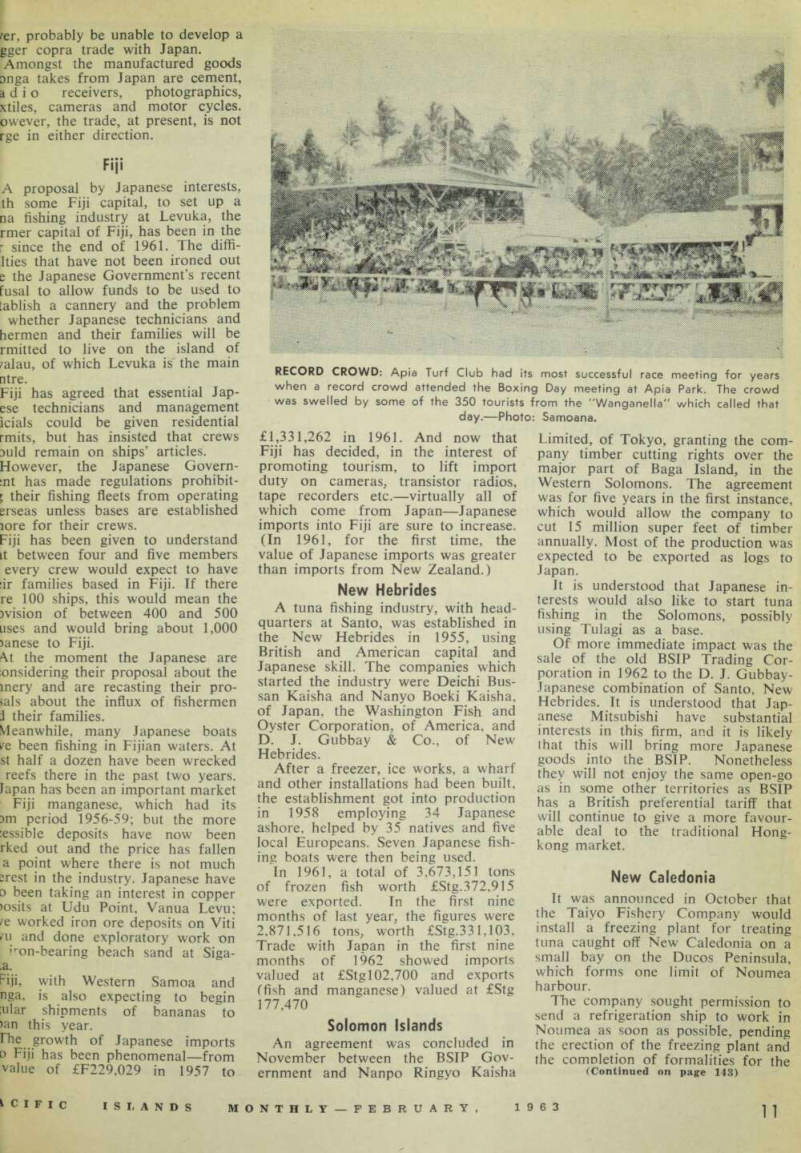
RECORD CROWD: Apia Turf Club Had its most successful race meeting for years when a record crowd attended the Boxing Day meeting at Apia Park. The crowd was swelled by some of the 350 tourists from the "Wanganella" which called that day.—Photo: Samoana.
itablishment of the company in New aledonia. „ , . , A fleet of about 25 fishing boats as expected to fish off the western nd north-eastern coasts of New laledonia. It was hoped that the ipanese company, when in full peration, would pump about 500,000 into the local economy. ! It was also announced in October lat a Japanese company was willing , assist financially and technically in reating a canning plant for citrus r uits in New Caledonia and to ex loit the product on a world market, 'his followed a trial shipment of 800 5 of citrus fruits from New Cale onia to Japan.
In January, two Japanese experts in New Caledonia investigating tie possibility of fishing for trepang sea slugs or beche de mer). A quick urvey of some of the reefs showed hat the creatures were plentiful. The apanese were also interested m buy ng shark fins.
The Japanese have long been in crested in New Csledonis s nickel md chrome and before the war had oncessions in the Colony. Since the var they have been New Caledonia’s lest customer for low grades of these ires. The balance of trade has been ill in New Caledonia’s favour —it im lorts goods to about one-sixth the falue of its exports to Japan.
Papua-New Guinea
Following the loss of timber leases n West New Guinea, Japanese in vests were negotiating big timber contracts in mid-January with Aus tralian logging operators in New Britain. The contracts could have an annual turnover of about £1,500,000.
The growth of imports from Japan in the last half dozen years has been great—and this coupled with the almost equal volume of imports from Hongkong is already giving Austra lian manufacturers and exporters some headaches.
Japan is now second in importance in countries who export to the Terri tory.
In the year ending June, 1962, it, for the first time, beat the UK to second place with goods valued at £1,907,000. In 1956-57 the value was only £631,000. In 1962, P-NG ex ported goods valued at £A609,000 to Japan—mostly in the form of copra, cocoa, timber and shell.
There is no preferential tariff for British imports in P-NG.