Border-Hopping
Now Illegal
In N. Guinea
For the first time on record West vv Guinea natives have been sent :k across the border out of Aus lian New Guinea as “aliens”. 1 late January the Administration of P-NG announced that 44 ives who had arrived in Vanimo st on the Australian side of the der), looking for work had been ided back to UNTEA as “illegal nigrants”. )uring the Dutch regime in WNG, ives moved freely back and forth dss the border and it was no ret that some hundreds of West mans worked in Papua or that stralian New Guineans often ted Hollandia. The border people )ng to the same tribes and clans, :n own land in both Territories have lived in either as it suited n simply because they disregarded fact that there was a European le border. ’he people of Sentani—the fertile i immediately behind Hollandia— e family affinities with the Aus ian New Guineans just a few ;s away and at the time of the ch - Indonesian Agreement last r, 800 of them announced their ntion of going in a body to live the Australian side, n the event they didn’t do this and hey don’t do it soon—and sur itiously—it will be too late. lS late as October, a high ranking G official told PIM that if WNG ves crossed the border into Aus :an territory there would be no mpt to send them back, i the last six months, however, e has been a considerable change ieart in the Australian Territory, t there was the frantic effort to ey the border before the Dutch and to get the bulges or enclaves )utch influence back into the Aus an Territory where they belonged. ; Sept. PIM, p. 17.) hen came the outbreak of cholera he WNG territory and the very imate fear that human and aal diseases from which there been no danger while the Dutch s in control, would now find f way into the Australian terri er did national ambitions come it when the Dutch were there— r plan was that the West New
Guineans would be independent and they hoped that they would ultimately join forces with an independent Papua-New Guinea.
But from now it is going to be different. The border will not be just an imaginary line as it was in the 134 years of Dutch sovereignty, but a tightly held international frontier, even if it does divide native families and clan land.
In recent months P-NG Native Affairs officers have been patrolling in the area, impressing on border dwellers that they must make up their minds on which side of the border to live after May 1, 1963. It is also reliably reported that the Admini stration plans to establish a chain of quarantine stations and prob ably patrol posts right up the western border so that border infiltration will be rigidly controlled.
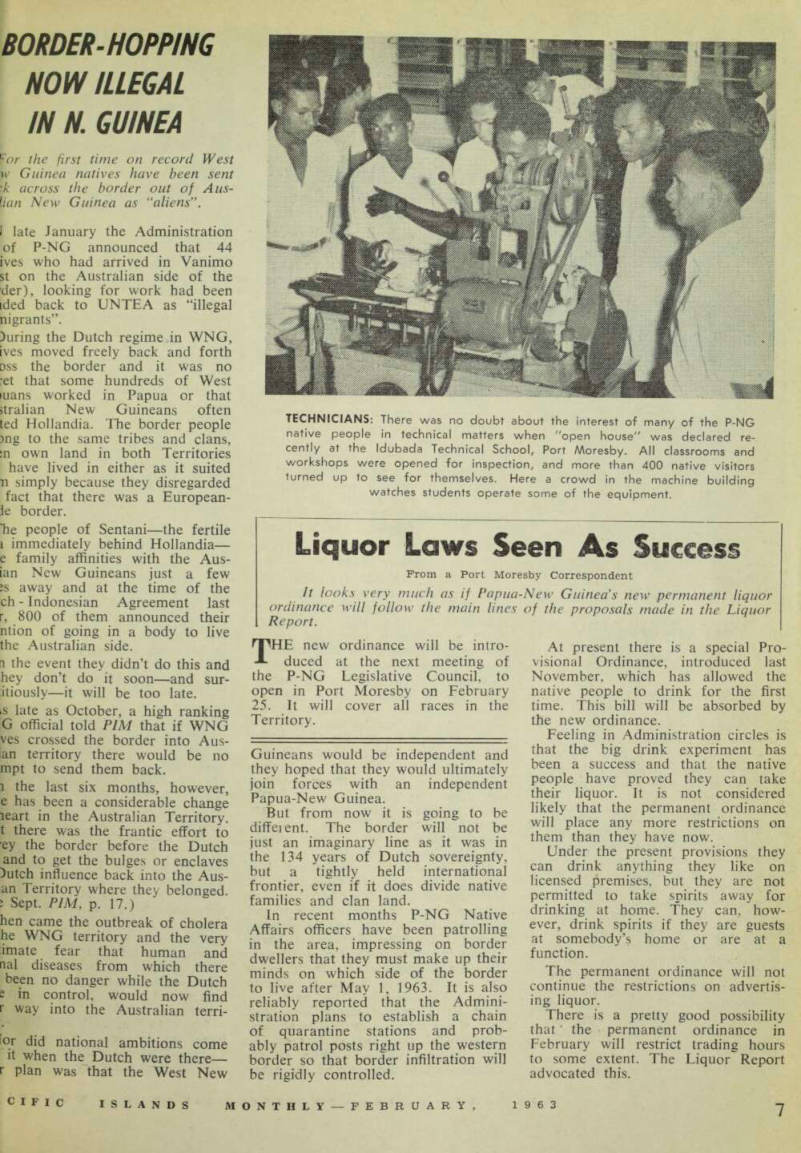
TECHNICIANS: There was no doubt about the interest of many of the P-NG native people in technical matters when "open house" was declared re cently at the Idubada Technical School, Port Moresby. All classrooms and workshops were opened for inspection, and more than 400 native visitors turned up to see for themselves. Here a crowd in the machine building watches students operate some of the equipment.