Tahiti Welcomes Tourists
pp. 140-141 · Read in the full issue
Tahiti is now easy for tourists. Accommodation is ample for present requirements; entry formalities are reduced to a minimum; and there are no troubles over currency as there were a few years ago.
IT is expected that within a few years, tourism will be French Polynesia’s main source of overseas income—at present provided by the export of phosphate from Makatea and the export of copra from the whole Territory.
Phosphate reserves are expected to last for no more than 10 years and may cut out long before that; copra production is unlikely to increase to any extent—although the population of the islands of French Polynesia is now increasing at a high rate.
The French Administration is look ing to tourism to take up the slack and is hard-headedly going after it.
At the same time, it has no intention of letting Tahiti be turned into an other Honolulu or permitting the growth of colonies of expatriates. It is virtually impossible to get per mission to stay longer than six months and visas are usually issued initially for no more than three months.
Shipping services that call at Papeete, port of entry for the whole group, include the Matson vessels Monterey and Mariposa; the Shaw Savill vessels Southern Cross and Northern Star; the Royal Dutch Mail’s Oranje; and the passenger cargo vessels Tahitien and Caledonien of Messageries Maritimes.
At Faaa, about two miles from Papeete, Tahiti has the longest jet runway of any airport in the Southern Hemisphere and although at present the air terminal does not match it, a brand new centre with every facility for international travellers is under construction and will be in use in 1963.
The international airlines at present operating into Faaa are: TAI, the French airline which has services from Paris via Montreal and Los Angeles; from Sydney, via Noumea, New Caledonia, and Nadi, Fiji; and a shuttle service to and from Honolulu; TEAL, which operates a weekly ser vice from Auckland, NZ, via Nadi, to Faaa direct each week and SPAL, which operates from Honoloulu to Faaa direct each week and fortnightly via Tafuna.
Hotels The Government Tourist Bureau divides Tahiti hotels into “Hotels de Tourisme” and “Hotels” and lists them as follows: Hotels de Tourisme: Hotel Bel Air, in Punaauia district, just on the other side of Faa’a air port from Papeete; rates for room only are from 700 to 1,150 Pac. Fes. per night.
Hotel Faratea, at Taravao, about 40 miles from Papeete right on the isthmus that joins Tahiti-Nui to Tahiti-Iti; accommodation is in bungalows, and room with meals rate is 2,000 Pac. Fes. single, 2,950 Pac.
Fes. double.
Hotel laorana Villa, at Punaauia, about 8 miles from Papeete; bunga lows and rooms, with bar, restaurant etc ; from 450 to 800 Pac. Fes. per night, without meals.
Hotel Matayai, in Tipaerui Valley, about one mile from Papeete; from
600 to 1,200 Pac. Fes., room on] (with off-season rates, November er of March).
Hotel Moana Nui, just south of th airport; rates from 1,320 to 1,98 Pac. Fes., room only.
Hotel Taaone, about 2i miles ea: of Papeete; bungalow style, with bai restaurant, beach, etc.; room onl 1,300 Pac. Fes., single; 1,600 Pa< Fes., double. (Off-season rates.) Hotel Tahiti, 11 miles west c Papeete; rooms and bungalows fror 835 Pac. Fes. to 2,200 Pac. Fes. pe night, room only; restaurant, bar an swimming in new pool or off the ree: Hotel Tahiti Village, at Punaaui; 10 miles south of Papeete; bungalm units with bar, restaurant and one c the rare white sand beaches i Tahiti; rates for room only are 1,20 to 2,000 Pac, Fes. per night. (Ofl season rate and hotel transport t Papeete.) Hotel Arahiri, about 31 miles fror Papeete, on East Coast road; bungs low type accommodation with bai restaurant, etc.; rates are 800 to 1,10 Pac. Fes., for room only. (Off-seaso rates.) Hotels: Grand Hotel, right in Papeete; rate are 225 to 600 Pac. Fes,, room onl} per night.
Hotel Heiata, on eastern outskirt of Papeete; 900 to 1,000 Pac. Fes room only, per night. (Off-seaso] rates.) Hotel Royal Tahitian, also oj eastern Papeete outskirts; 1,000 Pac Fes. single; 1,200 Pac. Fes, double room only, per night. (Off-seaso] rates.) Hotel Temehani, right in Papeete 300 to 500 Pac. Fes., per night, roon only.
Hotel Tiki Tapu, in Tipaerui on< mile from Papeete; 800-900 Pac. Fes. room only, per night. (Off-seasoi rates.) At most of the tourist hotels then are bands and dancing nightly, plu opportunities of seeing the Tahitiar dances (to which most tourists giv« the Hawaiian misnomer of hula] locally called tamure and which Ber Covit, in his official guide book, dc scribes as “forceful, suggestive; violent and sexy”.
What To Do The average tourist length of stay in Tahiti is longer than in most other Pacific Islands and is somewhere in the region of two weeks. The mos< frequently taken excursions are:
» The trip around Tahiti of ap proximately 73 miles (the road is tar-sealed), o The boat trip to Moorea it leaves Papeete every morning about 9 and takes about two hours. The weather can some times be rough so those in need of sea-sick pills should go armed.
The average visitor remains over night and returns next day but on Sundays a special return-the same-day excursion is arranged. i» The air trip to Bora Bora. Daily flights (except Sunday) in DC4 aircraft of 75 minutes duration.
Most people stay at least three days.
Transport
Transportation in Tahiti is by taxis, J-Drive cars, motor scooters, motor sed bicycles (Solex) and plain ♦icycles.
Taxis are expensive and most isitors hire themselves either a car, a notor-scooter or bicycle.
There are seven firms which hire ;ars—some on a straight-out daily *asis, some on a mileage basis.
Whichever way it is tackled, it will iikely work out at about 500 to 800 3 ac. Fes. per day. (Some of the setter known firms advertise cars at "$2 or 175 Fes. per day”, but these dso have a charge of 8 Fes. per kilo metre with a minimum daily mileage )f 50 Kms.) An International Driving Permit or iriving licences from any overseas :ountry are accepted. Up until the 2nd of 1962 local people required no iriving licence (it will likely be neces sary in 1963), but they are reason ably competent motorists for all that.
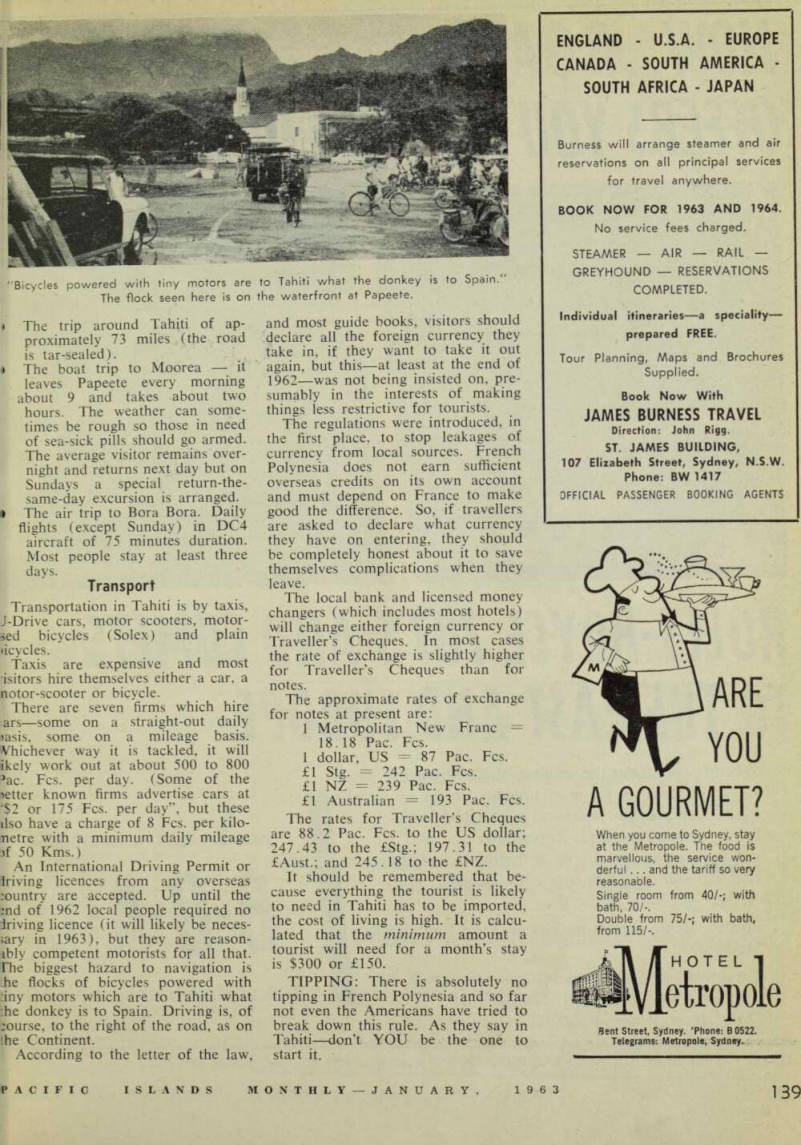
Fhe biggest hazard to navigation is he flocks of bicycles powered with :iny motors which are to Tahiti what :he donkey is to Spain. Driving is, of :ourse, to the right of the road, as on the Continent, According to the letter of the law,
and most guide books, visitors should declare all the foreign currency they take in, if they want to take it out again, but this—at least at the end of 1962—was not being insisted on, pre sumably in the interests of making things less restrictive for tourists.
The regulations were introduced, in the first place, to stop leakages of currency from local sources. French Polynesia does not earn sufficient overseas credits on its own account and must depend on France to make good the difference. So, if travellers are asked to declare what currency they have on entering, they should be completely honest about it to save themselves complications when they leave.
The local bank and licensed money changers (which includes most hotels) will change either foreign currency or Traveller’s Cheques, In most cases the rate of exchange is slightly higher for Traveller’s Cheques than for notes.
The approximate rates of exchange for notes at present are; 1 Metropolitan New Franc = 18.18 Pac. Fes. 1 dollar, US = 87 Pac. Fes. £1 Stg. = 242 Pac. Fes. £1 NZ = 239 Pac. Fes. £1 Australian = 193 Pac. Fes.
The rates for Traveller’s Cheques are 88.2 Pac. Fes. to the US dollar; 247.43 to the £Stg.; 197.31 to the £Aust.; and 245.18 to the £NZ.
It should be remembered that be cause everything the tourist is likely to need in Tahiti has to be imported, the cost of living is high. It is calcu lated that the minimum amount a tourist will need for a month’s stay is $3OO or £l5O.
TIPPING: There is absolutely no tipping in French Polynesia and so far not even the Americans have tried to break down this rule. As they say in Tahiti—don’t YOU be the one to start it.
"Bicycles powered with tiny motors are to Tahiti what the donkey is to Spain."
The flock seen here is on the waterfront at Papeete.