Many Places
p. 127 · Read in the full issue
Benefit From
New Cable
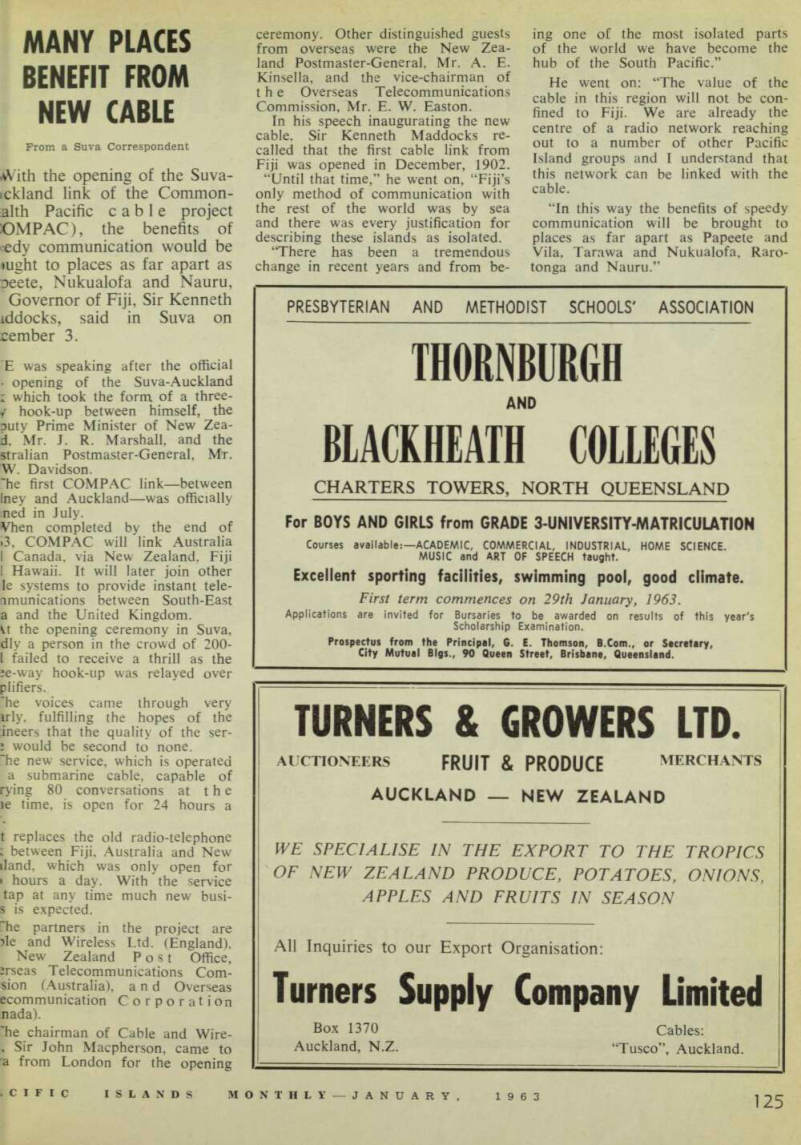
From a Suva Correspondent With the opening of the Suva ►ckland link of the Common
alth Pacific cable project
IOMPAC), the benefits of :edy communication would be •ught to places as far apart as peete, Nukualofa and Nauru, Governor of Fiji, Sir Kenneth tddocks, said in Suva on cember 3.
E was speaking after the official • opening of the Suva-Auckland i which took the form of a three / hook-up between himself, the puty Prime Minister of New Zea d. Mr. J. R. Marshall, and the stralian Postmaster-General, Mr.
W. Davidson.
'he first COMPAC link—between Iney and Auckland—was officially ned in July.
Vhen completed by the end of •3, COMPAC will link Australia I Canada, via New Zealand, Fiji I Hawaii. It will later join other le systems to provide instant tele nmunications between South-East a and the United Kingdom.
Vt the opening ceremony in Suva, dly a person in the crowd of 200l failed to receive a thrill as the se-way hook-up was relayed over plifiers.
Tie voices came through very irly, fulfilling the hopes of the ineers that the quality of the ser ; would be second to none.
Tie new service, which is operated a submarine cable, capable of rying 80 conversations at the le time, is open for 24 hours a t replaces the old radio-telephone : between Fiji, Australia and New dand, which was only open for » hours a day. With the service tap at any time much new busi s is expected.
Tie partners in the project are lie and Wireless Ltd. (England), New Zealand Post Office, srseas Telecommunications Colli sion (Australia), and Overseas ecommunication Corporation nada).
Tie chairman of Cable and Wire , Sir John Macpherson, came to a from London for the opening
ceremony. Other distinguished guests from overseas were the New Zea land Postmaster-General, Mr, A. E.
Kinsella, and the vice-chairman of th e Overseas Telecommunications Commission, Mr. E. W. Easton.
In his speech inaugurating the new cable. Sir Kenneth Maddocks re called that the first cable link from Fiji was opened in December, 1902.
“Until that time,” he went on, “Fiji’s only method of communication with the rest of the world was by sea and there was every justification for describing these islands as isolated. ‘There has been a tremendous change in recent years and from be
ing one of the most isolated parts of the world we have become the hub of the South Pacific.”
He went on; “The value of the cable in this region will not be con fined to Fiji. We are already the centre of a radio network reaching out to a number of other Pacific Island groups and I understand that this network can be linked with the cable.
“In this way the benefits of speedy communication will be brought to places as far apart as Papeete and Vila, Tarawa and Nukualofa, Raro tonga and Nauru.”