Any Threat To P-NG "Would
p. 123 · Read in the full issue
Be From Communism”
From a Port Moresby Correspondent The military situation in Papua-New Guinea was given orominence in December, with special stress on the role of Pown Pacific Islands Regiment. The PIR comprises New Guinea men with European officers.
I-GEN. Sir Reginald Pollard, re tiring Chief of the Australian aeral Staff, said in Port Moresby i) Any military threat to P-NG nld be from Communism in the :th. > The PIR would be needed in v Guinea during “the early days ndependence”. ► There was “nothing sinister” ut the work at present being done the Sepik district, near the West v Guinea border, by Australian ny detachments. ieneral Pollard in December made are well tour of the Territory be ; he retires in January.
Jewsmen asked him about the itary situation along the border about the role of the PIR and P-NG Volunteer Rifles (a Euro n militia).
Jeneral Pollard said he had no rs that anything was going to pen in P-NG. But if anything did pen the PIR and the PNGVR ild be invaluable, t was nonsense to suggest that itia forces were being pushed into background. But Australia had to
have a regular army, and now for the first time it had one.
Previously Australia always had Britain to “hold the fort” while Aus tralian forces were raised, trained and equipped, but Australia would never have that situation again.
General Pollard said the PIR was undoubtedly a thoroughly efficient force which could give a good ac count of itself. It could take the place of a guerilla force while large forces came in from Australia.
In a limited time it would not be the job of the PNGVR to take such a guerilla role. It was an essential adjunct to home defence.
General Pollard said the Army work in the Sepik was engineering work “of utmost economic impor tance to the Territory”. It had noth ing whatever to do with West New Guinea.
Engineers were learning how to handle local materials, local staff and to cope with tropical conditions. All this was first class training.
The Chief of the General Staff said the Army still planned to have native officers for the PIR, but it was a matter of education. Anybody in the
army with the qualifications could obtain a commission—it was no longer necessary to go through Dun troon. It was hoped some P-NG natives would qualify to study at the Officers’ Cadet School in 1963.
Earlier, General Pollard had ad dressed a parade of PIR men at a Trooping of the Colour ceremony at Taurama Barracks, Port Moresby.
He told them that they were a young force but in the years to come they would be the foundation of a stable force “which will be most important and necessary in the early years of in dependence”.
He said the PIR was doing an im portant job in remote areas by visit ing villages not visited regularly by the Administration.
He stressed the importance of edu cation and the necessity of learning English. He also told the men; “You should never fail to go to European officers or NCO’s if you have any trouble or worry.”
CO of the PIR, Lt.-Col. K.
McKenzie, told a passing-out parade of native cadets at Sogeri Secondary School in December that should there be an enemy in P-NG the PIR would expect the help of all former cadets.
They would be expected to come into the army and join the fight.
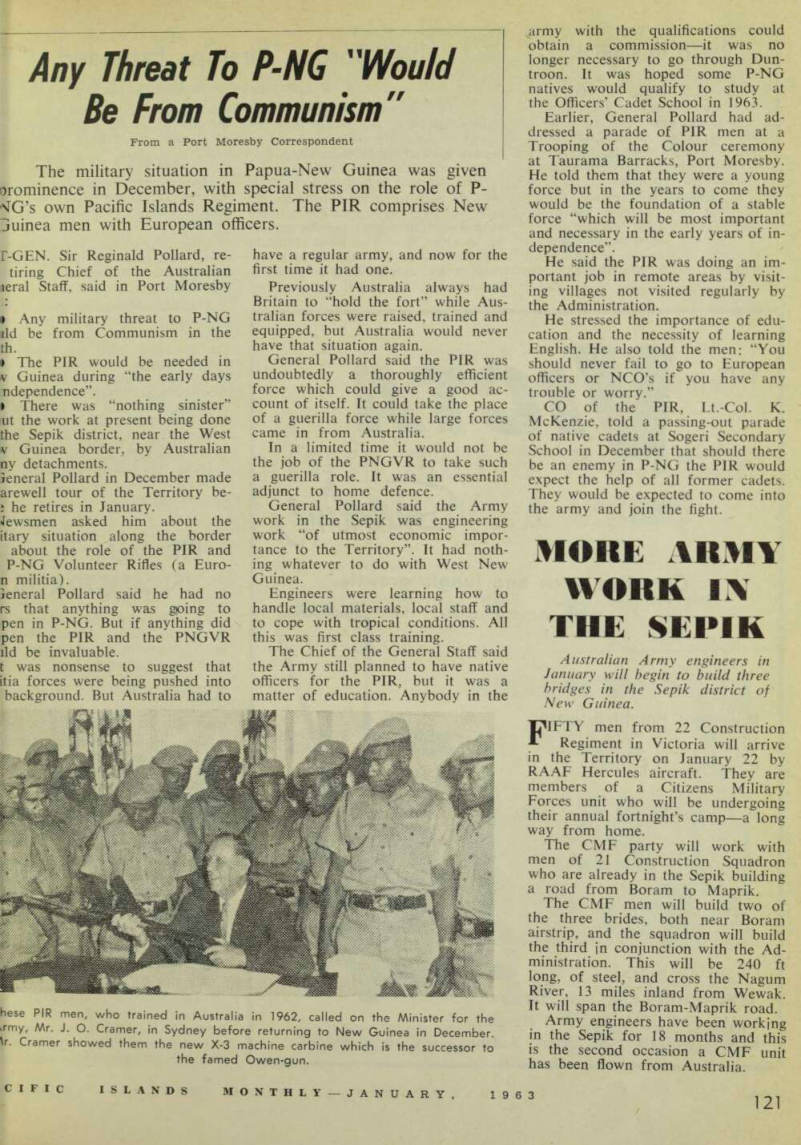
?hese PIR men, who trained in Australia in 1962, called on the Minister for the ?rmy, Mr. J. O. Cramer, in Sydney before returning to New Guinea in December. ?r. Cramer showed them the new X-3 machine carbine which is the successor to the famed Owen-gun.