Paper-backs
p. 97 · Read in the full issue
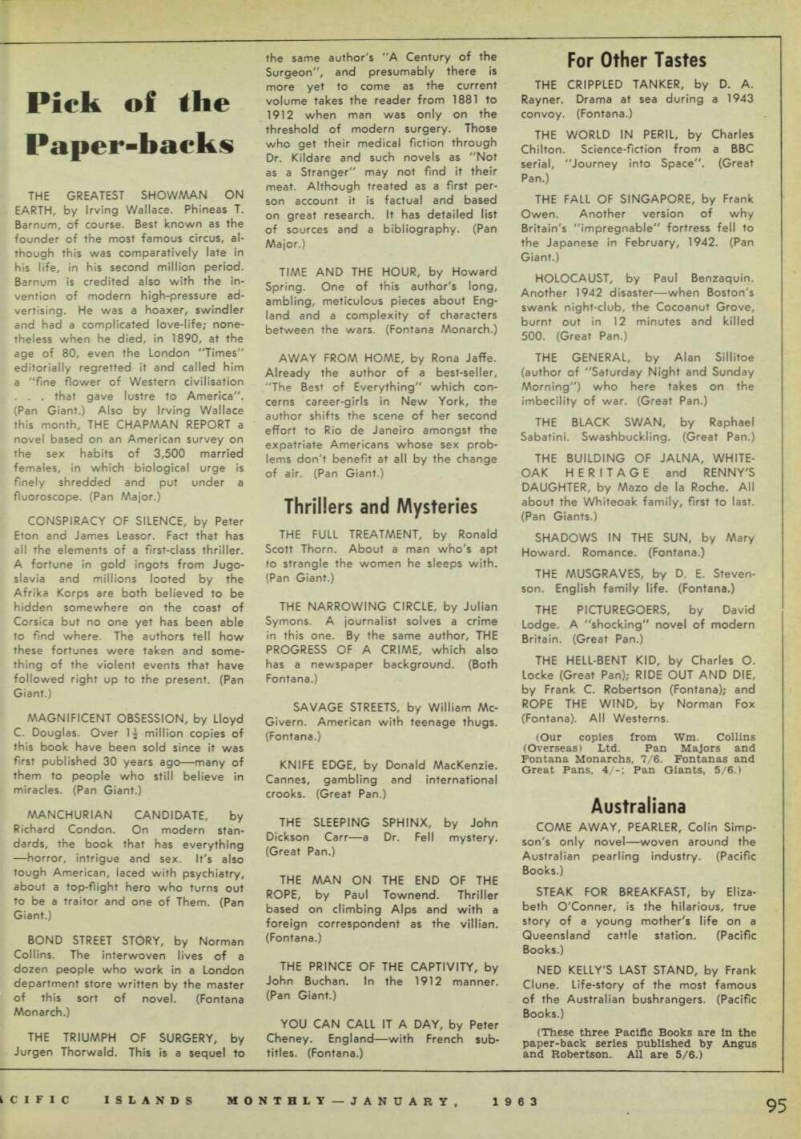
Pick of the Paper-backs
The Greatest Showman On
EARTH, by Irving Wallace. Phineas T.
Barnum, of course. Best known as the founder of the most famous circus, al though this was comparatively late in his life, in his second million period.
Barnum is credited also with the in vention of modern high-pressure ad vertising. He was a hoaxer, swindler and had a complicated love-life; none theless when he died, in 1890, at the age of 80, even the London "Times" editorially regretted it and called him a "fine flower of Western civilisation . . . that gave lustre to America". (Pan Giant.) Also by Irving Wallace this month, THE CHAPMAN REPORT a novel based on an American survey on the sex habits of 3,500 married females, in which biological urge is finely shredded and put under a fluoroscope. (Pan Major.)
Conspiracy Of Silence, By Peter
Eton and James Leaser. Fact that has all the elements of a first-class thriller.
A fortune in gold ingots from Jugo slavia and millions looted by the Afrika Korps are both believed to be hidden somewhere on the coast of Corsica but no one yet has been able to find where. The authors tell how these fortunes were taken and some thing of the violent events that have followed right up to the present. (Pan Giant.)
Magnificent Obsession, By Lloyd
C. Douglas. Over 1£ million copies of this book have been sold since it was first published 30 years ago—many of them to people who still believe in miracles. (Pan Giant.)
Manchurian Candidate, By
Richard Condon. On modern stan dards, the book that has everything —horror, intrigue and sex. It's also tough American, laced with psychiatry, about a top-flight hero who turns out to be a traitor and one of Them. (Pan Giant.) BOND STREET STORY, by Norman Collins. The interwoven lives of a dozen people who work in a London department store written by the master of this sort of novel. (Fontana Monarch.)
The Triumph Of Surgery, By
Jurgen Thorwald. This is a sequel to
the same author's "A Century of the Surgeon", and presumably there is more yet to come as the current volume takes the reader from 1881 to 1912 when man was only on the threshold of modern surgery. Those who get their medical fiction through Dr. Kildare and such novels as "Not as a Stranger" may not find it their meat. Although treated as a first per son account it is factual and based on great research, it has detailed list of sources and a bibliography. (Pan Major.) TIME AND THE HOUR, by Howard Spring. One of this author's long, ambling, meticulous pieces about Eng land and a complexity of characters between the wars. (Fontana Monarch.) AWAY FROM HOME, by Rona Jaffe.
Already the author of a best-seller, "The Best of Everything" which con cerns career-girls in New York, the author shifts the scene of her second effort to Rio de Janeiro amongst the expatriate Americans whose sex prob lems don't benefit at all by the change of air. (Pan Giant.)
Thrillers and Mysteries
The Full Treatment, By Ronald
Scott Thorn. About a man who's apt to strangle the women he sleeps with. (Pan Giant.)
The Narrowing Circle, By Julian
Symons. A journalist solves a crime in this one. By the same author, THE PROGRESS OF A CRIME, which also has a newspaper background. (Both Fontana.) SAVAGE STREETS, by William Mc- Givern. American with teenage thugs. (Fontana.) KNIFE EDGE, by Donald MacKenzie.
Cannes, gambling and international crooks. (Great Pan.)
The Sleeping Sphinx, By John
Dickson Carr—a Dr. Fell mystery. (Great Pan.) THE MAN ON THE END OF THE ROPE, by Paul Townend. Thriller based on climbing Alps and with a foreign correspondent as the villian. (Fontana.)
The Prince Of The Captivity, By
John Buchan. In the 1912 manner. (Pan Giant.) YOU CAN CALL IT A DAY, by Peter Cheney. England—with French sub titles. (Fontana.)
For Other Tastes
The Crippled Tanker, By D, A.
Rayner. Drama at sea during a 1943 convoy. (Fontana.) THE WORLD IN PERIL, by Charles Chilton. Science-fiction from a BBC serial, "Journey into Space". (Great Pan.)
The Fall Of Singapore, By Frank
Owen. Another version of why Britain's "impregnable" fortress fell to the Japanese in February, 1942. (Pan Giant.) HOLOCAUST, by Paul Benzaquin.
Another 1942 disaster—when Boston's swank night-club, the Cocoanut Grove, burnt out in 12 minutes and killed 500. (Great Pan.) THE GENERAL, by Alan Sillitoe (author of "Saturday Night and Sunday Morning") who here takes on the imbecility of war. (Great Pan.) THE BLACK SWAN, by Raphael Sabatini. Swashbuckling. (Great Pan.)
The Building Of Jalna, White
Oak Heritage And Penny's
DAUGHTER, by Mazo de la Roche. All about the Whiteoak family, first to last. (Pan Giants.)
Shadows In The Sun, By Mary
Howard. Romance, (Fontana.) THE MUSGRAVES, by D. E. Steven son. English family life. (Fontana.)
The Picturegoers, By David
Lodge. A "shocking" novel of modern Britain. (Great Pan.) THE HELL-BENT KID, by Charles O.
Locke (Great Pan); RIDE OUT AND DIE, by Frank C. Robertson (Fontana); and ROPE THE WIND, by Norman Fox (Fontana). All Westerns. (Our copies from Wm. Collins (Overseas) Ltd. Pan Majors and Fontana Monarchs, 7/6. Fontanas and Great Pans, 4/-; Pan Giants, 5/6.)
Australian
Come Away, Pearler, Colin Simp
son's only novel —woven around the Australian pearling industry. (Pacific Books.)
Steak For Breakfast, By Eliza
beth O'Conner, is the hilarious, true story of a young mother's life on a Queensland cattle station. (Pacific Books.)
Ned Kelly's Last Stand, By Frank
Clune. Life-story of the most famous of the Australian bushrangers. (Pacific Books.) (These three Pacific Books are In the paper-back series published by Angus and Robertson. All are 5/6.)