Of Matthew Flinders
pp. 94-95 · Read in the full issue
The Long And The Short Of Matthew Flinders
Most Australians are more or less familiar with the life story of Captain Matthew Flinders, one of the most tragic figures in their country’s history. The facts of his life are straightforward enough, but there is more than one way of interpreting them, as Sydney writer Sidney J. Baker shows in his new biography, My Own Destroyer.
AT the age of 15, despite his father’s opposition, Flinders joined the Royal Navy as a lieutenant’s servant. At 17, he sailed to Tahiti on Bligh’s second voyage to collect breadfruit for the West Indies.
At 21, he went to Australia, where he did valuable exploratory work along the southern coasts with his friend George Bass. At 26, having caught the eye of the powerful Sir Joseph Banks, he was put in charge of HMS Investigator to circum navigate Australia and survey its un known coasts.
After flouting the Admiralty and nearly losing Sir Joseph’s patronage by trying to smuggle his newly married wife Ann aboard the In vestigator, Flinders sailed for Aus tralia, reaching Cape Leeuwin on December 6, 1801.
During the next 18 months, he not only circumnavigated the continent, but filled in most of the blank sections of the map with meticulously accurate observations. (His charts for parts of the Gulf of Carpentaria, with only a few additional observations, are still in use).
On reaching Sydney in mid-1803, the Investigator was condemned as unseaworthy, although she later re turned to England after a voyage of great and constant danger.
Meanwhile, believing that the Admiralty would give him another ship so that he could chart part of the Australian coast in greater detail, Flinders obtained a passage in HMS Porpoise for England.
The Porpoise in company with two other ships, the Bridgewater and Cato, left Sydney in August, 1803, and seven days later the Porpoise and Cato were wrecked on the Great Barrier Reef.
After returning to Sydney in a cutter, Flinders was given command of the cranky 29-ton colonial schooner Cumberland. In this, he returned to the scene of the ship wrecks, picked up some officers and men who had remained there, and pushed on, as he hoped, for England.
Flinders, then 29, looked forws eagerly to being reunited with I wife after an absence of three ye; and to being rewarded by Fortum smiles for his great exploratory wo: But things did not turn out tB way.
Twenty-three days out of Timor route to the Cape of Good Hoi one of the pumps of the cram Cumberland failed and the sB could make little progress.
So Flinders decided to make t the French-ruled island of Mauritii Although France and England hi been at war, Flinders felt certain receiving kind treatment at the islan for, besides having a passport frc the French, he had acted kindly Sydney towards the French exploi Baudin, who had planned to put in Mauritius on his way home.
Trouble at Mauritius As Flinders had no charts of tl Mauritius coast, and finding that d waters were littered with coral reee he decided to follow a small vess; which was heading into Baye du Cs Soon after anchoring, Flinde learned that, after a brief respii Britain and France were at war agaij Despite this, the French we courteous, if formal.
Next day, Flinders called on t'l Captain-General of Mauritius, t'J shortish, thick-set Charles DeCaen..
DeCaen kept Flinders waiting tw hours in the street before seeing hirj When he did, he told Flinders blunfli that he was both an imposter au a spy. His passport, he said, ha been made out for the Investigate* whereas Flinders had arrived in tit Cumberland, which was clearly ul suitable for exploration. Heno Flinders could not be Flinders ntr could he be an explorer.
Besides this, DeCaen said, Flindea had pursued a French vessel into tf Baye du Cap, and only by skilfi handling had it escaped being ov© taken.
All Flinders’ protests of innocence d efforts to establish that he was io he was were in vain.
Next day, however, DeCaen parently had second thoughts, and nted Flinders to join him and his Ee for dinner that evening.
Flinders sent a messenger back with clear-cut refusal. The result was it he remained a prisoner of Gaeo on Mauritius for seven long irs.
When at last, broken in health, he is released and returned to igland, he still did not get the cognition and rewards he thought deserved. In less than four years, len barely 40 and having just com ;ted an account of his exploratory »rk, he was dead.
On the surface, it would appear it Flinders’ career ended as it did cause he made an error in replying DeCaen as he did and because he ;n became a victim of circum tnces. But Baker does not see ngs as simply as this in My Own istroyer, which is set within the imework of psycho-analysis.
To Baker, Flinders’ career was svitably headed for disaster from early age because of a blemish his character: he could not stand ysically small men.
Flinders himself was 5 ft 6 in. 1. He got on fine with all men »ger than himself, such as Bass and nks. But he resented small men
such as his father, Bligh and DeCaen, and was obsessed with an urge to defy them when they had any authority over him.
Baker says: “Since we lack details of Flinders’ early life as a boy, it is impossible to say precisely how his objection against his father began, but that he flouted his father by refusing to become a surgeon and by choosing to follow a naval career there can be no doubt.
“If, as events were to prove, a ‘little’ son can successfully challenge a ‘little’ father, we are able to see how a pattern of conduct can be established.”
“To psycho-analysis,” Baker goes on, “the factor known as repetition compulsion in any personality serves as an important guide to the structure of that personality . . .
“In Flinders’ case, we can presume that he felt guilt because of his successful contest with his father and that the seeds of this guilt were buried far back in his infancy . . .
“We can have no doubt that he repeated such conflicts many times in the course of his short life and none with such unhappy results as his clash with General DeCaen.”
Although Baker has put together every scrap of available evidence to support his contentions, some readers will probably feel that it is in sufficient.
However, for those unbelievers, Baker’s book is still worth a place on their bookshelves as an excellent short biography of its subject.—
R.A.L.
(MY OWN DESTROYER. Currawong Publishing Co. Pty. Ltd. 29/6.)
Brown Men And Red Sand
by Charles P. Mountford. This is a well-established book by the Aus tralian ethnologist, and was first pub lished over 10 years ago. It describes one of half a dozen journeys he has made into Central Australia and is accepted as a standard work on the aborigines and their environment.
The author says, in an introduction, that it is not intended as an anthropological treatise but as a travel book. Nonetheless it is con cerned mostly with the natives he met in his journey and a great deal about their culture and folk-lore. (Published by Angus and Robertson Ltd. Australian price, 28/6.)
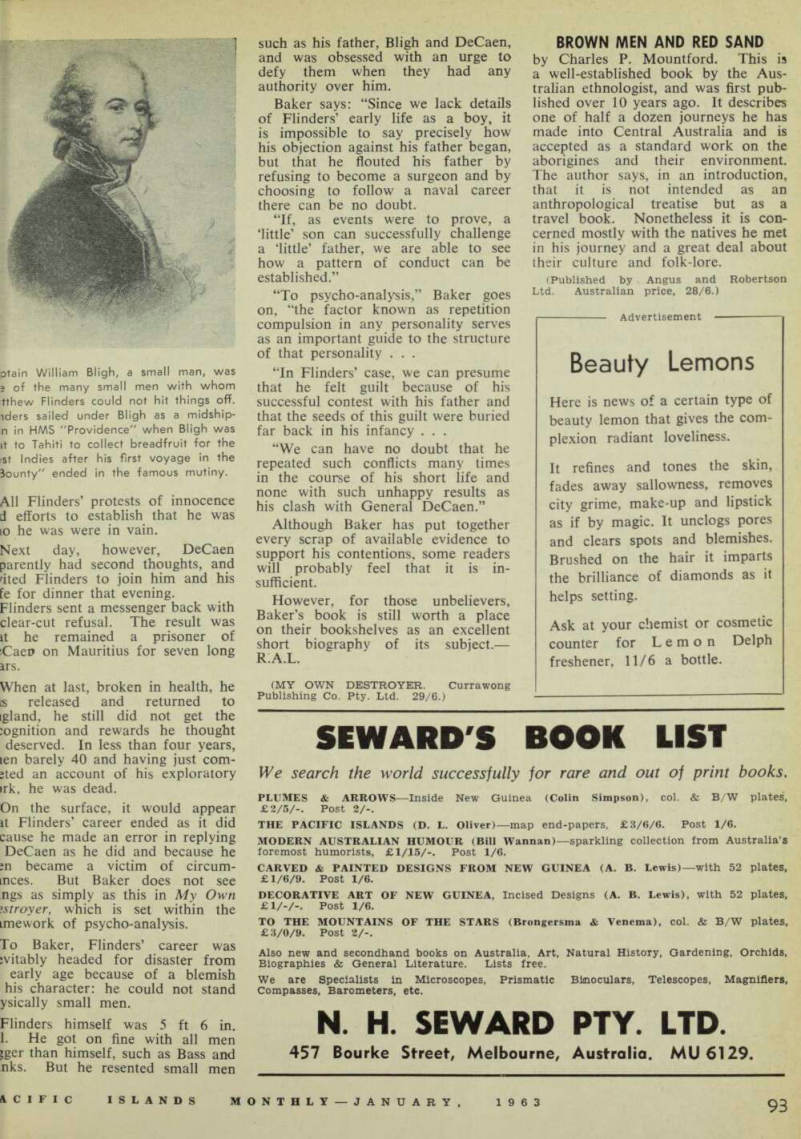
?otain William Bligh, a small man, was ?e of the many small men with whom ?tthew Flinders could not hit things off. ?nders sailed under Bligh as a midship ?n in HMS "Providence" when Bligh was ?t to Tahiti to collect breadfruit for the ?est Indies after his first voyage in the Bounty" ended in the famous mutiny.