From Wattle Daub To Sail -
p. 93 · Read in the full issue
Like Roofs
Has Australian architecture grown up? Melbourne architect
Robin Boyd {The Australian
Ugliness ) attempts to supply an answer in an entertaining, 90page book written with a shrewd eye for the essentials. His ver
dict: Australian building prob
ably has grown up. r J I HE Walls Around Us is the story of Australian architecture in capsule form, made even more palat able by the author’s sketches.
The title page says the book is “Told and illustrated for young readers”, but God only knows why the publishers bothered to add this line, for this is a book for the general adult reader and for all inveterate house-watchers.
Its story begins with the wattle and daub huts of the first settlers and covers the 175 years to the new Sydney Opera House, whose con toversial sail-like roof is now being erected.
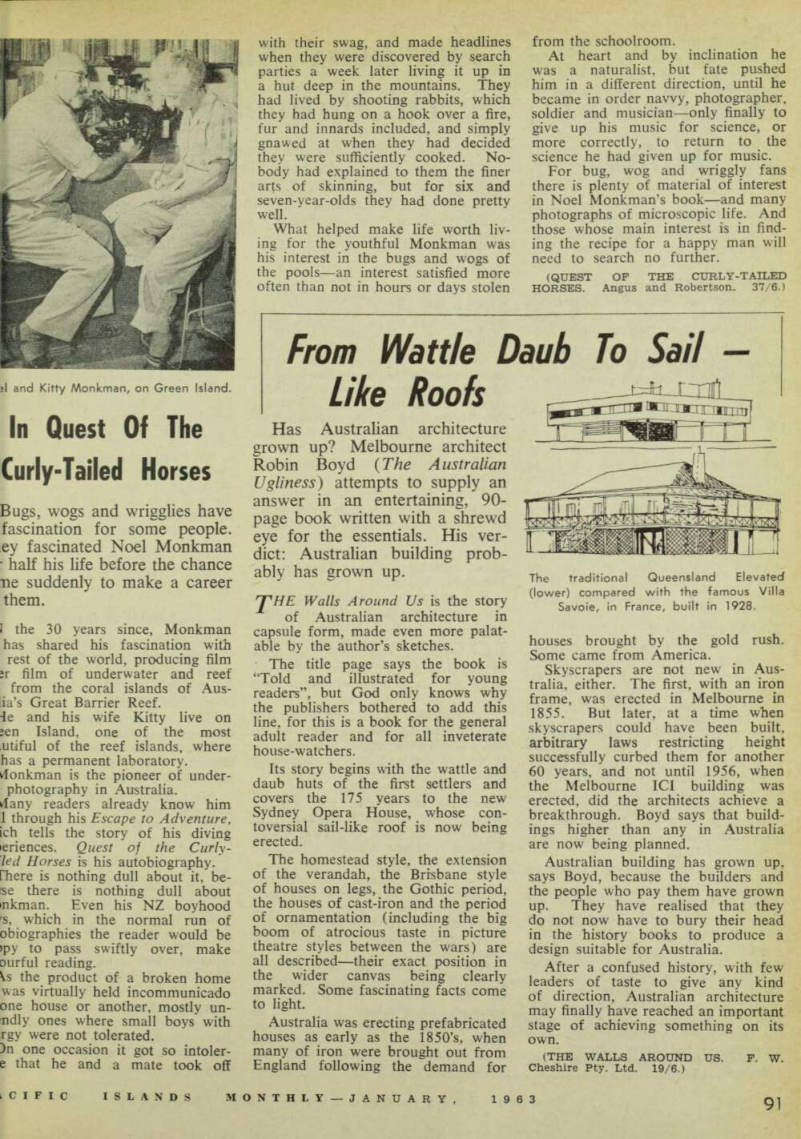
The homestead style, the extension of the verandah, the Brisbane style of houses on legs, the Gothic period, the houses of cast-iron and the period of ornamentation (including the big boom of atrocious taste in picture theatre styles between the wars) are all described—their exact position in the wider canvas being clearly marked. Some fascinating facts come to light.
Australia was erecting prefabricated houses as early as the 1850’s, when many of iron were brought out from England following the demand for
houses brought by the gold rush.
Some came from America.
Skyscrapers are not new in Aus tralia, either. The first, with an iron frame, was erected in Melbourne in 1855. But later, at a time when skyscrapers could have been built, arbitrary laws restricting height successfully curbed them for another 60 years, and not until 1956, when the Melbourne ICI building was erected, did the architects achieve a breakthrough. Boyd says that build ings higher than any in Australia are now being planned.
Australian building has grown up, says Boyd, because the builders and the people who pay them have grown up. They have realised that they do not now have to bury their head in the history books to produce a design suitable for Australia.
After a confused history, with few leaders of taste to give any kind of direction, Australian architecture may finally have reached an important stage of achieving something on its own.
(The Walls Around Us. F. W.
Cheshire Pty. Ltd. 19/6.)
The traditional Queensland Elevated (lower) compared with the famous Villa Savoie, in France, built in 1928.