No Pidgin
pp. 85-86 · Read in the full issue
English For These New Guinea Youngsters!
By Rev. Dr. Ralph M. Wiltgen, SVD Divine Word Missionary
)IDGIN English is not tolerated at Bundi. It was resolved at the eginning and has been rigidly ad ered to since that teaching should be one entirely and exclusively in Eng sh.
When the United Nations mission, eaded by Sir Hugh Foot, visited the rust Territory of New Guinea in 962, it singled out the Bundi school nd its founder for special praise be ause they had succeeded in making □ many small children fluent in Eng sh.
The UN Mission flew to Bundi just 3 see the school, and stayed nearly ivo hours visiting classrooms, asking uestions and talking to pupils.
Sir Hugh Foot said in a letter to father Morrison afterwards: “I can onfidently say that no school we tave seen gave us greater pleasure ►r encouragement than this school in he mountains.
“Our visit to you convinced us—if ye needed any convincing—that it
is essential to by-pass Pidgin and go straight for the teaching of English from the beginning, “Only by this means can the younger generation be given the kind of confidence which your children so strikingly display.”
The Divine Word Mission has had a. station at Bundi since 1933. When the first missionaries arrived, the area was virgin forest. To build an airstrip, the missionaries had to level a moun tain top, and this they did with out the aid of machinery. The air strip is 2,100 ft long and 4,200 ft above sea level.
When Father Morrison was as signed to Bundi Mission in 1957, one of his first tasks was to start a school, As Bundi is isolated, he decided to make his school different from the usual government and mission schools.
Instead of taking youngsters eight and 10 years of age, he decided to admit those of six to eight. Instead of
spending a year or two on Pidgin English, he decided to use English from the start. And instead of start ing with a day school, he decided to start with a boarding school.
The lack of roads, the distance from outlying villages, and the heavy rainfall (220 inches a year) dictated the boarding school policy.
In January, 1958, when the call went out for prospective students, some 50 boys, mostly from neigh bouring villages, responded. Of these, 36 were chosen in the six- to eight year-old range, the remainder being refused admission because of “old age”.
A graduate from the Native Teachers’ Training College of the Alexishafen Vicariate was sent to Bundi as a teacher, and the school opened on February 1, 1958.
To feed the 36 boarders, relatives and friends of the boarders trudged long miles over jungle paths with weekly supplies of sweet potatoes.
Then came Max David, Bundi’s first lay missionary, who soon put the food situation on a more satisfactory footing. Brother David is a graduate of the Hawkesbury Agricultural Col lege, near Sydney.
With the help of hundreds of chil dren in the vicinity of Bundi, he planted gardens of sweet potatoes, taro, soya beans, peanuts, bananas, cabbages, string beans and many other plants, the seeds of which he received from friends in Australia.
Twenty girls were admitted to the school half way through the first year.
“There being no female teacher on the station at that time, we were very hesitant to start with girls in a board ing school,” Father Morrison says.
“But serious difficulties had been experienced in other areas where the boys had been educated and not the girls when an educated male had tc seek an uneducated wife, “This resulted in a subsequent re lapse in the educational standard ol
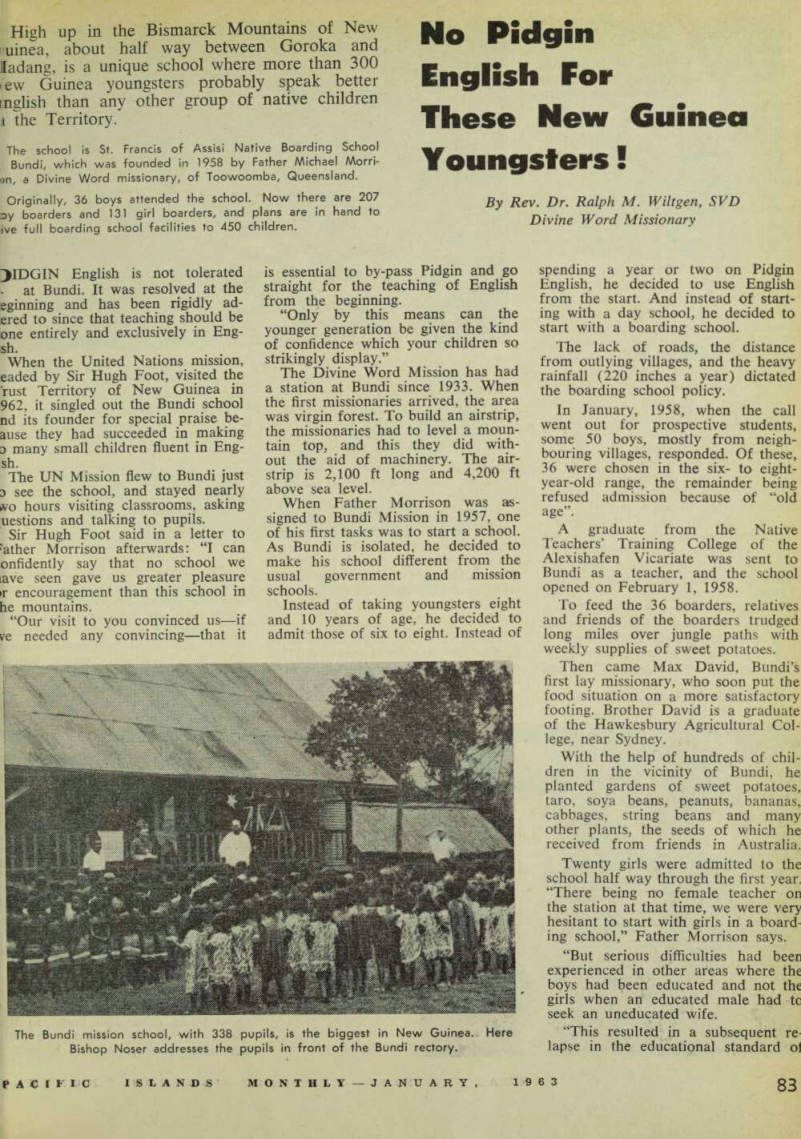
The Bundi mission school, with 338 pupils, is the biggest in New Guinea. Here Bishop Noser addresses the pupils in front of the Bundi rectory.
the children, as basic progress in edu cation begins with an educated mother.”
According to Father Morrison, the children “adapted themselves wonder fully to the boarding school system, even those 40 per cent, who were so far from their villages that they could not enjoy week-ends at home”.
The main difficulty in the first year was supervising and assisting the native teacher.
In 1959, 69 boys and 31 girls were enrolled, and the school became offi cially registered in the category of Territory Primary School, 3rd class.
This is the highest rating that can be attained outside of rating on the Aus tralian syllabus.
“While we feel sure we could attain rating on the Australian syllabus,”
Father Morrison says, “it is imprac tical for us to do so as we would then be deprived of Government financial help in school materials, which we could ill afford to lose”.
In January, 1960, a lay missionary couple from Melbourne, Mr. and Mrs. B. J. Green, joined the teaching staff. Mr. Green, who had been a teacher and head teacher with the Department of Education in Victoria for more than 20 years, became head teacher of the Bundi school.
With the arrival of the Greens, the admission age was lowered to six and seven years. About one-third of the new enrolments were girls, and the total number of students reached 235.
Mrs. F. J. Morrison, Father Morri son’s mother, who had been a teacher with the Queensland Department of Education for 19 years, joined the teaching staff in Janunary, 1961, and so did her husband.
This made it possible to lower the
age limit for admission to five and six years. More than half the new pupils were girls.
At the end of 1961, all children who were not meeting the standards set were weeded out. Father Morri son had found by then that children who started at the school between five and six were better student material than those who started at seven or eight.
“The younger children adapted themselves to the school syllabus much better than the older,” he says.
At the beginning of last year, the enrolment age was reduced still fur-
ther to five. Half of the new pupils were girls, and the total enrolment! was then 338.
These pupils were divided into 125 classes of 30 pupils or less, with one: exception, and the 12 classes were; divided into five grades.
The school then had 14 teachers* —seven New Guineans and two male: and five female lay missionaries. Six: other male lay missionaries, together' with Brother David who had estab lished a sawmill to provide timber for the constantly growing school,, looked after other needs.
Pastoral work is taken care of by' Father Morrison, Father Anthony' Javorski, from Slovakia, and Father ■ Essel (diocesan priest) from Mainz, , Germany.
The Sisters of Charity at Potts Point Sydney, will probably send three nuns to the school as teachers this year when the school’s enrolment is expected to reach 400.
The school will soon be extended to include a Junior Agricultural School and a Technical School for training cabinetmakers.
For this, Father Morrison would like financial assistance from the United Nations. Although the alloca tion cannot be made directly, Sir Hugh Foot promised to see what he could do.
“The Agricultural School must come if our boarding school is to flourish,” Father Morrison says, “and some trade must also come to the area if the children are to use their schooling to advantage at home”.
When Max David (left) arrived at Bundi to begin his lay mis sionary career, he at once began giving Father Morrison (right) competition beard-wise and soon outdistanced him.
Max David is a trained agriculturalist from Australia and runs the Bundi Mis sion Farm which keeps the boarders well fed. Mrs. Green (centre) is a lay mis sionary teacher in the school.
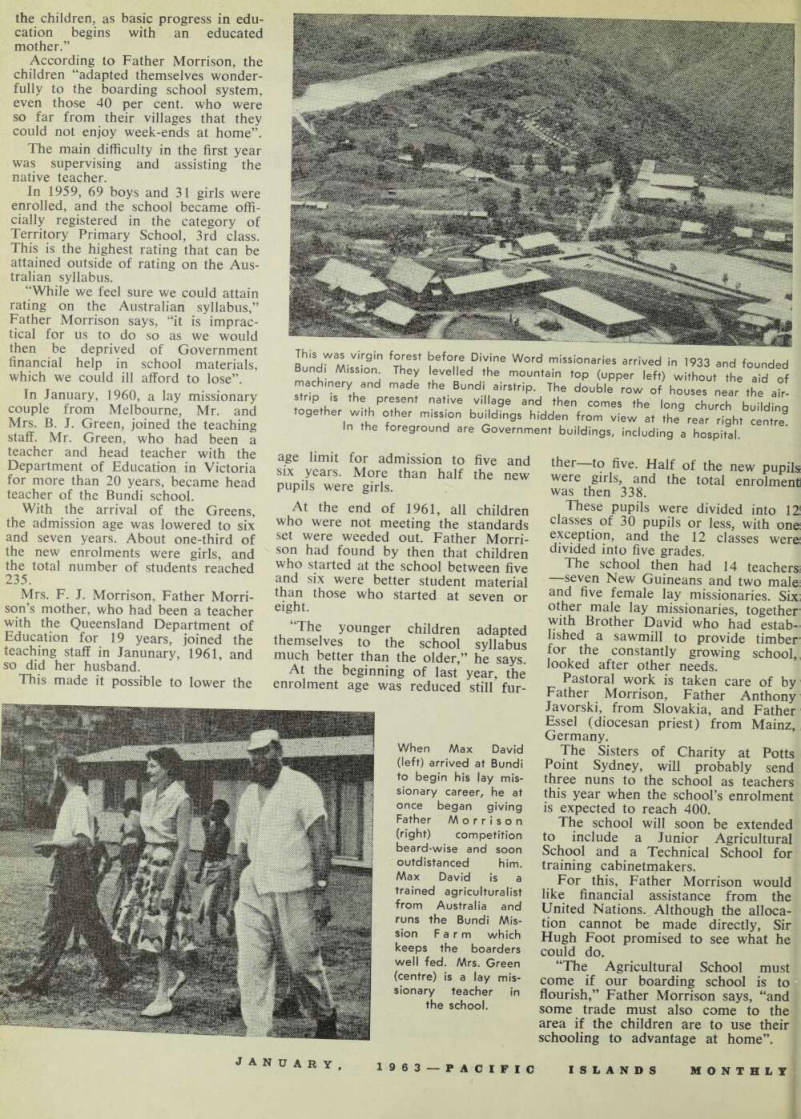
This was virgin forest before Divine Word missionaries arrived in 1933 and founded Bundi Mission. They levelled the mountain top (upper left) without the aid of machinery and made the Bund, airstrip. The double row of houses near the air strip is the present native village and then comes the long church building together with other mission buildings hidden from view at the rear right centre In the foreground are Government buildings, including a hospital