Disturbs Government
pp. 73-78 · Read in the full issue
Highlights Of The Budget Session
Fiji's Birthrate Increase Disturbs Government
From our Suva Correspondent Fiji is concerned about the problems that will arise if the Colony’s “population explosion” continues. Two references to birth control were made at the Budget session of the Fiji Legis lative Council, one by the Governor, Sir Kenneth Maddocks.
JIR KENNETH told the Council " that Fiji’s economic well-being quired a considerable reduction in ie birth-rate of all races. It was the oyernment’s policy, he said, to dis minate information about family anning as widely as possible. The irrent facilities of 12 clinics would ; extended next year to all 51 Gov nment dispensaries.
The Financial Secretary, Mr. H. P. tchie, said that the economy was owing signs of improving but that any difficulties still lay ahead aking it necessary to press forward quickly as possible with plans to 'rease production of all sorts. He :nt on: “At the same time, I consider that e of our most urgent needs is a luction in the rate of population :rease, and I hope that proposals • accelerating family planning will ar fruit rapidly.
“I would emphasise these two ints most strongly—the need both increase productivity and to slow svn considerably the population »wth. Both must go together and •elieve that if they can be achieved standard of living of the peoples Fiji will increase.”
Fiji s population is now about ),000, 205,000 of whom are Indian I 175,000 Fijian. The Indian birth e last year was 44 per 1,000. 3ther points made in the Fiji Bud session were: The Common Market dr. H. P. Ritchie said Fiji stood gam if Britain entered the Com n Market. He said that the prob -5 effects would be that Fiji would e to give imports from member 1 associated territories the same itment she gave at present to im ts from the Commonwealth.
Tius imports from the “Six” and nch territories in the Pacific would the same rates of duty as did orts from Britain.
As far as Fiji’s near neighbours of Australia and New Zealand were con cerned Fiji could permit them to en joy the present low rates of duty.
That choice would remain with Fiji.
Mr. Ritchie said Fiji would remain free to levy duties for revenue and protective duties to assist the Colony’s development.
On the export side Fiji would get the same treatment from other asso ciated territories as those territories gave to the Six and their associates.
Under Article 133 of the Rome Treaty, which provided that members should progressively reduce Customs duties to nil, the effect would be that once that stage was reached Fiji’s produce would enter Common Market countries free of duty, and would enjoy tariff preferences in most cases against non-associated countries.
Negotiations on Fiji’s main export —sugar—were not complete, but Britain was insisting that the Com monwealth Sugar Agreement should continue till the end of 1969, when it is due to expire. (In practice up till now the agreement runs for eight years and each year when a new price is negotiated the agreement is ex tended for another year.) Britain was proposing that the agreement should be continued after 1969, or that the enlarged community should give equivalent benefits to the Commonwealth countries concerned, (Under the Commonwealth agree ment Fiji and other producers enjoy a price preferential which has risen as high as £3O above the world price.) Mr. Ritchie said that of particular interest to Fiji was the Common wealth Market Development Fund which existed to help associated terri tories. If Britain joined the “Six”, Fiji could expect to get aid from an extension of the fund, financed by Britain and other new members, and perhaps also from further funds con-
ibuted by the present members.
The fund provides aid in different ays: • It grants subsidies and loans i special terms for the economic id social infrastructure and for pro cts of a productive character of iblic importance; • It can be used to ease interest irdens and to help finance local abilisation schemes; and • It can be used to provide tech cal assistance, scholarships and fel wships.
Summing up, Mr. Ritchie said: “My view is, in short, that pro led our sugar exports are safe larded, it is to our overall advantage Britain joins the Common Market d if we become an associate.”
Copra Criticism
A warning that copra grading ight be introduced in Fiji unless the ality improved was given by the >vernor. Apart from a lower output s quality of the copra sold had en decreasing, Sir Kenneth said.
For some time copra arriving at va had been under observation and ts showed that moisture and free ty acid contents were rising adily.
“Unless there is a marked improve mt some form of copra grading ght have to be introduced,” he d.
He said he was aware that in 1956 measure to provide for the grading copra was withdrawn in the face opposition by growers. However, ; Government could not stand by i allow the quality to continue to teriorate. If there was no improve int legislation would have to be icted and enforced. ‘lt cannot be too strongly empha ;d that if Fiji is to earn a good
living from its produce, then the pro duce must be of high quality,” he added.
Better Telephones
Sir Kenneth Maddocks forecast that by 1964 telephone subscribers at Suva and Lautoka would be able to dial each other directly.
Contracts had been placed for the supply of equipment for the link, which would be a micro-wave system.
Subsequently this would become the main artery of a system which would serve the whole of Viti Levu. Part of the project is a new automatic ex change to be built at Lautoka.
Civil Service Referring to the Fiji Civil Service, Sir Kenneth Maddocks said that about 91 per cent, of the officers were of local origin.
He said the process of localisation of the service would continue within the limits imposed by the need to maintain efficiency and to secure a balanced distribution of posts between Indians and Fijians.
Overseas officers who come to Fijji in future would be on contract, which should eventually mean a big saving in pensions, and a reduction in the number of long-term officers. (Over)
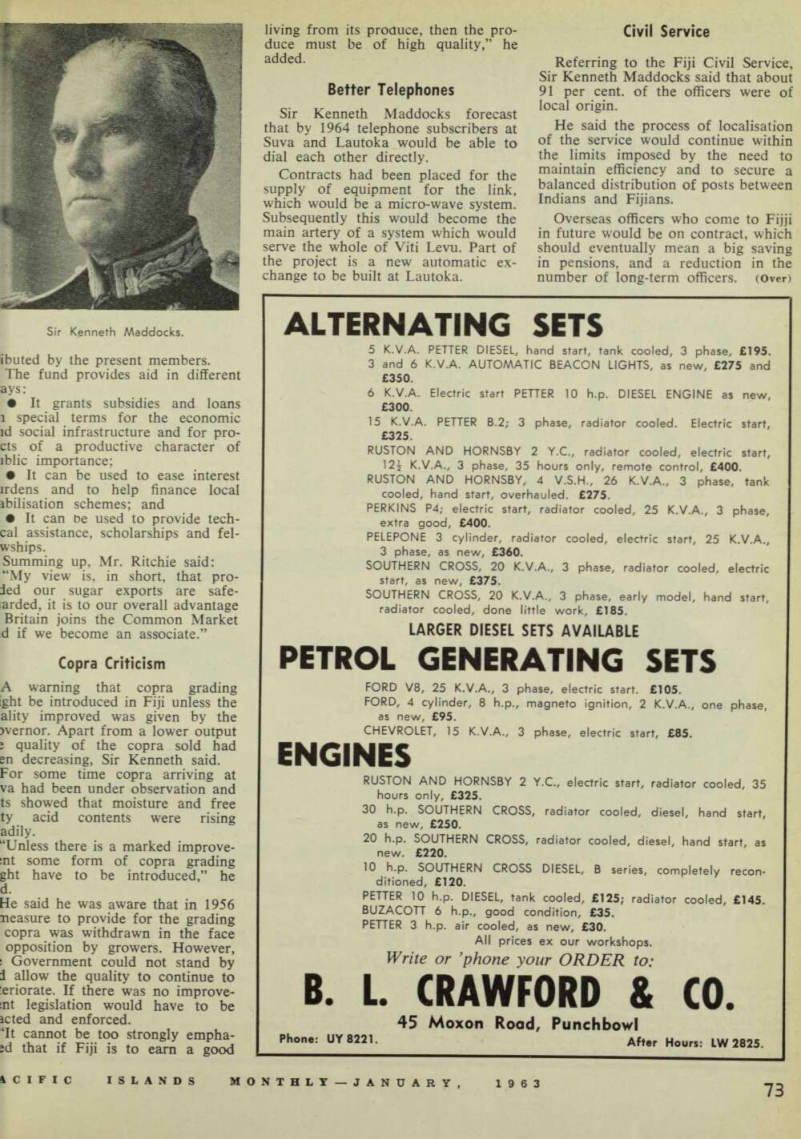
Sir Kenneth Maddocks.
[Employing officers in contract for united terms of three years means uat when local men are capable of llling posts the Government is not jp for heavy commitments at the nd of a contract officer’s term.] The Governor said he was pleased nat local people were being trained or more responsible posts in com nerce, but that there was room for wider and more vigorous applica ion of the principle. He hoped that 11 employers would adopt it.
The Governor spoke before heads If departments were called before lie unofficial members of the council sitting as a Select Committee) to splain their financial requirements iir 1963.
One departmental head, Mr. T. A. [andford, acting as Police Com lissioner, said that in the police force le right type of men for promotion ) senior posts had not become avail ile.
Mr. Handford agreed that the sub antive head of the department, Mr. . H. T. Beaumont, had said some sars ago that in seven years or so e hoped to fill vacancies in the senior rades by promotion of local officers.
Mr. Handford said it was essential lat standards of efficiency should be laintained. If suitable officers could ot be obtained locally, they would ave to be got elsewhere.
All posts which had recently been [led from overseas were either posts jquiring specialist qualifications, or aes for which there was no suit ile local person. He did not mean y that that there would never be litable local candidates for pro lotion.
In 35 posts classed as senior (assis mt superintendent to commissioner) fere was one locally-born superinten ;nt, one local deputy superintendent, id one local assistant superinten ;nt.
Police to Serve Elsewhere Fiji police will be allowed to serve i other Pacific territories, and icmbers of other police forces may ;rve in Fiji under a law passed / the Council at the Budget session.
The law was introduced at the iggestion of the Secretary of State ir the Colonies who had asked if iji could assist if the internal situa jn in West Pacific territories was isatisfactory.
However assistance would be given itside the Colony only if the internal tuation in Fiji was satisfactory, ut no policeman would be sent rerseas against his wishes.
Ratu K. K. T. Mara (a Fijian ember), although agreeing with the
move, startled the council when he announced: “When the day comes that there is no Fijian to defend the Queen’s peace and interests of this territory so that someone else has to come and defend it, it will mean there will be no Fijians left, “But I hope I will not live to see the day when we will need their help to send forces over to Fiji to maintain law and order. Fiji is the foremost British territory in the Pacific, and of the dependent territories, Fiji is the foremost in loyalty anywhere in the world.”
Nadi Airport
Expansion at Nadi International
Airport in 1963 will cost £1,125,000, provided the member governments of the South Pacific Air Transport Council (Australia, New Zealand, and Britain agree). This figure was given at the session. The biggest item is £628,000 for maintenance and recurrent expenses which, alone, is more than double the estimated revenue of £305,000 for 1963.
Other proposed expenditure in eludes: • £24,000 for capital items; • £BO,OOO for parking space to cope with increased jetliner traffic; • £lOO,OOO to complete the new operations building; and • £60,000 for proposed new hous ing and other buildings. (Over)
The New Zealand Government pays 20 per cent, of the capital cost, while Britain and Australia pay equal shares of the remainder.
Perhaps that inconvenient staircase in the new terminal building may go.
Well-known to air travellers, it has been under constant criticism since the new terminal building was opened in February, 1960.
A hint that it might be eliminated was dropped by Mr. H. P. Ritchie who was asked if it would be possible to do away with the need for pas sengers to use the stairway. Mr.
Ritchie said the Government “was hopeful” the staircase could be eliminated.
The annual debate on the Fiji Budget gives unofficial members of the Council the chance to range far and wide over many topics. It is traditionally the wordiest debate of the year, and 1962 looked like being no exception for there is a general election in the offing.
There was a major sensation when the debate collapsed suddenly after only one member had spoken. This was Mr. H. B. Gibson, the European member for the Eastern Constituency who traditionally starts the debate rolling on the budget.
Each year after Mr. Gibson has
finished unofficial members show t reluctance to rise to their feet to coni tinue the debate. It is little use ar official member getting up, for he han nothing to offer till he knows wha* the unofficials are going to say. Bui many of the unofficial do not warn to speak till they hear what theii colleagues have to say—they jocke: for positions in the debate.
The silence went on so long thii year that the Speaker, Mr. Maurice Scott, warned that if nobody wanted to speak he would have no option but to put the question that thu Estimates for 1963 be adopted.
The silence continued and he a second warning, adding: “It seemr extraordinary to me”.
When there was still a reluctance to speak Mr. Scott put the motion* which was carried on the voices.
It transpired later that severe unofficial members had speeches pr© pared and were ready to deliver them but each had been waiting for the other. They were astounded wheie the axe fell. One Fijian membea who was out of the chamber at thii time was amazed when he returnee to find it all over.
The unofficial members had no onn but themselves to blame for the som mess.