Tropicalities
pp. 19-25 · Read in the full issue

Western Samoa is at present going through a rush of rubber stamps to the head. Like form filling and breathing hard while wading even the fine print, it is a symptom of the newly independent State which should clear up in time.
'n the meantime, the new officials love it, even if it does drive the European visitor up the wall.
RAVAIL really begins on the short air hop between Tafuna Faleolo when the visitor of even sw days (who already has got a nit to Enter) is asked to fill in a stionnaire that, apart from the id information that officials thirst r, wants to know such things as r mother’s and father’s birth >es. You are also asked to emnly swear” to obey the laws Western Samoa. s one official said to us in Apia other day, Western Samoa doesn’t t an influx of visitors and likes eep an eye on those that do come, umably it just helped someone to » an eye on us better by knowing our mother was born in an ure little village in Victoria, xalia. fter this, landing formalities are nore than receiving the appropri rubber-stamp in your passport (at the time) the rather mystify official invitation to “come and me Wednesday,” or whatever •ens to be about two days prior our scheduled departure.
How to Exit
r Wednesday—or whatever S (for p) Day you happen to have— will have read the notice on the tboard at Aggie Grey’s about necessity for getting your pass stamped with an “exit permit”, will probably have been told le dire fate of the three recent lese visitors who didn’t, so you present yourself at the Immigra- Office in the Police Department ing. aen we arrived the officer was “clearing the Tofua ” so to fill ne we stepped into Police Super dent A. L. Philipp’s office, »y. The Superintendent was born exas and comes quickly to the übbish,” he said, “All that went ast year. Since the beginning of there has been no need for
visitors of a few days to get exit permits.”
Well, we said, the acting Govern ment Secretary gave us to under stand they were necessary, presum ably as a final check on these people they like to keep an eye on. And what about these Japanese?
Those, said Supt. Philipp, were unfortunate. The man who usually does immigration duty at the airport was sick on that day and the relief sent out knew only the 1961 law, not the amended 1962 version. This man wouldn’t let the Japanese on the plane so they had to drive 25 miles back into Apia for the necessary rubber stamp to be put on their passports.
By the time they had again driven 25 miles back to Faleola the plane, of course, had departed.
But Who Knows?
We don t know whether Superin tendent Philipp on that occasion ex plained to the unhappy Japanese that there had been no need for a stamp in the first place, but we fancy they were mad enough in any case.
The trouble with some Govern ment officials, said Supt. Philipp, is that they don’t know their own law.
He could assure us that the law said “no exit permit necessary.’
Fine for us to know it. we thought; but we’re still in the soup if no one else knows it.
Nonetheless we hadn’t the nerve to go straight back into the Immigra tion Office but went away quietly and privily consulted the hotel (which reiterated that the stamp was neces sary); the local airline, which was of the same mind; and the New Zea land High Commissioner who said that although he believed that it wasn’t legally necessary, it was as well to be on the safe side and get the passport stamped.
So on the Thursday, sneaking in under Supt. Philipp’s eagle eye, we visited the Samoan Immigration Officer.
“Is this stamp really necessary?” we asked.
“Yes,” he said. “Sit.”
We sat. He opened the passport, grabbed a rubber stamp, pushed it firmly into a blank space, scribbled his name. The stamp said; “Seen.
Bearer is permitted to leave for Tahiti via Pago Pago.”
Honour was satisfied. We were cleared for take-off.
A few days previously we had been in the Inland Revenue Depart ment on quite another matter con nected with statistics. \Vhile we were talking to the official, out of the blue he dived for a piece of paper, scribbled on it and said, “Here, you might as well have this now you are here.”
It said: Taxation OK. Immigration Officer for clearance purposes only.” \Ve don t know what year’s law he was working on, or whether he was just projecting into the future.
But since, anyhow, we were never asked to produce it, we’ve just put it away tenderly amongst our SOUVCnirS - (Over)
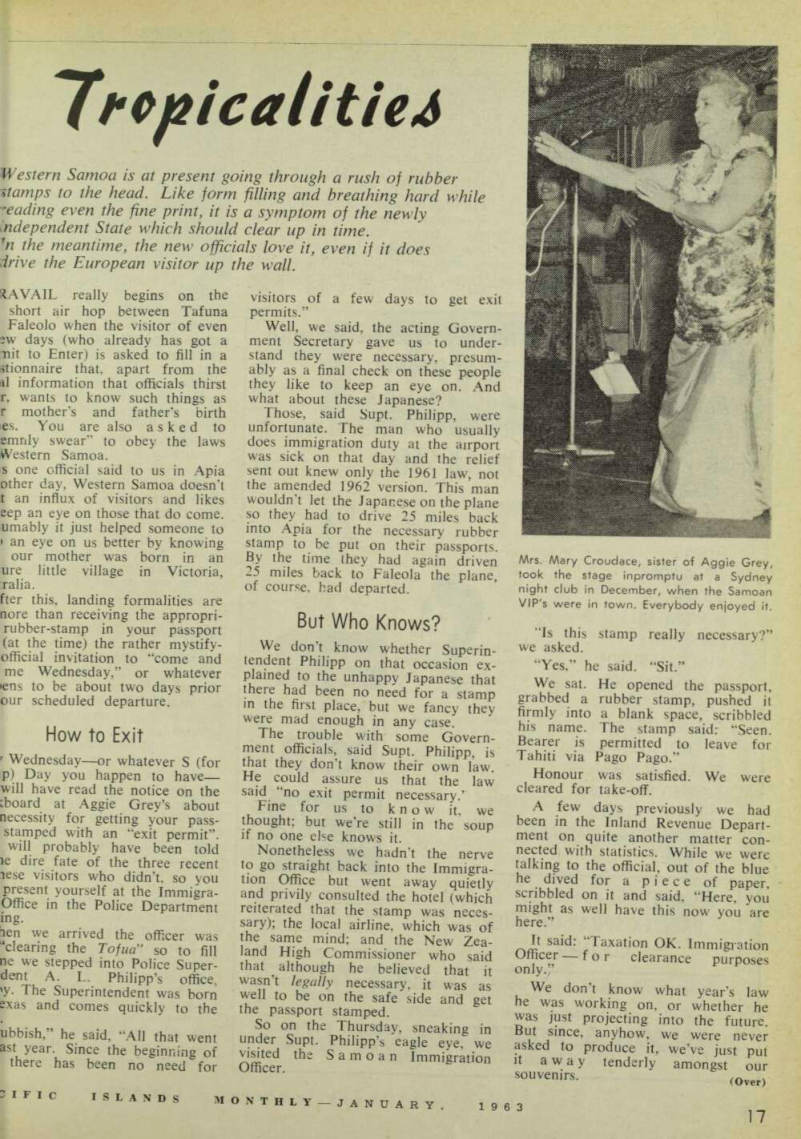
Mrs. Mary Croudace, sister of Aggie Grey, took the stage inpromptu at a Sydney night club in December, when the Samoan VIP's were in town. Everybody enjoyed it.
VIPs Come to Town WE don’t know what it cost Pan American Airways in December to bring to Sydney that big party of VlP’s from America, Samoa and rip, and we suspect PanAm itself hasn t totted up the bill yet. But they cer tainly did the job in style, with the best hotel accommodation (TV m your room), and tours and shows laid on.
A number of well-known Islands faces were both seen and heard asleep at the ballet, but this, they assured us later, was no reflection on the ballet performance —merely an indica tion of the extent of hospitality which
had kept them awake for 72 hours.
As long as you are prepared to work on the old adage that it doesn t matter what the newspapers say as long as they say something, PanAm must have been more than pleased at the space the VIP invasion rated in the Press. Titles and spelling were mixed with abandon, and no reporter ever satisfactorily settled the point of who outranked who.
All the mainland Americans were millionaires, Aggie Grey’s hotel was moved from Apia to Pago and Governor H. Rex Lee couldn t get into the same paragraph as Suva Mayor Charles Stinson without Charles having star billing. Prime
Minister Fiame Mataafa was pll Mr. Mataafa, and his Independl State somehow managed to be owi by New Zealand still.
What the newspapers didn’t mi tion was the fact that the inaugu flight from Pago to Sydney dir which was what all the hoo-haa T about, wasn’t inaugural at all. By time PanAm got the VlP’s aboard Pago, plus their luggage, the aim didn’t have room enough to sp for the fuel. Problem: Were they offload a handful of VlP’s or toi down at Nadi and top up the 1 tanks? Answer: Stop at Fiji!
The return direct flight Sydney Pago got inaugurated, thank hea T Among the VlP’s on that flight Jim Macdougall, doyen of the Syd columnists, who in Honolulu mans to get the same sort of Press tn ment as our boys gave the Ameri party—i.e.: The space was there the facts weren’t too good.
The day after Jim’s arrival phone was running hot over a Ha lulu Star Bulletin story reporting as having turned thumbs dowm Honolulu’s hotel, beaches and g The locals were most irate, reader even quoted at Jim a i story which made some unfavour remarks about some Austra beaches.
Explained Jim, sweating at brow; “I didn’t say anything lik: I was taken for a ride by a locaj porter who did all the talking w I just grunted.”
Bloody Mary
AGGIE GREY was billed wide; Sydney as “the original Bid Mary”.
“Just fancy,” said an incredu Sydney Press photographer toe “She admits it!”
It would be more accurate to not that Aggie admits it, but tha* doesn’t deny it. She used to den but has long since given up.
The fact is that Aggie Grey w Michener’s Bloody Mary.
Aggie Grey is not sure who str that rabbit running, but the firstJ she ever saw it in print was in W\ Price’s book, Adventures in Pan published in 1956.
Perambulating Price referred tt as “boarding-house keeper and p type for Bloody Mary”.
Later Aggie went to American was astounded when she steppe the ship at San Francisco aneb received by a big party of Pres; insisting she was Bloody Mary..' known to Aggie, the Press offica the ship had spread the good Aggie didn’t particularly enthuse; it, and when on her trip throug
it became clear that the reputation going to stick anyhow, she finally ght up with James Michener 10 had stayed at her boarding se during the war) and asked him it blank, lichener replied (the old •othie): “Only the good parts of ody Mary are you, Aggie!” loody Mary was a fictitious racter and Bali Ha’i was a tious island—although people still itify the “real” Bali Ha’i as just ut every island from Bougainville Vloorea. ostscript: We know an untold y about Bloody Mary’s true itity, and this must be the time it. Bloody Mary was really a Jdnese woman who, we were told 1960, was “now living along the 1 between Vila and the airstrip”, were told New Hebrides identity Tge Hill knew her well. When we ; visited the New Hebrides we ; to ask George to take us to her. fe visited the New Hebrides soon r. George Hill died the day be we arrived. aim's Fan HEN Queen Elizabeth, the Queen Mother, visited Sydney in 1958 was presented with a pandanus made by the people of Pitcairn id —and she made good use of it in the heat of Queensland and iritius. ow her daughter, Queen Eliza , will be in Sydney in a month wo and she, too, will have a urn fan. rrangements for the presentation been made through the ernor-General by Mr. and Mrs.
3 . Ward, Seventh-day Adventist
lonanes on Pitcairn from 1938 to , who also arranged the 1958 mtation. le Wards are now retired but a
large part of their heart is still on Pit cairn. They keep in very close touch, and know more Pitcairn news than anybody outside of Pitcairn. They are also excellent publicists for the island —occasionally giving talks and inter views.
One room of their cottage at 10 Donald Street, Carlingford, Sydney, is kept for their Pitcairn “treasures”, which are added to from time to time as the Pitcairn mail arrives. The room is a storehouse of Pitcairn handcrafts.
There are model sailing ships, bowls, vases and ornaments of miro wood from Henderson Island, beauti fully carved walking sticks, decorated
pearl shell, pandanus baskets, bags and fans, pressed and painted leaves.
There are many souvenirs of the Bounty itself—pieces of metal ballast, threads of the hempen cable attached to the anchor (which was in the sea from 1790 to 1957), pieces of flint from the Bounty’s tinder box, a small piece of the Bounty’s rudder, and a selection of the hand-wrought copper nails made by the mutineers to build their houses, or pulled from the Bounty’s timbers (some of the nails are today still in the timbers of Pit cairn homes). There are also many of the stone implements used by the people who populated Pitcairn at one time and of whom nothing is known.
?e of the Pitcairn relics and handcrafts the Sydney home of Mr. and Mrs.
F. P. Ward.
also found when we visited Wards recently that they had a all supply of their 64-page booklet, me Ashore, A Peep at Pitcairn md, which they wrote while on cairn, and which is otherwise only lilable on Pitcairn. The booklet a collector’s item, but the Wards J us they would sell the remaining »ies for 5/- plus postage—and we ommend the bargain!) fhe Wards went seven months hout mail on Pitcairn during the r —when 300 letters finally turned in one batch. But the next gap s twice as long—l 4 months with mail. Five letters finally turned at the end of that—all the others 1 presumably been sunk.
J Bomb Man GORDON KEYS, the man who knows more about the auroral plays of H-bombs in the South fific than anybody outside of a all group of American scientists, Apia for NZ in December after : years in Western Samoa. But he 1 still be interested in bomb eras, for he will continue this and er studies at Central Otago, jordon Keys has been in charge of Mulinuu (Apia) Observatory se last five years. He and his irming wife, a Cook Islands girl, 'e been among Samoa’s most popu residents. Keys is one of those ; polite, patient fellows it is im sible to rattle; to whom nothing any trouble.
Je kept a check on the auroral slays produced by all of America’s :ific high altitude H-bomb blasts.
He saw the first one by accident when at midnight on August 1, 1958, he happened to be at his front door as the sky lit up. America had let off a bomb at Johnston Island, 2,000 miles from Samoa, without any prior announcement.
No doubt Keys would insist that it was dead easy to keep a check on the later ones because times and dates were announced beforehand. But we know something ourselves about the difficulties of bomb watching, and we would advise you not to fall for that.
We can remember, as if it were yes terday instead of last August, squat ting on a mountain in American Samoa from 4 p.m. one day to 3 a.m. the next, waiting for a bomb that never went off—one of a whole line of H-bombs that never went off.
There we were with our cine camera, tape recorder, transistor radio, package of sandwiches, crate of Melbourne Bitter and bottle of insect repellant, just waiting for the night sky to blaze up in red and blue with white streaks through the middle— but we ended with a wet behind.
The first few hours were dramatic enough.
“This is April Weather,” boomed our transistor, “transmitting on Operational Countdown. . . . This is April Weather, transmitting on Operational Countdown—This is . .
Time passed. “This is H-minus 60
minutes,” boomed our radio, all the way from Johnston. “Next call time will be H-minus 50 minutes. All forces at any distance, except those outside the danger area, must avoid use of binoculars, telescopes and other optical instruments to avoid possible eye damage.”
All good stuff. However, time passed.
“There has been a hold,” said our radio. “I repeat, there has been a hold. Time is now H-minus 60 minutes.”
Time passed. “This is H-minus 50 minutes,” said The Voice. “There has
Mr. and Mrs. J. Gordon Keys.
i:en a hold. I repeat, there has been hold. Next call time will be H iinus 1 hour and 30 minutes.”
Up on our mountain near Pago the xisquitoes had long since licked off je repellant and the rain came down :e in Maugham’s book. The track our mountain top turned into a joving river of clay, and even if that »mb had gone off we couldn’t have :en it through the storm thrashed Ims.
But the bomb didn’t go off.
They held it and they held it, until lally in the early hours the voice mounced that “the event scheduled ir tonight has been cancelled”.
They cancelled it the next night, o, and the next, but the night after at the thing blew up before they ien got it off the ground. We weren’t ere. We had long since left the task bomb watching to rare, polite, tient fellows like Gordon Keys, 10 was doing the job properly on s own mountain near Apia. e'll Regret It 3HE Pacific is such a widely scattered place that it takes us our time to keep tab on what is ppening in it without reading the rrespondence columns of the mdon Press. But more’s the pity, r we missed at the time an interest g letter in the London Times of jgust 21, from Sir John Gutch, igh Commissioner Western Pacific tween 1955 and 1960. If Sir Gar- Id Barwick, Australia’s Minister for Jemal Affairs, also missed seeing we would, respectfully, like to are our discovery with him: “Your leading article in today’s ue [wrote Sir John] appears, like ' West New Guinea agreement it f. to place the Papuans last in Jer of consideration in this matter, icreas surely their interests, primi e though many of them still are, mild have come first.
“Only the Dutch who, as their ime Minister has made clear, gave to Indonesian aggression because ;y could not count on the support their allies, seem to have expressed alms about the future of the puans. ‘During the next nine months the itch administrators whom they know d trust are to be replaced by a atch United Nations team with no owledge of their country or their rtoms. This may, as you suggest, wide experience from which the lited Nations can profit, but I doubt ether it will bring much profit to > Papuans. ‘This interim period is to be fol ded by Indonesian rule in prepara n for a plebiscite before the end of 59, but who can seriously believe
Kobenhavn
that a fair expression of the Papuans’ wishes is likely to result from this arrangement?
“No doubt the Indonesian pro gramme will include as a first step the elimination of any Papuans who have been prominent under the Dutch regime.
“I cannot see that anyone is to be congratulated on the outcome of this protracted dispute except the Indo nesians who are getting what they want and I have little doubt that in the long run this sacrifice of Papuan interests to expediency will be the cause of more serious trouble than has been averted.
“Australia, in particular, will have every reason to regret the admission of an unreliable and aggressive neighbour into her backgarden and onto the threshold of the Pacific.”
As WPHC, Sir John was one of those who would have been glad to see some sort of political association between West New Guinea, P-NG and the BSIP (“if that’s what they decide in their own time,” he once told us).
His outspoken comment to The Times on Australia’s position is thus important.
Above is the Danish ship "Monsunen" and, below, the nameplate given to Mr.
Reece Discombe at Vanikoro.