Church Self-Governing
p. 12 · Read in the full issue
Significant Step: Papuan Church Self-Governing
The Papua Ekalesia—the first church to reach autonomy within Papua-New Guinea —will continue to move towards union with other churches in the Territory.
MOVES towards union have in the past been made by the London Missionary Society, which has “fathered” the new Papuan church, and these efforts will be discontinued, even though the Papua Ekalesia has its own self-governing Assembly as authority.
The Papua Ekalesia came into existence in P-NG on November 21 —the 88th anniversary of the land ing in Port Moresby in 1874 of Dr.
William Lawes, Pa p u a’s first missionary and European resident.
Dr. Lawes brought with him LMS experience on Niue Island, and also the word “ekalesia”, which is a
Samoan version of the Greek word meaning assembly of people.
The word has now gone into the languages of Papua, so that thousands of Christians regard it as being synonymous with church. “Are you an ekalesia?” means “Are you a member of the church?” For this reason it was regarded as a fitting choice as the name of the new Papuan church.
The governing body of the Papua Ekalesia comprises about 30 Papuans, 20 Europeans and some South Sea islanders.
The LMS in Papua has now virtu ally ceased to exist, except as a legal entity. The Rev. D. E. Ure, secretary of the LMS, has become the secretary treasurer of the Papua Ekalesia.
First chairman of the Assembly is the Rev. Percy Chatterton, a missionary with long experience in Papua. The vice-chairman is a Papuan, Rev. Reatau Mea, Workers from overseas are now servants of the Papua Ekalesia.
At least 50,000 people are associ ated with the Papua Ekalesia, which operates training centres, schools and hospitals. It is getting help from many churches including the Presby terian Church, the Congregational Church of Samoa and the Nauru Protestant Church.
The LMS founders in 1795 de clared it as a fundamental principle that the society would not send any particular form of church order to missionary fields.
The LMS has been in the Pacii since 1797, when 30 missionarii arrived in Tahiti from England the Duff —the first Protestant mil sionaries to leave England for ai foreign country. A leading light the formation of the LMS, Rev. E Thomas Haweis, had been an e; thusiastic reader of the voyages Cook, Wallis and Bligh, and he f« the South Seas were a good startiii point.
A big party of church leaders fra the Pacific and abroad took part the inauguration of the Papn Ekalesia in Port Moresby.
They included the general sect tary of the LMS, London, R© Maxwell O. Janes; the secretary the LMS in Australia and M Rev. Norman F. Cocks, of Sydno and the Rev. Vavae Toma, of We Samoa, who is secretary of the Coc tinuation Committee set up by a ge eral conference of churches held Apia in 1961. This body among othi things is establishing a central the logical college in the South Seas, Suva.
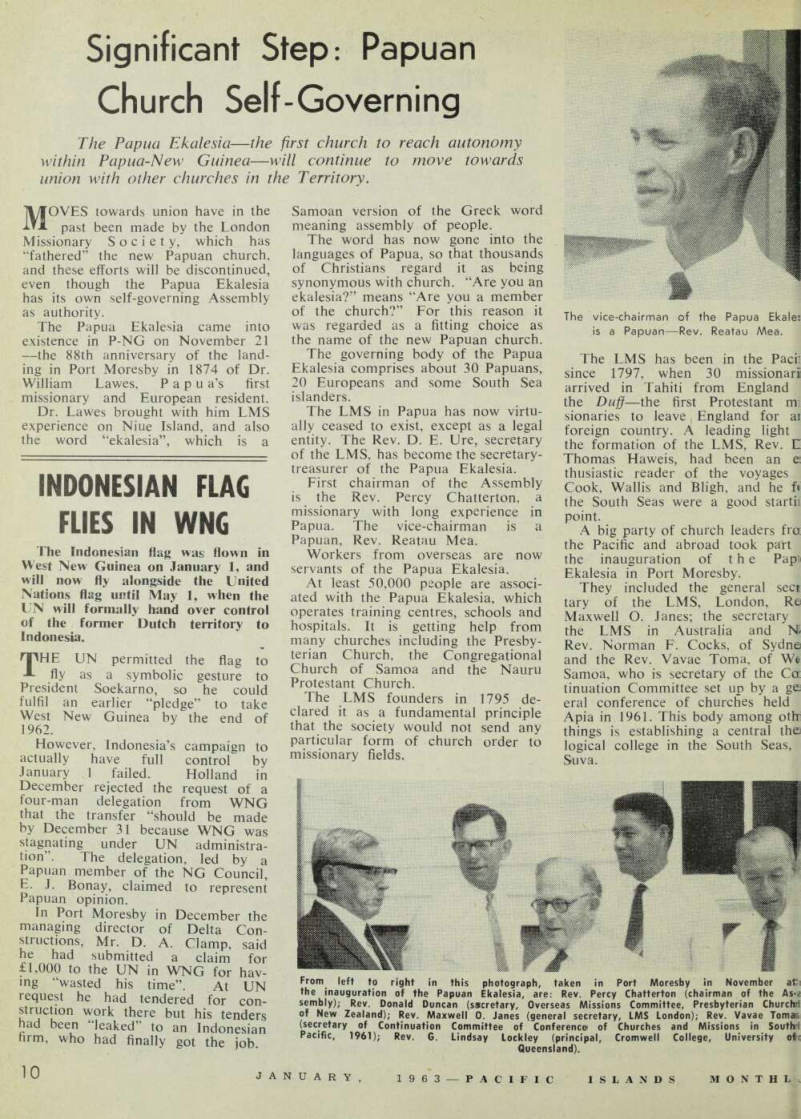
The vice-chairman of the Papua Ekale: is a Papuan —Rev. Reatau Mea.
From left to right in this photograph, taken in Port Moresby in November at the inauguration of the Papuan Ekalesia, are: Rev. Percy Chatterton (chairman of the As sembly); Rev. Donald Duncan (secretary Overseas Missions Committee, Presbyterian Church of New Zealand); Rev. Maxwell O. Janes (general secretary, LMS London); Rev. Vavae Toma (secretary of Continuation Committee of Conference of Churches and Missions in South Pacific, 1961); Rev. G. Lindsay Lockley (principal, Cromwell College, University of Queensland).