Doubts Grow In P-Ng On
pp. 9-11 · Read in the full issue
New Deal For Fiji’s Men As...
"Open Slather " Drinking
As 1962 drew to a close, there were growing doubts in Papua-New Guinea about the wisdom of “open slather” drink ing for natives, while in Fiji many people were wondering what would happen after New Year’s Day when new legislation would be in force giving males of all races freedom to drink what they liked.
IN New Guinea, where natives have had full drinking rights on licensed premises since November 2, outspoken statements by several lead ing citizens in December indicated that everyone was not as happy about the new liquor set-up as Territories Minister, Mr. Hasluck, professed to be after 62 natives were charged with drunkenness in late November, New Britain’s Director of Catholic Education, Rev. Father John O’Han lon, said the introduction of native drinking in P-NG was not nearly as trouble free as might appear on the surface.
Father O’Hanlon, who was a mem ber of the Liquor Inquiry Commis sion which resulted in an interim ordinance lifting the ban on native drinking, said this in a letter to the New Britain District Advisory Coun cil.
Father O’Hanlon claimed that drinking conditions in hotels were be coming “disgusting”. Sales to natives
of basic foodstuffs were dropping, hotel property was being stolen, natives were using food money to buy liquor, and the degeneration of drink ing conditions in hotels were driving white people into private clubs.
“In other words,” he said, “the native who battled so hard to get into our bars now finds himself in undis puted possession. Surely his victory is hollow now he finds himself alone with his compatriots.”
In Port Moresby, the Papuan presi dent of the Fairfax Local Govern ment Council, Toua Kapena, said that some people in Hanuabada village were drinking so heavily that they were always borrowing money.
Several women had reported that their husbands were spending up to half their weekly wages in hotel bars as soon as they received their pay.
Although it had always been the custom to lend money, food or any thing else, many people were now re fusing to lend money as they realised
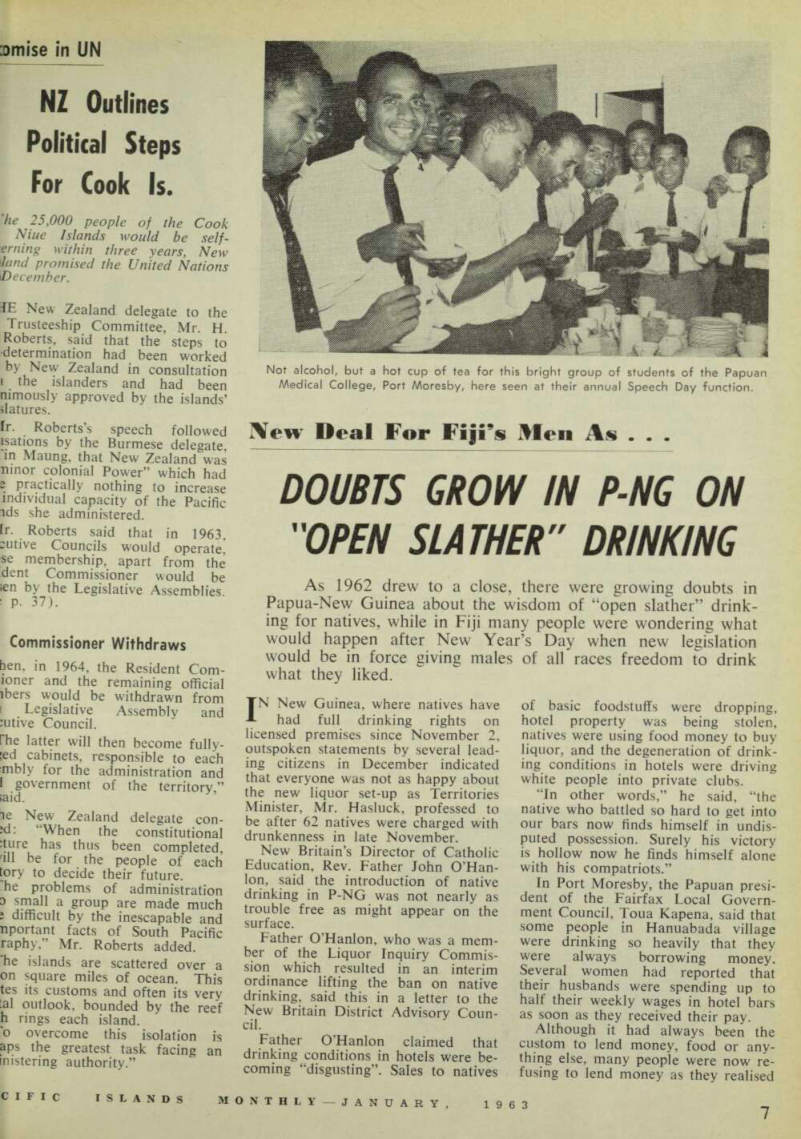
Not alcohol, but a hot cup of tea for this bright group of students of the Papuan Medical College, Port Moresby, here seen at their annual Speech Day function.
it would only encourage their friends to drink, Mr. Kapena added that mission aries, health, education and welfare officers should conduct a campaign throughout the Territory to educate the natives about the harmful effects of liquor.
Another native leader, Pastor Reatau Mea, of the Papua Ekalesia, told a meeting of about 350 people at an anti-drink meeting at Hanua bada that liquor threatened the life of the whole of Papua and New Guinea.
Meanwhile, the P-NG Director of the Department of Information, Mr.
L. Newby, announced that social and sports organisations throughout the Territory would be asked to co operate with the Administration and missions in temperance education programmes.
He said this after representatives of missions and organisations interested in the promotion of sane drinking had a two-day meeting convened by the Administration in Port Moresby.
The representatives agreed that there were ample grounds for co operation between the Administra tion, missions and voluntary organisations, and that an education programme should be based on the right of the individual to make his own decision about drinking; an in tellectual rather than an emotional approach; and an aim to present facts accurately and conservatively.
The meeting proposed that the Ad ministration should prepare and dis seminate factual information about alcohol.
The meeting agreed it was pre ferable for organisations to combine in a temperance programme, rather than to work separately.
Another development during De cember was the publication of the Liquor Inquiry Commission’s report.
The report, which was issued on December 13, urged that drinking hours should be restricted in the Ter ritory’s hotels and clubs.
It said that the European popula tion in the Territory should “be pre pared to accept a limitation of privi leges it has previously enjoyed”. The Commission proposed that a new ordinance should limit trading hours in hotels and private clubs to 12 hours —from 10 a.m. to 10 p.m., and from 11 a.m. to 1 p.m. and 4 p.m. to 7 p.m. on Sundays.
At present, hotel bars are open from 9 a.m. to 11 p.m. daily except Sunday when they are open for short periods. Private clubs are open every day from 10 a.m. to midnight.
The Liquor Commission, which was headed by Judge F. R. Nelson, of Melbourne, had seven members, two of whom were natives.
The Commission supported a pro posal that a new type of licence —a tavern licence—should be introduced permitting the sale of intoxicants to the public without the necessity to provide bedroom and dining room accommodation.
Other Developments
The Commission also proposed canteen licences.
It added that a licensee should have power to close a bar at his dis cretion.
Other events on the liquor front in the Territory during the month were: © The fining of 62 natives in Port Moresby on December 3 for drunken ness on the night of November 29. • An announcement by the Ac ting Administrator, Dr. J. T. Gun ther, that he had decided on a partial relaxation of restrictions on liquor advertising, which had previously been limited to the publication of price lists.
The fining of 62 natives for drv kenness followed the rowdiest scei in Port Moresby since natives H been permitted to drink. Most them were picked up in the vicim of the Hotel Papua, almost direa
opposite the police station, and w*
locked up for the night.
When Mr. Hasluck was asked the House of Representatives whetl; there had been “a spate of drunk; ness charges” against Papuans, said he was not quite sure what cc stituted a spate, but “a very succo: ful party” had been held and people had been “arrested and loci: up for their own protection”.
Mr. Hasluck went on: “They to the occurrence quite happily, anoi think the person who suffered rm discomfort was the Assistant Co missioner of Police, who was 10l awake all night by their singing.
“The next morning, all exo about 13, whose bail was forfeit! appeared in court and were fined 1 each. It was generally felt, I thir that a good time was had by all.
“This single instance of meis making, arising out of a new-foic liberty, certainly does not, in view, warrant unusual concern; we believe that as the people beco: accustomed to their new opportunir
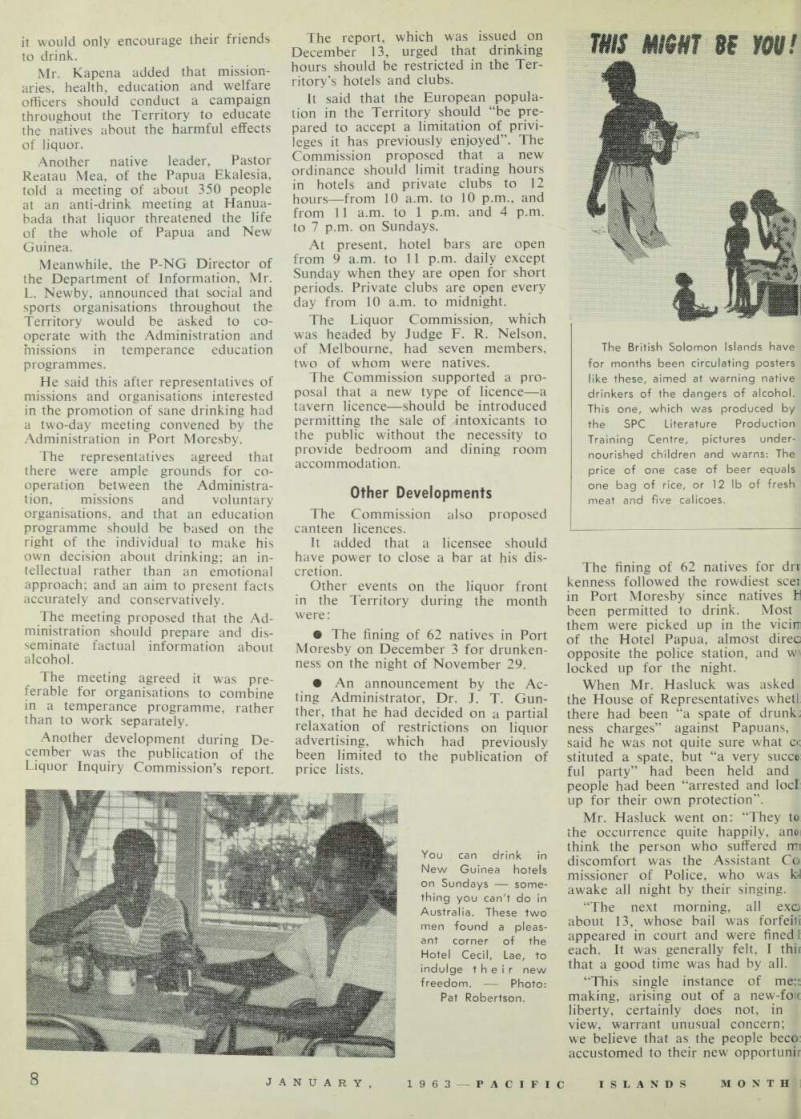
You can drink in New Guinea hotels
on Sundays - some
thing you can't do in Australia. These two men found a pleas ant corner of the Hotel Cecil, Lae, to indulge their new freedom. - Photo: Pat Robertson.
;;y will learn to restrain themselves :d act with temperance.
“We feel that the number of parties lit end this way will be no greater an the number of parties that end in dmilar way on the Australian main nd.”
Iln his announcement on liquor ad rtising in the Territory, Dr. Gunther id that restrictions were being re ;ced followed “representations by vertising interests and assessment developments since the introduc n of the Liquor Ordinance on Dvember 2”.
IDr. Gunther said advertisements iuld now be permitted which did more than include: The name of the liquor, manu facturer, where available, in what sizes, prices.
Modest claims in English as to the qualities of the liquor.
Pictures of the containers, label, and liquor in glasses.
Background pictures of a scenic nature but not of people in social situations.
Restrictions would not be lifted on vertisements which suggested that nk was a prerequisite for a arantee of social and material ad icement.
Advertising in Papuan and New linean languages would be pro fited.
Dr. Gunther said the restrictions to continued would guard against ad vising which put pressure on 3ple, who did not drink liquor, to e up drinking.
Fiji Position
[n Fiji the legislation which will ne into force on New Year’s Day ing males of all races freedom drink what they like was passed the Legislative Council last July.
Previously, Fijians and Indians re restricted to beer only for con nption on licensed premises. fhe Government had planned to e liquor for all sexes, but when the islation was under discussion the ian and Indian members objected Migly. Thus, Fijian and Indian men will still have to secure a mit to drink, but for European men there is no restriction—except t they may not drink in hotel bars.
Jnder the new legislation, whole ; licences will be converted into ■licences, which means that liquor i now be sold by the single bottle, iviously, sales had to be made in > of not less than two gallons.
New High Commissioner M. Laurent Pechoux has returned to France after four years’ service as French High Commissioner in the Pacific. His replacement will be M.
Camille Biros, a former Secretary- General to the Government in New Caledonia, where he was popular.