Something Definite' Wanted:
pp. 7-8 · Read in the full issue
Fijians Demand Voice In Their Own Future
From our Suva Correspondent A resolution of the Legislative Council of Fiji, adopted on December 13, that “there should be no change in Fiji’s present constitution until the Fijian people express their desire for further constitutional changes”, came as a surprise.
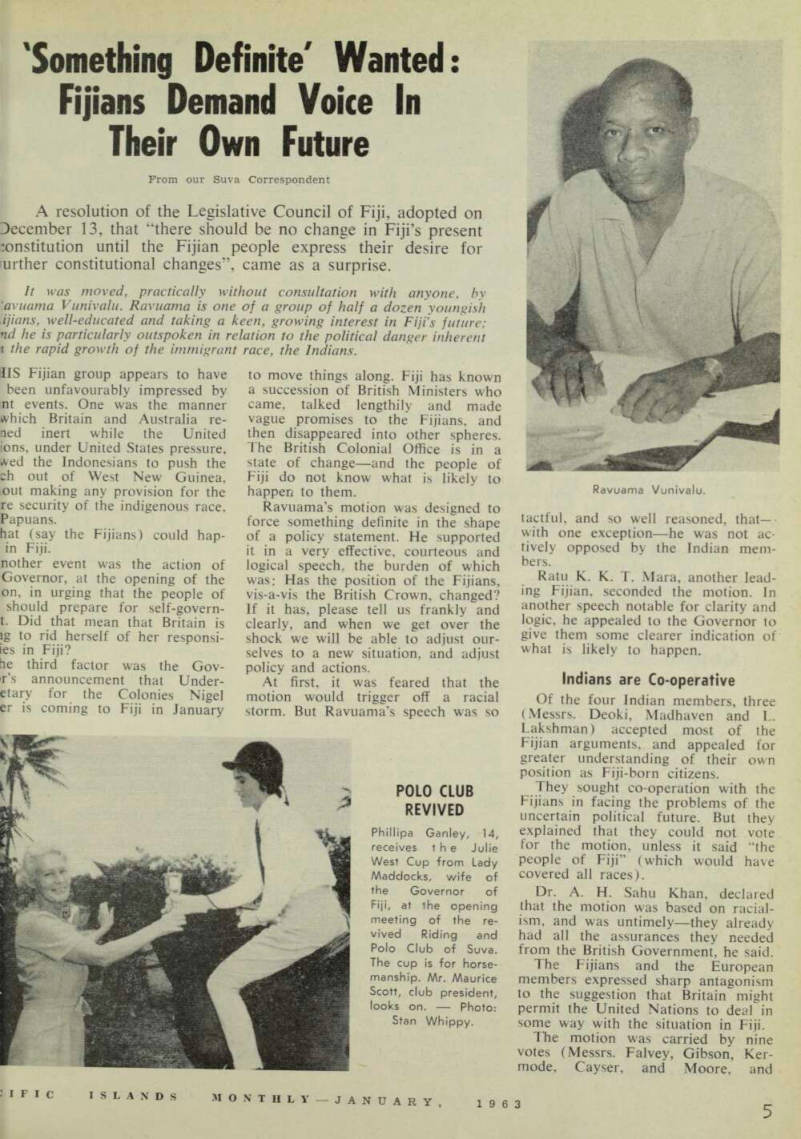
It was moved, practically without consultation with anyone, by [avuama Vunivalu. Ravuama is one of a group of half a dozen youngish iijians, well-educated and taking a keen, growing interest in Fiji’s future; nd he is particularly outspoken in relation to the political danger inherent i the rapid growth of the immigrant race, the Indians.
lIS Fijian group appears to have been unfavourably impressed by nt events. One was the manner which Britain and Australia re ned inert while the United ions, under United States pressure, wed the Indonesians to push the ch out of West New Guinea, tout making any provision for the re security of the indigenous race, Papuans. hat (say the Fijians) could hap in Fiji. nother event was the action of Governor, at the opening of the on, in urging that the people of should prepare for self-govern t. Did that mean that Britain is ig to rid herself of her responsi ies in Fiji? tie third factor was the Gov t’s announcement that Under etary for the Colonies Nigel er is coming to Fiji in January
to move things along. Fiji has known a succession of British Ministers who came, talked lengthily and made vague promises to the Fijians, and then disappeared into other spheres.
The British Colonial Office is in a state of change—and the people of Fiji do not know what is likely to happen to them.
Ravuama’s motion was designed to force something definite in the shape of a policy statement. He supported it in a very effective, courteous and logical speech, the burden of which was: Has the position of the Fijians, vis-a-vis the British Crown, changed?
If it has, please tell us frankly and clearly, and when we get over the shock we will be able to adjust our selves to a new situation, and adjust policy and actions.
At first, it was feared that the motion would trigger off a racial storm. But Ravuama’s speech was so
tactful, and so well reasoned, that— with one exception—he was not ac tively opposed by the Indian mem bers.
Ratu K. K. T. Mara, another lead ing Fijian, seconded the motion. In another speech notable for clarity and logic, he appealed to the Governor to give them some clearer indication of what is likely to happen.
Indians are Co-operative Of the four Indian members, three (Messrs. Deoki, Madhaven and L.
Lakshman) accepted most of the Fijian arguments, and appealed for greater understanding of their own position as Fiji-born citizens.
They sought co-operation with the Fijians in facing the problems of the uncertain political future. But they explained that they could not vote for the motion, unless it said “the people of Fiji” (which would have covered all races).
Dr. A. H. Sahu Khan, declared that the motion was based on racial ism, and was untimely—they already had all the assurances they needed from the British Government, he said.
The Fijians and the European members expressed sharp antagonism to the suggestion that Britain might permit the United Nations to deal in some way with the situation in Fiji.
The motion was carried by nine votes (Messrs. Falvey, Gibson, Ker mode, Cayser, and Moore, and
Polo Club
Revived
Phillips Ganley, 14, receives the Julie West Cup from Lady Maddocks, wife of the Governor of Fiji, at the opening meeting of the re vived Riding and Polo Club of Suva.
The cup is for horse manship. Mr. Maurice Scott, club president, looks on. - Photo: Stan Whippy.
Ravuama Vunivalu.
Ravuama Vunivalu, Ratu P. K. Gani lau, Ratu K. K. T. Mara, and Semesa Sikivou) to four (the four Indian members).
European sentiment probably was summed up effectively by Mr. C. W.
Cayzer.
“We don't want freedom (so called) or constitutional changes pushed on us until we are ready for them,” said Mr. Cayzer. “We must be on our guard, that we are not in fluenced by the insensate demands going on in the world today for ‘liberation whether you want it or not’.
“The world has seen too much, in the last few years, of countries being given so-called freedom, when some of them did not want it, and certainly in most cases were not fit for it.
“That tendency is flaring up all over the world today and, frankly, I am sometimes ashamed of being an Australian, when I think that the Australian Government and the Aus tralian people were too weak to utter a stronger protest against the murder and rape of West New Guinea.
“The fruits of that are already be ing reaped in the demand that the agreed conditions should be waived in favour of Indonesia, and also in problems cropping up at the other end of the archipelago.”
Mr. Cayzer said that when he was a youngster the world still was under the peaceful influence of Queen Vic toria, and Britain really meant some thing.
“But now we have a yelping pack of newly-emerged countries which are completely incapable of running their own affairs, let alone interfering with the affairs of other nations, and we should resist any inclusion in their ac tivity,” he said.
“The United Nations is an ideal but, human nature being what it is, it does not work. When dealing with welfare, health services and that sort of thing I have nothing but praise for it; but when it starts interfering with the control of other countries, and their business, I feel nauseated.”
Mr. Cayzer called United Nations an “anatomical monstrosity with no teeth”, compared it with the pre-crea tion verse in Genesis, and said, “It is without form and void.
“That is the United Nations. I want none of it. I hope this Colony will be spared interference by the United Nations.”
No More Concessions Ravuama told the council that the Fijians would not yield any further concessions about their rights. After having seen developments in other territories, they saw a sort of conflict between the general assurances that have been given to them from time to time, and what they now regard as pressure brought about by high powered politics, affecting the future of the Fijian people. He told the Council that the motion was designed to get, from those responsible for Fiji, re-affirmation of their acceptance of the trust which the Fijian people had placed in them.
Ravuama claimed that the Fijian people had not been kept fully in formed by the Colonial office of its plans for the political future of the Colony, The purpose behind his motion was to bring out views and ideas which would give some indica tion of the kind of future the children of the present generation might ex pect.
“Without an authoritative statement —and that statement must come from the Government—the Fijian people will continue to wonder, to seek, to ask, but not to find,” he said.
But his plea was in vain. The Gov ernment closed up and said nothing, apart from the Colonial Secretary quoting passages from the Governor’s address of November 23.
All the official members abstained from voting. The Colonial Secretary, Mr. P. D. Macdonald, made it clear at the outset that the Government was not going to get involved in the debate. Critical people could say that was typical of the lack of strong leadership in Fiji.