the Up-and-Up
p. 156 · Read in the full issue
Steamships on the Up-and-Up
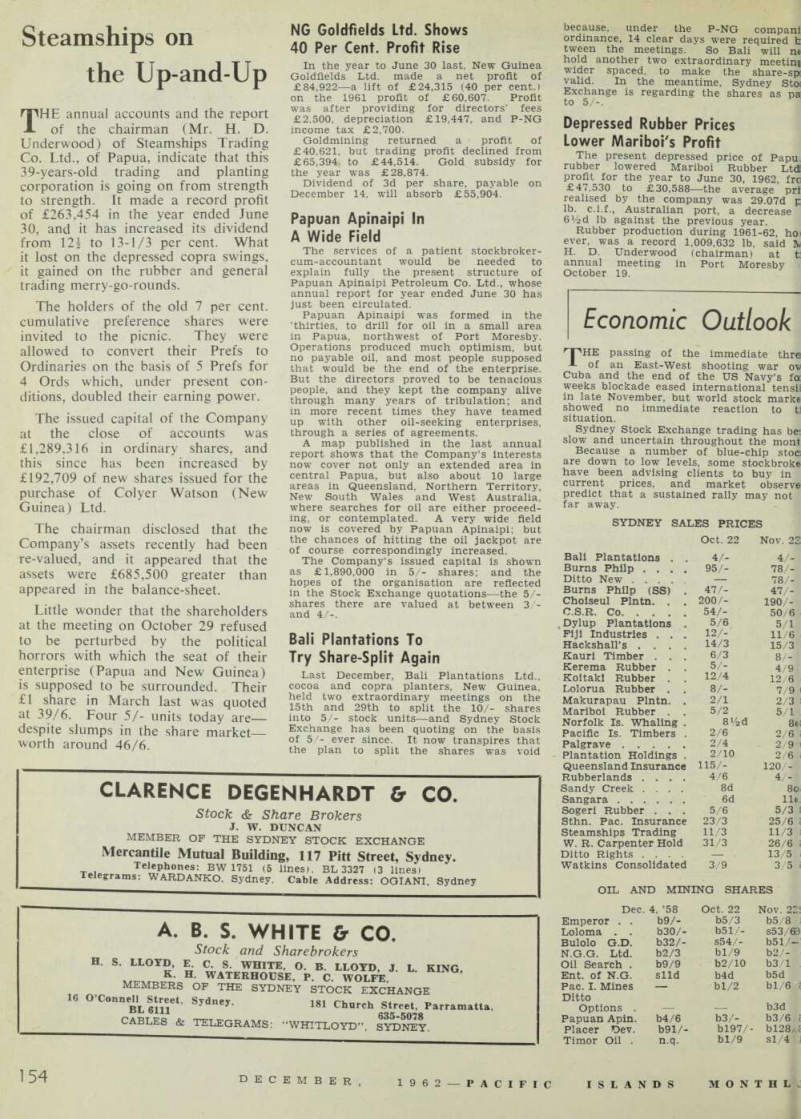
THE annual accounts and the report of the chairman (Mr. H. D.
Underwood) of Steamships Trading
Co. Ltd., of Papua, indicate that this 39-years-old trading and planting corporation is going on from strength to strength. It made a record profit of £263,454 in the year ended June 30, and it has increased its dividend from 12i to 13-1/3 per cent. What it lost on the depressed copra swings, it gained on the rubber and general
trading merry-go-rounds.
The holders of the old 7 per cent, cumulative preference shares were invited to the picnic. They were allowed to convert their Prefs to Ordinaries on the basis of 5 Prefs for 4 Ords which, under present con ditions, doubled their earning power.
The issued capital of the Company at the close of accounts was £1,289,316 in ordinary shares, and this since has been increased by £192,709 of new shares issued for the purchase of Colyer Watson (New
Guinea) Ltd.
The chairman disclosed that the Company’s assets recently had been re-valued, and it appeared that the assets were £685,500 greater than appeared in the balance-sheet.
Little wonder that the shareholders at the meeting on October 29 refused to be perturbed by the political horrors with which the seat of their enterprise (Papua and New Guinea) is supposed to be surrounded. Their £1 share in March last was quoted at 39/6. Four 5/- units today are— despite slumps in the share market worth around 46/6.
NG Goldfields Ltd. Shows
40 Per Cent. Profit Rise
In the year to June 30 last, New Guinea Goldfields Ltd. made a net profit of £84,922—a lift of £24,315 (40 per cent.) on the 1961 profit of £60,607. Profit was after providing for directors’ fees £2,500, depreciation £19,447, and P-NG income tax £2,700.
Goldmining returned a profit of £40,621, but trading profit declined from £65,394 to £44,514. Gold subsidy for the year was £28,874.
Dividend of 3d per share, payable on December 14, will absorb £55,904.
Papuan Apinaipi In
A Wide Field
The services of a patient stockbroker cum-accountant would be needed to explain fully the present structure of Papuan Apinaipi Petroleum Co. Ltd., whose annual report for year ended June 30 has just been circulated.
Papuan Apinaipi was formed in the ’thirties, to drill for oil in a small area in Papua, northwest of Port Moresby.
Operations produced much optimism, but no payable oil, and most people supposed that would be the end of the enterprise.
But the directors proved to be tenacious people, and they kept the company alive through many years of tribulation: and in more recent times they have teamed up with other oil-seeking enterprises, through a series of agreements.
A map published in the last annual report shows that the Company’s interests now cover not only an extended area in central Papua, but also about 10 large areas in Queensland, Northern Territory, New South Wales and West Australia, where searches for oil are either proceed ing, or contemplated. A very wide field now is covered by Papuan Apinaipi; but the chances of hitting the oil jackpot are of course correspondingly increased.
The Company’s issued capital is shown as £1,890,000 in 5/- shares; and the hopes of the organisation are reflected in the Stock Exchange quotations—the 57shares there are valued at between 3/and 4/-.
Bali Plantations To
Try Share-Split Again
Last December, Bali Plantations Ltd., cocoa and copra planters, New Guinea, held two extraordinary meetings on the 15th and 29th to split the 10/- shares into 5/- stock units—and Sydney Stock Exchange has been quoting on the basis of 5/- ever since. It now transpires that the plan to split the shares was void
because, under the P-NG compani ordinance, 14 clear days were required b tween the meetings. So Bali will n< hold another two extraordinary meeting wider spaced, to make the share-sp valid. In the meantime, Sydney Sto Exchange is regarding the shares as pa to 5/-.
Depressed Rubber Prices
Lower Maribor's Profit
The present depressed price of Papa rubber lowered Mariboi Rubber Ltd profit for the year to June 30, 1962, frc £47,530 to £30,588 —the average pri realised by the company was 29.07 d e lb. c.i.f., Australian port, a decrease 6Vzd lb against the previous year.
Rubber production during 1961-62, ho ever, was a record 1,009,632 lb, said IV H. D. Underwood (chairman) at t annual meeting in Port Moresby i October 19.