BSIP Workers
p. 135 · Read in the full issue
Back at Work After Strike
After having been on strike /er wages for three days, most the 1,100 native workers em oyed by the Government and ivate enterprise in Honiara turned to work early in ovember after the Government omised increased wages and
iproved conditions.
IHE strike began when 930 Gov . eminent labourers and others on y rates walked out in protest at the iv Mayle wage schedule for all wernment staff. About 200 workers ployed by private enterprise Iked out in sympathy.
Fhe strike was the culmination of veek of unrest during which an air resentful discontent built up. Dur the strike, some strikers blocked road with oildrums and threatened overturn cars.
Jnder the new wage schedule, ex piate officers received a 20 per cent, rease in salaries, local staff 13 cent, and day rate workers 10 per t. The increases for expatriate and d staff were retrospective to April, 1, but day workers were not nted retrospectivity. reviously labourers’ wages were a day.
The Mayle award offered sixpence a day increase.
The strike was eventually settled at 6/- a day, which was regarded in Honiara as a win for the strikers.
Private enterprise labour received similar increases.
The decision to strike was made on October 27, when natives employed by the Public Works Department met to discuss the salary revisions.
Speakers claimed that the revisions were not fair to all workers.
On October 30, the Secretary for Protectorate Affairs, Mr. M. A. An drew, met about 200 representatives of the workers, and a committee of six men was chosen to explain the workers’ grievances.
Mr. Andrew and Mr. A. H. Pick wood met the committee on Novem ber 1 and 2 for negotiations.
At these meetings, the six repre sentatives were informed that on the question of accident pay, which had been raised, the Government was pre pared to offer full pay for three months, followed by half-pay while a man remained in hospital.
Labourers would be entitled to three days’ sick pay a month for the first six months of their service; after that, they would receive 21 days’ paid sick leave a year, which was the same as the sick leave for classified workers.
Although there was some appre hension earlier in the week among workers who were not striking, and police investigated several stories of intimidation, investigations proved that the stories were not true.
By the end of that week, Mr. E.
Evans’ labour force was back at work, and a few classified workers had begun to drift back to their jobs.
Of the 431 classified workers and labourers employed by the Public Works Department, all but 12 were back at work by November 9, and other Government departments were also normal.
Most of the men employed by private enterprise returned to work during the week.
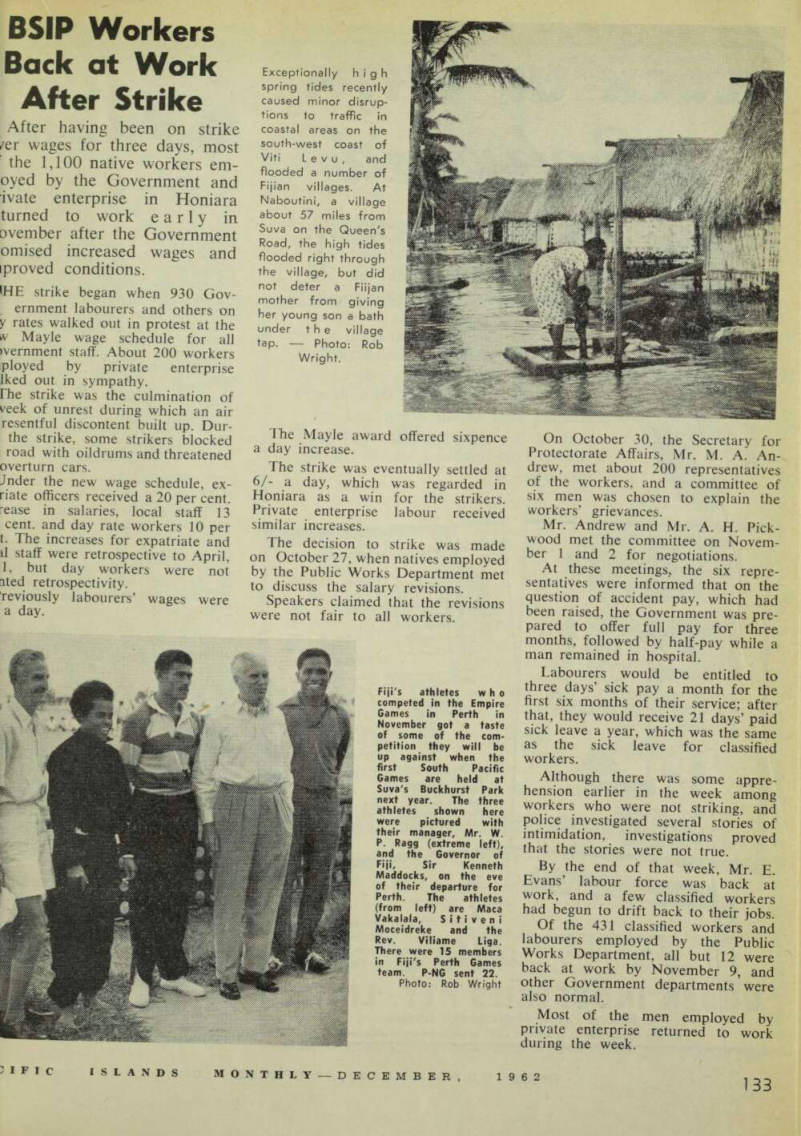
Exceptionally high spring tides recently caused minor disrup tions to traffic in coastal areas on the south-west coast of Viti Levu, and flooded a number of Fijian villages. At Naboutini, a village about 57 miles from Suva on the Queen's Road, the high tides flooded right through the village, but did not deter a Fiijan mother from giving her young son a bath under th e village tap. Photo; Rob Wright.
Fiji's athletes who competed in the Empire Games in Perth in November got a taste of some of the com petition they will be up against when the first South Pacific Games are held at Suva's Buckhurst Park next year. The three athletes shown here were pictured with their manager, Mr. W.
P. Ragg (extreme left), and the Governor of Fiji, Sir Kenneth Maddocks, on the eve of their departure for Perth. The athletes (from left) are Maca Vakalala, Sitiveni Moceidreke and the
Rev. Viliame Liga.
There were 15 members in Fiji's Perth Games team. P-NG sent 22.
Photo: Rob Wright