Four New
p. 97 · Read in the full issue
Stories
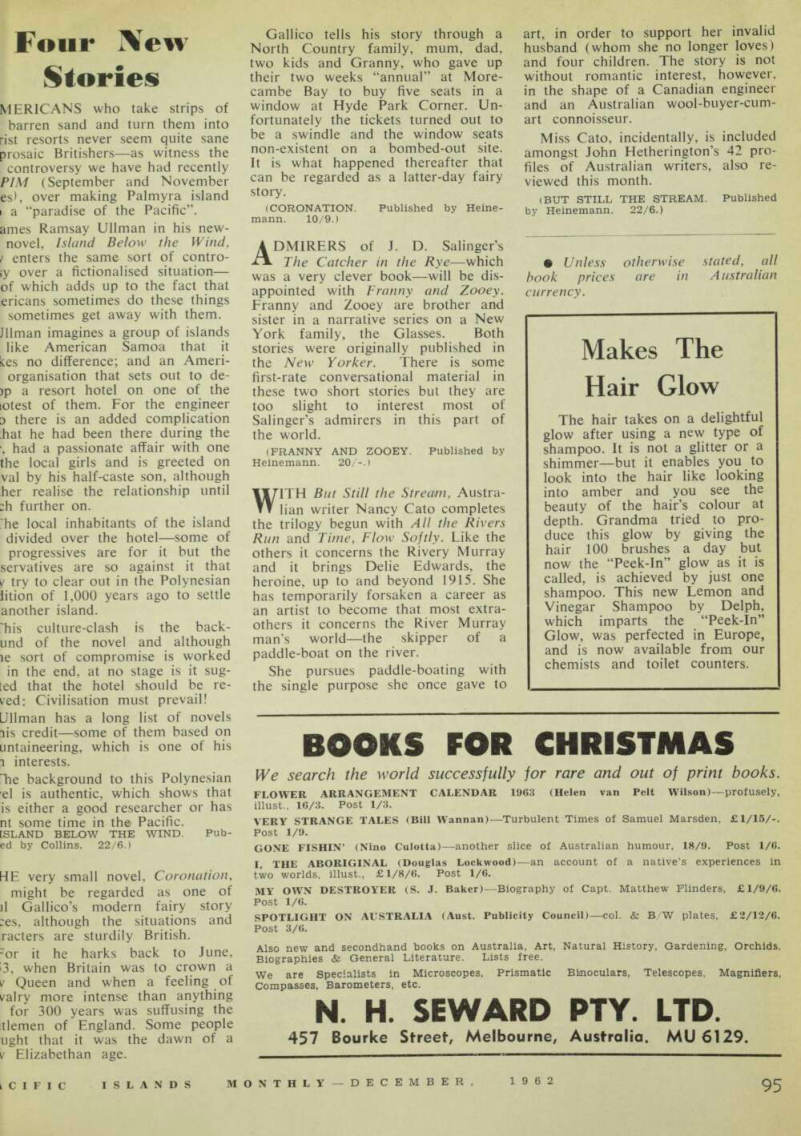
MERICANS who take strips of barren sand and turn them into rist resorts never seem quite sane prosaic Britishers —as witness the controversy we have had recently PIM (September and November es), over making Palmyra island » a “paradise of the Pacific”, ames Ramsay Ullman in his new novel, Island Below the Wind, / enters the same sort of contro jy over a fictionalised situation— of which adds up to the fact that ericans sometimes do these things sometimes get away with them.
Jllman imagines a group of islands like American Samoa that it Ices no difference; and an Ameri organisation that sets out to de >p a resort hotel on one of the lotest of them. For the engineer a there is an added complication ;hat he had been there during the ■, had a passionate affair with one the local girls and is greeted on val by his half-caste son, although her realise the relationship until :h further on. :he local inhabitants of the island divided over the hotel—some of progressives are for it but the servatives are so against it that y try to clear out in the Polynesian lition of 1,000 years ago to settle another island.
'his culture-clash is the back und of the novel and although le sort of compromise is worked in the end, at no stage is it sug ted that the hotel should be re ved: Civilisation must prevail! [Jllman has a long list of novels lis credit—some of them based on untaineering, which is one of his i interests.
'he background to this Polynesian el is authentic, which shows that is either a good researcher or has nt some time in the Pacific.
[Sland Below The Wind. Pub
ed by Collins. 22/6.) HE very small novel, Coronation , might be regarded as one of il Gallico’s modern fairy story :es, although the situations and racters are sturdily British. -or it he harks back to June, [3, when Britain was to crown a v Queen and when a feeling of ('airy more intense than anything for 300 years was suffusing the itlemen of England. Some people ught that it was the dawn of a v Elizabethan age.
Gallico tells his story through a North Country family, mum, dad, two kids and Granny, who gave up their two weeks “annual” at More cambe Bay to buy five seats in a window at Hyde Park Corner. Un fortunately the tickets turned out to be a swindle and the window seats non-existent on a bombed-out site.
It is what happened thereafter that can be regarded as a latter-day fairy story. (CORONATION. Published by Heine mann. 10/9.) ADMIRERS of J. D. Salinger’s The Catcher in the Rye —which was a very clever book—will be dis appointed with Franny and Zooey.
Franny and Zooey are brother and sister in a narrative series on a New York family, the Glasses. Both stories were originally published in the New Yorker. There is some first-rate conversational material in these two short stories but they are too slight to interest most of Salinger’s admirers in this part of the world. (FRANNY AND ZOOEY. Published by Heinemann. 20/-.) WITH But Still the Stream, Austra lian writer Nancy Cato completes the trilogy begun with All the Rivers Run and Time, Flow Softly. Like the others it concerns the Rivery Murray and it brings Delie Edwards, the heroine, up to and beyond 1915. She has temporarily forsaken a career as an artist to become that most extra others it concerns the River Murray man’s world —the skipper of a paddle-boat on the river.
She pursues paddle-boating with the single purpose she once gave to
art, in order to support her invalid husband (whom she no longer loves) and four children. The story is not without romantic interest, however, in the shape of a Canadian engineer and an Australian wool-buyer-cum art connoisseur.
Miss Cato, incidentally, is included amongst John Hetherington’s 42 pro files of Australian writers, also re viewed this month. (BUT STILL THE STREAM. Published by Heinemann. 22/6.)
• Unless otherwise stated, all book prices are in Australian currency.