Fiji’S Souvenir
p. 77 · Read in the full issue
Business Is
Booming
From a Suva Correspondent
In sophisticated city circles,
hat could be more U than de
inter tags for rum, sweet sherry
md even champagne!) from
irk grey or yellow mother-of ;arl? |R miniature hand carved “canni " bal forks” with masi-patterned indies, in three sizes for cocktail bits, sweet corn, seafoods and the rgest for spearing the occasional ive?
These are some of the latest gim icks in Fiji’s still small but sprout % souvenir industry.
The last couple of years have seen markable advances in local arts and afts in Fiji, mainly due to the agination and enterprise of a few ople who are not only determined produce a wider range of pro-
ducts, but are insisting on a high standard of quality and finish.
Gone are the days when the tourist’s choice of mementoes was limited to baskets, masi, mats or the not always inspired jewellery to be got at the markets.
Handpainted shirts, muu-muus and even serrated sulus, from the very amateurish to the very professional, are to be spied by the dozen during a stroll through Suva’s shopping area, while the always attractive raintree beckons from many a window in tables, trays and novelties and even from the store signs themselves, In one of the most popular haunts, particularly of the American tourists, butter “dishes” from the black-lipped “Mela Mela” shell with matching richly opalescent butter knives nudge all-shell cruet sets which have tiny spoons of mother-of-pearl.
In the same “studio”, the frivolous femme can choose earrings of Niusawas (small coconuts) or whale ivory (from a whale caught in Lau) while the male shopper may plump for a tortoiseshell comb inlaid in sterling silver. These combs are rather pricy so are usually only made to order. „ , . , ; , , Popular with locals and visitors alike are the hand-painted shirts, some sporting the Fijian coat of arms on the pocker, while one shop offers a variety of tropical designs from pineapples to masi patterns.
Here, also, can be found the maddest collection of headgear calculated to set the feminine heart a-flutter.
Mostly of voivoi, the hats are all shapes and sizes, from Mexican som breros with up to 16 voivoi pom poms, to tall deerstalkers with masi pugarees, to the more conventional Coolie shapes.
Some of the hats are sprayed in jet or gold to gild the lily that wears them even more, Muu-muus—-long, short, full or sli™—i n tropical prints or hand painted cottons, with an oriental or Hawaiian bent, are snapped up almost as soon as they appear on the racks. Particularly are they pounced on by locals going away who feel ,he folk ? at home wUI expect them to appear ln something tropical, Then there are bikinis in peach cotton with the gleam of a gold and white hibiscus, casual sunfrocks and shirtmakers with hand-painted de signs, and blouse and shorts sets in all ' he sunniest shades , u m °uf ri l tr f nc * or P^ ace mats as brought forth an array to be se^, n m . markets m woven voivoi mas h a nd in the stores fashioned P ar, d hand-painted linen a nd printed vilene. 1 an y number of shops oner pendants of the attractive local shells as well as brooches> earrings and bracelets contrived from local woods, shells and sometimes , oca , stone U ' s a n helping to make life more interesting—if more expensive—for the oft-tempted Fiji resident. But Christmas gifts are becoming less of a problem as the years go by.
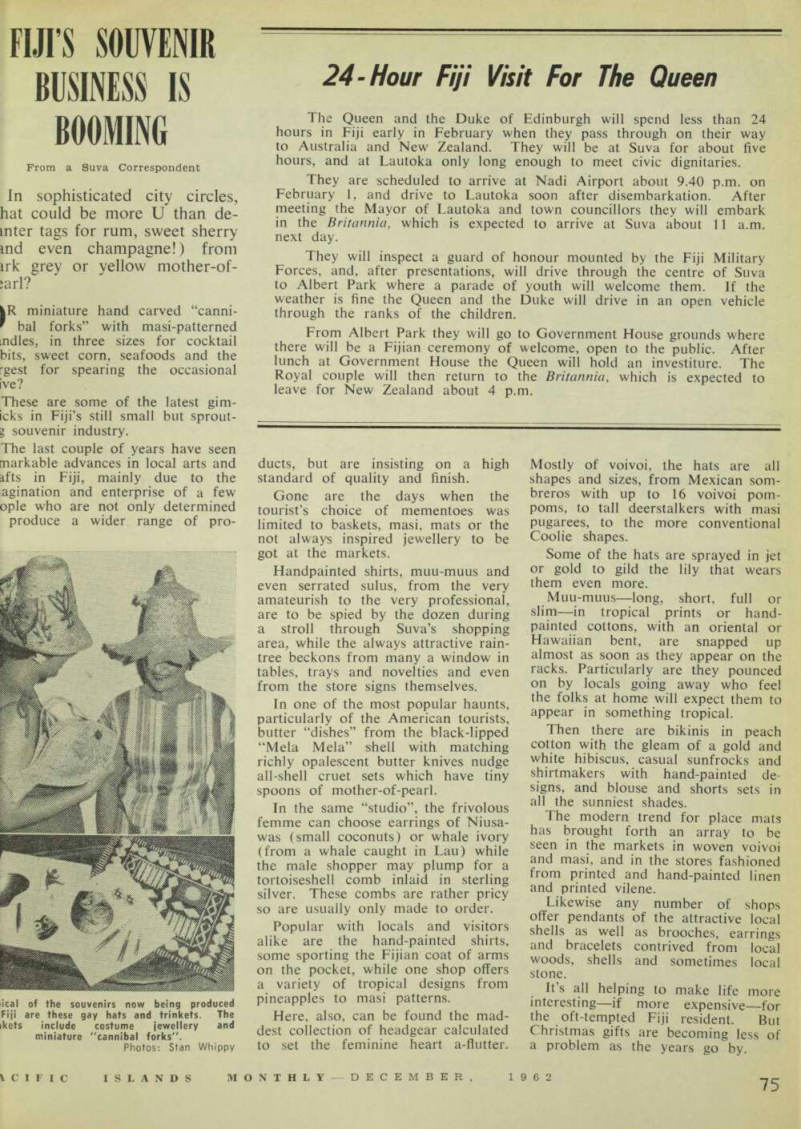
[?]ical of the souvenirs now being produced Fiji are these gay hats and trinkets. The [?]kets include costume jewellery and miniature "cannibal forks".
Photos: Stan Whippy