Number One
p. 63 · Read in the full issue
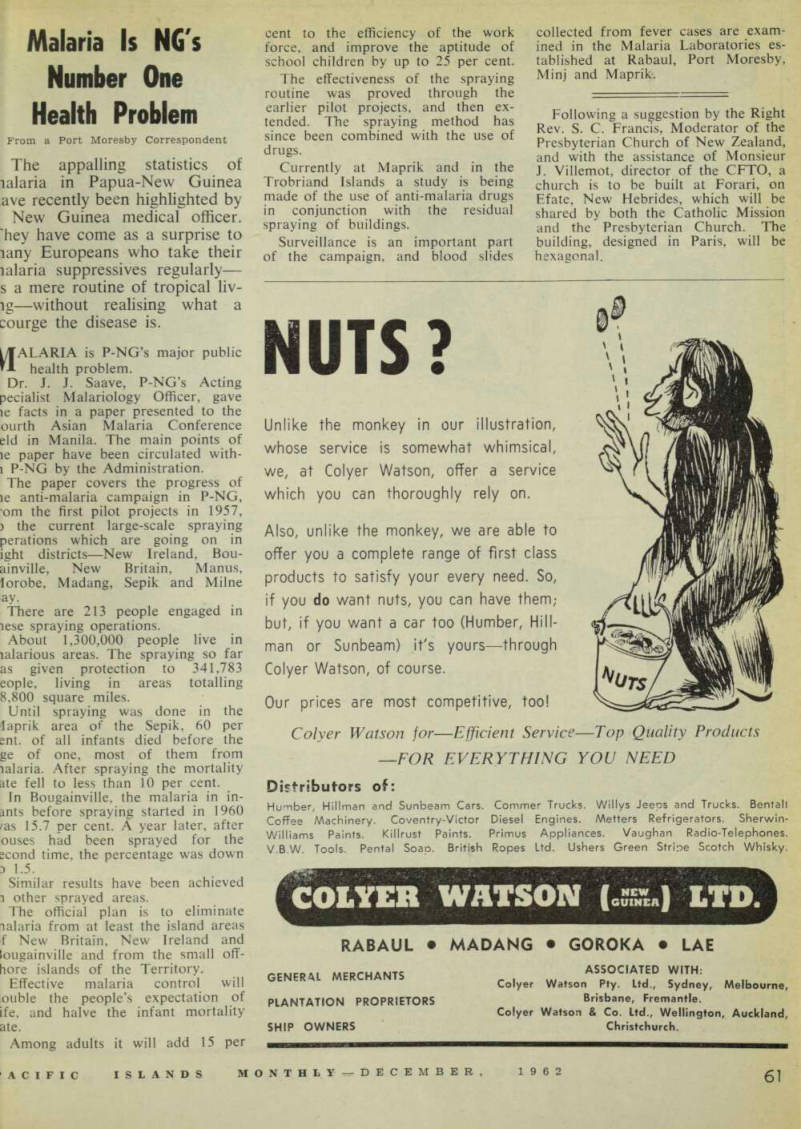
Malaria Is NG's Number One Health Problem
From a Port Moresby Correspondent The appalling statistics of
lalaria in Papua-New Guinea
ave recently been highlighted by
New Guinea medical officer, ffiey have come as a surprise to iany Europeans who take their
lalaria suppressives regularly—
s a mere routine of tropical liv
ig—without realising what a
courge the disease is. i/lALARIA is P-NG’s major public health problem.
Dr. J. J. Saave, P-NG’s Acting pecialist Malariology Officer, gave le facts in a paper presented to the ourth Asian Malaria Conference eld in Manila. The main points of le paper have been circulated with i P-NG by the Administration.
The paper covers the progress of le anti-malaria campaign in P-NG, om the first pilot projects in 1957, ) the current large-scale spraying perations which are going on in ight districts—New Ireland, Bou ainville, New Britain, Manus, lorobe, Madang, Sepik and Milne ay.
There are 213 people engaged in lese spraying operations.
About 1,300,000 people live in lalarious areas. The spraying so far as given protection to 341,783 eople, living in areas totalling 8,800 square miles.
Until spraying was done in the laprik area of the Sepik, 60 per ent. of all infants died before the ge of one, most of them from lalaria. After spraying the mortality ate fell to less than 10 per cent.
In Bougainville, the malaria in in ants before spraying started in 1960 fas 15.7 per cent. A year later, after ouses had been sprayed for the scond time, the percentage was down a 1.5.
Similar results have been achieved i other sprayed areas.
The official plan is to eliminate lalaria from at least the island areas f New Britain, New Ireland and tougainville and from the small off hore islands of the Territory.
Effective malaria control will ouble the people’s expectation of ife, and halve the infant mortality ate.
Among adults it will add 15 per
cent to the efficiency of the work force, and improve the aptitude of school children by up to 25 per cent.
The effectiveness of the spraying routine was proved through the earlier pilot projects, and then ex tended. The spraying method has since been combined with the use of drugs.
Currently at Maprik and in the Trobriand Islands a study is being made of the use of anti-malaria drugs in conjunction with the residual spraying of buildings.
Surveillance is an important part of the campaign, and blood slides
collected from fever cases are exam ined in the Malaria Laboratories es tablished at Rabaul, Port Moresby, Minj and Maprik.
Following a suggestion by the Right Rev. S. C. Francis, Moderator of the Presbyterian Church of New Zealand, and with the assistance of Monsieur J. Villemot, director of the CFTO, a church is to be built at Forari, on Efate, New Hebrides, which will be shared by both the Catholic Mission and the Presbyterian Church. The building, designed in Paris, will be hexagonal.