For Tongan Castaways
pp. 49-51 · Read in the full issue
Emotional Welcome Home For Tongan Castaways
From PIM Correspondents The makeshift outrigger canoe in which three castaways from the Tongan yacht Tuaikaepau made their heroic 300mile voyage from South Minerva Reef to Kadavu, Fiji, in October was shipped from Suva to Tonga early in November in the Tongan Government ship Aoniu.
IT will probably go on permanent display in Nukualofa as an example of Tongan craftsmanship in an emergency.
The outrigger, called Malolelei, was built from the timbers of a wrecked Japanese fishing boat which the 17 Tongan members of the Tuaikaepau found on Minerva Reef after their yacht went aground there and broke up on July 7.
The skipper of the Tuaikaepau, Tevita Fifita, his son, Sateki Fifita, and Tevita Uaise’e. a carpenter who designed Malolelei, set out from Minerva Reef in the outrigger on October 7 in the hope of bringing aid to their shipwrecked comrades after vainly awaiting rescue for three months. Sateki Fifita was drowned after the outrigger capsized a mile and a half off the Kadavu coast.
Captain Fifita later gave the outrigger to the people of Kadavu’s Nacamoto village, and the elders of the village refused to part with it
when Captain S. B. Brown, of the Maroro, went to Nacamoto to bring the vessel to Suva for shipment to Tonga. However, the younger men of Nacamoto said the boat should be sent to Suva, La * r . whl -n the Melanesia went to Nacamoto, the elders had reconciled their differences with the >' ou l n B. me " and allow ? d ‘ he outrigger to be handed over and taken to Suva.
About a fortnight earlier the 12 survivors of the Tuaikaepau who had rested in hospital at Suva after their ordeal on Minerva Reef had been taken back to Tonga in an RNZAF Sunderland.
The Sunderland touched down in the bay off Nukualofa at 2.30 p.m. on October 22 amid great excitement, The afternoon had been declared a public holiday and from midday people had been moving towards Faua Harbour, about a mile away from the main wharf, The harbour is used for small
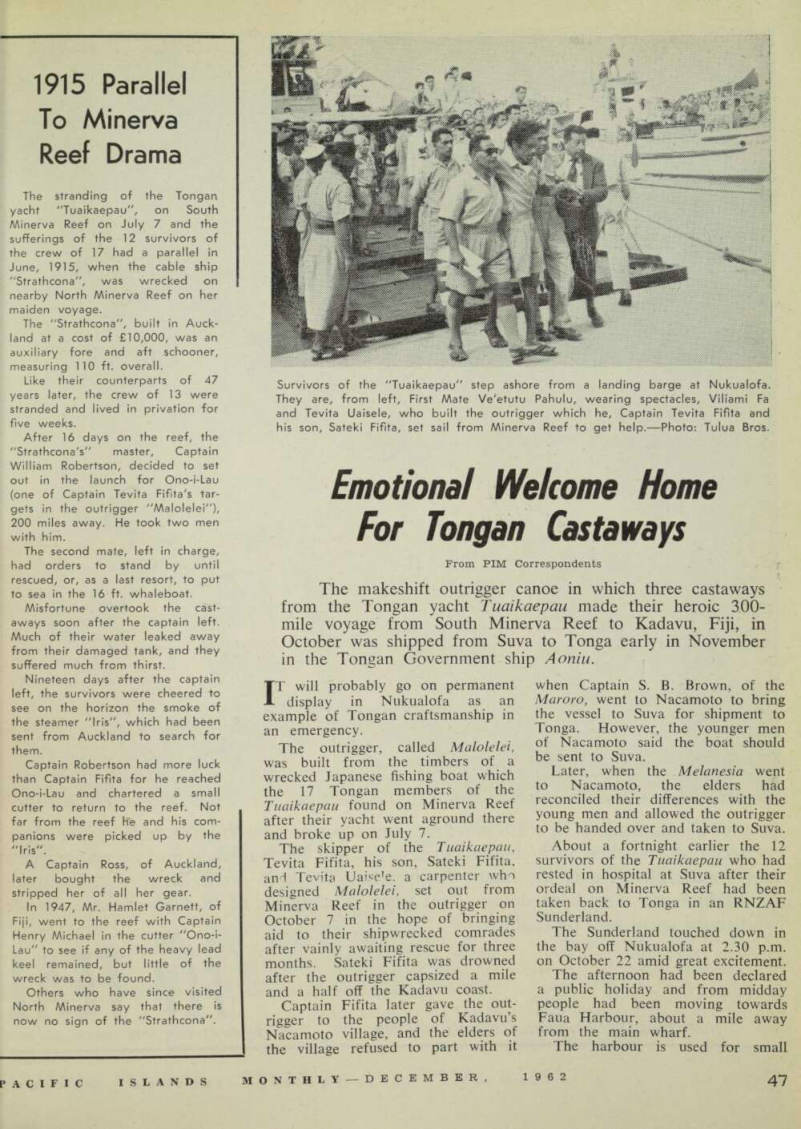
Survivors of the "Tuaikaepau" step ashore from a landing barge at Nukualofa.
They are, from left, First Mate Ve'etutu Pahulu, wearing spectacles, Viliami Fa and Tevita Uaisele, who built the outrigger which he, Captain Tevita Fifita and his son, Sateki Fifita, set sail from Minerva Reef to get help. —Photo: Tulua Bros.
islal vessels and yachts, and it s from this harbour that the aikaepau sailed on July 4.
By two o’clock, the wharf and >le surrounding the harbour were :ked with people, and the road o town right up to the entrance the Royal Palace was lined with loolchildren.
Earlier the TSMV Kao, a landing ift type vessel, had sailed out into ; bay with close relatives of the vivors.
After the Sunderland touched wn, its passengers and crew were tied by dinghy to the Kao, where : survivors met their relatives.
Ehe vessel was dressed over-all as ; sailed up the channel into Faua irbour, and it was a silent and lotional crowd which greeted the urning men. It was a sad as 11 as a joyous occasion.
As the vessel touched the slip y, the Police Band played the mn “Deep Harmony”.
The survivors, still showing signs their three-month ordeal, were ;eted and welcomed by the Deputy ;mier, Prince Tu’ipelehake, on half of Queen Salote, the chiefs d the people.
In a speech, Prince Tu’ipelehake inked the New Zealand Govern ;nt and all concerned in the rescue erations. He commended the plain, the mate and the crew of : Tuaikaepau for the way they had irked together and lived up to their mgan traditions.
Although he recalled with sadness it some had given their lives, he s thankful that more had lived.
Members of the official party, binet Ministers and chiefs then Icomed the survivors.
Later, led by the Deputy Premier in his car, the castaways were driven down the coast road which was flanked by row upon row of school children.
At the mala’e (open ground out side the Palace), an enormous crowd had assembled to greet them as they passed into the Palace grounds for an audience with Queen Salote.
After the audience, the survivors were driven to the Vaiola Hospital, again through crowds lining the main street.
Early in November, they were still in hospital recuperating from their ordeal.
Queen Salote directed the hospital doctors and nurses to give her daily reports of the men’s progress.
Alapasita, wife of Captain Tevita Fifita, was staying at the hospital to nurse her husband back to health.
The survivors held daily prayer meet ings, as they did when they were living in the Japanese wreck. They used an old Bible which they had with them on the reef.
Big celebrations were planned for the men when they returned to their homes. Some of the men are from Haapai, some from Tongatapu and one is from Vavau.
A court of inquiry into the strand ing of the Tuaikaepau on South Minerva Reef was expected to begin during November.
On November 2, Olaf Ruhen, a noted Australian writer on Australian and Islands subjects, flew from Sydney to Tonga to gather material for a book on the Minerva Reef epic.
The book will be published by Angus & Robertson Pty. Ltd., of Sydney, in association with the Minerva Bookshop Pty. Ltd., of Auckland, about the middle of 1963.
In gathering his material, Olaf Ruhen will also have the assistance of the reporters and photographers of The Fiji Times whose coverage of the Minerva Reef drama was pub lished in newspapers throughout the world. The Fiji Times bought all rights to a book on the subject from the Tongan castaways, and obtained from them a log which they kept on Minerva Reef.
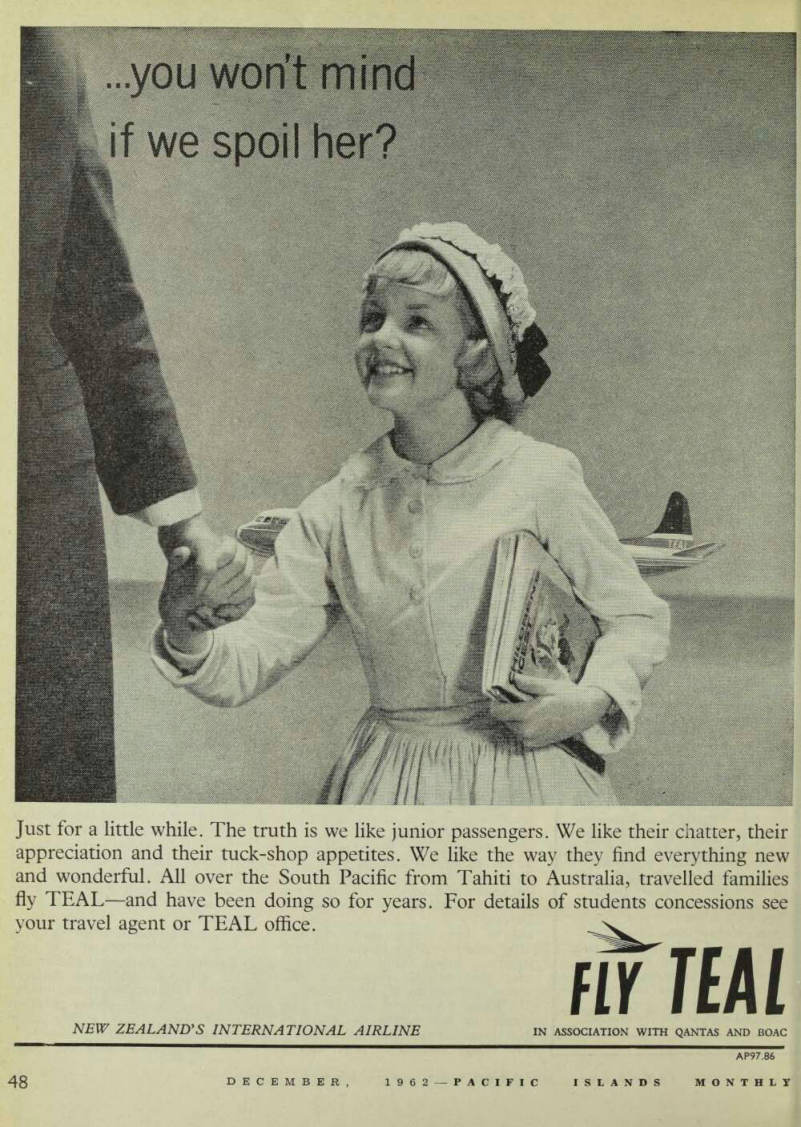
Members of the crew of the "Tuaikaepau" in the grounds of the Royal Palace at Nukualofa after their audience with Queen Salote. Captain Tevita Fifita is on the extreme right. —Photo; Tula Bros.
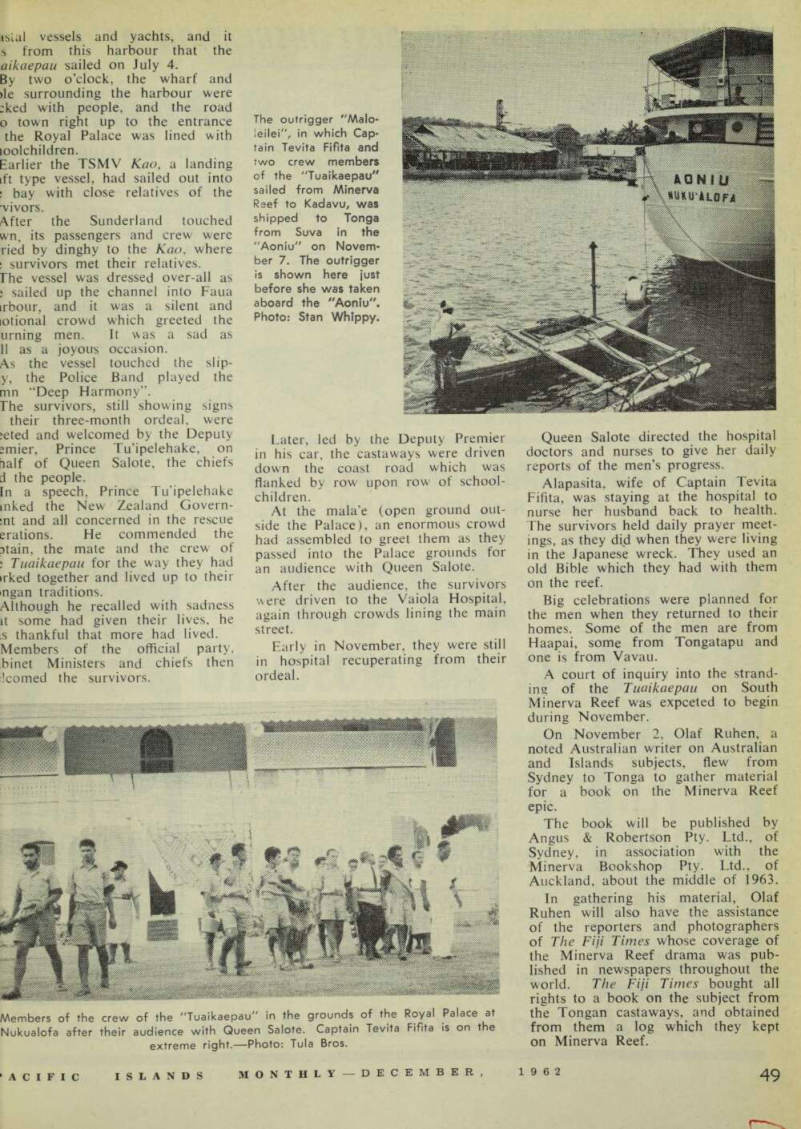
The outrigger "Malo leilei", in which Cap tain Tevita Fifita and two crew members of the "Tuaikaepau" sailed from Minerva Reef to Kadavu, was shipped to Tonga from Suva in the "Aoniu" on Novem ber 7. The outrigger is shown here just before she was taken aboard the "Aoniu".
Photo: Stan Whippy.