With Tolala
pp. 31-35 · Read in the full issue
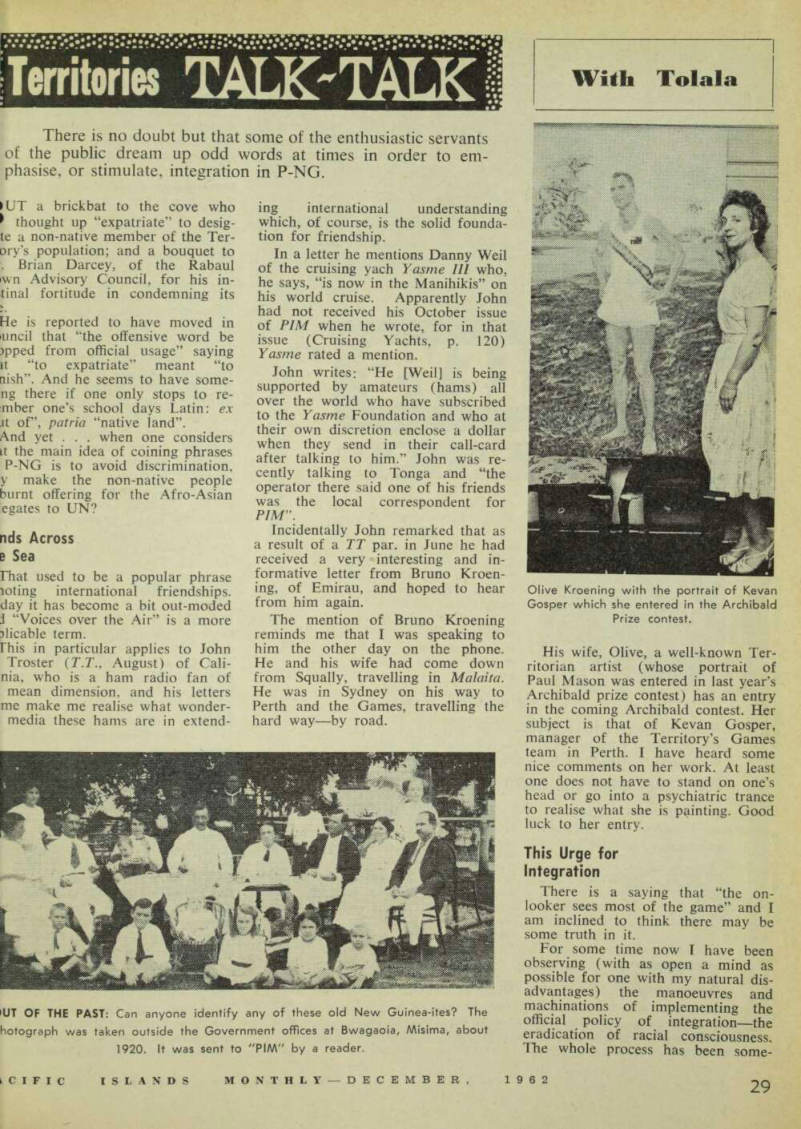
His wife, Olive, a well-known Ter ritorian artist (whose portrait of Paul Mason was entered in last year’s Archibald prize contest) has an entry in the coming Archibald contest. Her subject is that of Kevan Gosper, manager of the Territory’s Games team in Perth. I have heard some nice comments on her work. At least one does not have to stand on one’s head or go into a psychiatric trance to realise what she is painting. Good luck to her entry.
This Urge for
Integration
There is a saying that “the on looker sees most of the game” and I am inclined to think there may be some truth in it.
For some time now I have been observing (with as open a mind as possible for one with my natural dis advantages) the manoeuvres and machinations of implementing the official policy of integration—the eradication of racial consciousness.
The whole process has been some
Olive Kroening with the portrait of Kevan Gosper which she entered in the Archibald Prize contest.
what absorbing. There is now a generous scattering of professional and social titles amongst the indigenes; detailed reports in local newspapers of their social activities (weddings, coming-of-age parties, arrivals and departures); of their progress in the arts and crafts, to say nothing of their profound opinions on topical political questions, not forgetting the all-too-modern housing and amenities for the inmates of the Corrective Institutions. And now there is the open door for John Barleycorn and Mr. Booze.
Undoubtedly the papers, the police and the pubs will have to expand their respective pages, personnel and
premises to cope with the increased demand for news coverage, potential inmates of the luxurious institutions and the consumers of alcoholic liquor —boots or no boots, It is a great pity that global pres sure has been brought to bear to such an extent on Australia in re gard to P-NG conditions, and a greater pity that Australia has deemed fit to conform to this general pattern of acceleration of forcing Western civilisation (with all its faults) upon a still primitive people.
The day will come when this pre sent policy will be regretted. But now ... no stone may be left un turned to give an uplift to the native
ego, as rather subtly illustrated b the Hamori-design of the 2/3 Games stamp.
The stamp is one of the Commoi wealth Games series, issued on 0< tober 24, and depicts three runne] in a track race—two natives and or non-native—with one of the natrv runners well to the fore.
Enter John
Barleycorn
The letting-down of the colot barriers in the bars of Papua an New Guinea had such a general] good Press that it is to me sorrn what suspect. Be that as it may, a< cording to Press reports there wei no riots, clashes, rapes or botton pinching of females; at least, not i a curtain raiser. Time will tell.
No doubt the main participan were more or less well-seasoned tos pots who had learned their drinkir with the Army in the war.
It is to be hoped there will be n repetition of incidents that I sa amongst native drinkers during tl Japanese occupation of Rabaul whe; on many occasions, I was on the n ceiving end as native police, attache to the Kempei Tai, asserted the authority upon interned European “pulling no punches” (in a vei literal sense) whilst full of sake ar beer. That was a phase of alcohol dispensation in Rabaul which I d; not appreciate!
I have seen various phases Rabaul of the art of drinking. 1 German days the popular drinkir spots were the company clubs. Tl Neu Guinea Kompagnie, E. E. Fo sayth and Hernsheim & Cie had the premises where staff members co: gregated. The NGK club was locate in the premises which during tl 1914 military occupation became tl general canteen for the troops, ar when Civil Administration came in being became the offices of tl Crown Law Office in Mango Avenu opposite Park Street.
There was also a European hot) named “Frederichshof” and run, think, by the NDL. It was locat* in a two-storey building, later a quired by Cyril Gasgoine and usi for a time as the Masonic Temple its early years. In Chinatown the: were two hotels: Ah Chee’s ar Ching King’s, patronised mostly T the Chinese and Malays.
In the early twenties, after Ch Administration took over, there we: the Rabaul Hotel, run by Nelson Robertson, the two Chinese hote; the New Guinea Club (the old mit tary Sergeants’ Mess) and the RabaE Club (the old Officers’ Mess).
By that time the drinking popula >n had grown considerably; the :proboard was established (nearly ex-Diggers of War I) and the iministration staff had been stepped , with the usual public service ten ncy towards numerical strength.
There were no cinemas; no mixed cktail parties, the only relaxation nained in the pubs and the clubs. night it was the usual thing to : outside each club and pub gathering of house-boys, each ned with a hurricane lantern, squal id about waiting for the time when sir mastas would decide to go me, which meant a somewhat tor ms path in the dark to some chelor bungalow.
Rabaul night-life often had its flights. There were German old ie residents, still there, awaiting i finalisation of their affairs before iving for the homeland. Many of :m were somewhat desperate. They d lost the war, they had to leave i country, the future was most un ■tain. With old Omar Khayyam :y thought: Ah, fill the Cup—what boots it to repeat How time is slipping underneath our feet ; Unborn Tomorrow and dead Y esterday, Why fret about them if Today be sweet. that’s exactly what many of m did.
Fhere was pompous and very big x-foot-two and twenty stone) Herr the manager of one of the Big rman Firms, who used to come vn to Chinatown at night in ma culate evening dress and wearing J of those old-time collapsible ;ra hats. He was a most imposing are, full of good cheer and Girl and beer. After a session at Ah ee’s he would occasionally return his home in a wheel-barrow. . .
Then there was the inimitable old 1 Gevers, a long, lean cadaverous >king individual, who was native iour clerk for the HSAG. Bill was jovial soul; he never had trouble h his labour line; ships’ captains iw there would be no trouble with oading or loading while Bill was the job.
But there were times when he just 1 to relax. At night, after a pre dnary visit to Ah Chee’s, he would borrow or steal a T-Ford, com te with driver (a luxury in those fs) and invariably with the hood vn he would be driven through town slowly playing an old mophone. ’ don’t quite know why I am re-
calling these old-time identities.
There are few—very few—folk still alive who remember those Rabaul nights, and those who do are prob ably sitting back sedately, not the least eager to remember the nights when their house-boys guided them back to their bachelor flats.
And yet . . . it was a phase of Rabaul drinking before the advent of the cocktail parties, which fol lowed the coming of the women-folk with their social cliques and social symbols of maidenhair fern and polished brass and marital tropical triangles.
In Retrospect
In September PIM, I mentioned Australia’s first Expeditionary Force (AN&MEF) in War I and the speed with which it was organised and despatched to German New Guinea.
Came a letter the other day from a member of this same Force, com menting on some of the events and asking: “Can you remember the nick names given by the troops to the different forces and reinforcements as they arrived in Rabaul during the military occupation? I used to know them, but I’ve forgotten. Many of the names were not complimentary terms because some of the coves were pretty tough blokes”.
Replying to this old-timer it is needless to say the men were not hand-picked, and some of the characters amongst these willing Diggers were “weird mobs” and their behaviour startled the natives to no small extent. It is, however, interest ing to know the name by which the subsequent Forces and Reinforce
ments were popularly known, as suggested by the writer.
The Second Force, to arrive on December 7, 1914, was dubbed the “Druids”. They arrived with Colonel Pethebridge, who succeeded Colonel Holmes as Administrator on January 8, 1915.
The Third Force was called “The
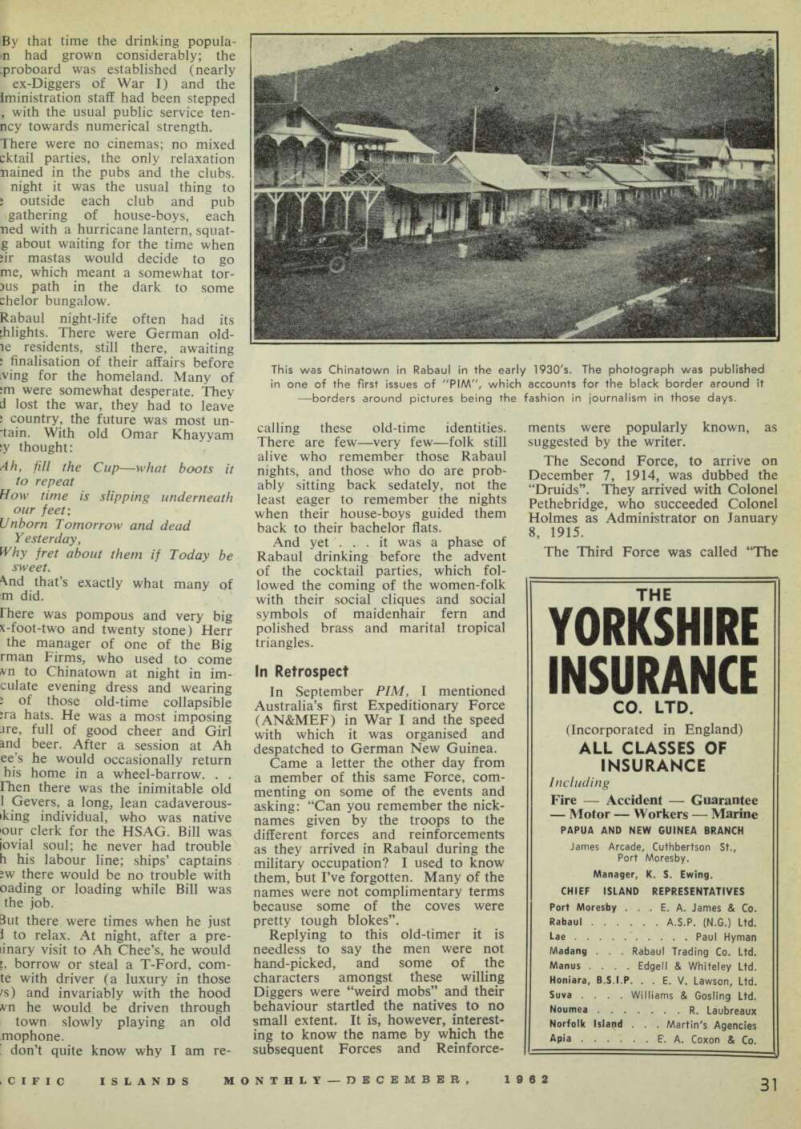
This was Chinatown in Rabaul in the early 1930's. The photograph was published in one of the first issues of "PIM", which accounts for the black border around it —borders around pictures being the fashion in journalism in those days.
’omicals” and arrived on February , 1915; the First Reinforcements, rriving on November 29, 1915 were The Measlies”.
Over a year later, on December 4, 1916, came the Second Reinforce lents, “The Wallingfords”. In Ictober of the next year the Third ud Fourth Reinforcements arrived ud were respectively named “The orty Thieves” and “The War babies”. Finally, on June 22, 1918, ame the Fifth and final Reinforce lent, “The Hungry Hundred”.
And such were the component arts of “The Coconut Lancers” as ley were called by the civilian uropeans in New Guinea. One can raw certain inferences as to the eneral characteristics of the ersonnel from the titles, and there no doubt there were some tough abies amongst them. Nor did the other ranks” have a monopoly mongst the (Get Rich-Quick) /allingfords, the Forty Thieves or le Hungry Hundred. orrection To keep the record straight it lould be pointed out that in Lew riday’s article on the Duke of
Yorks {PIM, Nov. p. 93) there ap pears an error (most likely a typo graphical one) where it mentions “we came to Mioko or Port Hunter . . . the first Christian settlement in the whole of New Guinea”. This should have read Molot, not Mioko.
Means to An End About NG’s health; Only recently another letter came from an old-timer in which he was recalling some of the incidents in the early Twenties in an isolated NG area where, as was the usual custom, the DO had been transferred from the Military to the Civil Administration (which dated from May, 1921).
“The same Captain X,” wrote my friend, “had cornered the local market for tortoise-shell, the odd pearl, etc., and when he was trans ferred to the Kavieng district in 1923 he had the opposition of a young doctor there. This doctor had a brain-wave. He put a boy in every village with a few bandages, salts, etc., thus competing with the DO’s representative, the Tul Tul.
Thus were Medical Tul Tuls born, or that’s the way I heard it, anyway.”
I don’t suppose the official history of the NG Public Health Depart ment will agree that this personal acquisitiveness laid the foundation to the creation of this useful adjunct to the service. But it could have been so. There were queer things ’neath the Tropic Sun, around ninety hundred and twenty-one. . . . And there were some good things which have gone unsung: Tom Brennan sailing about in the Lady Betty amongst isolated island groups for weeks on end; Raphael Cilento checking up on health conditions in forgotten areas in the Boina. And then about the same time was the famed Dr. Sylvester Lambert on his hookworm campaign, with his well organised willing workers and their chenopodium.
No, when you really stop and think and then compare the work of
the P-NG PHD with both the Federal and States Health Depart ments in Australia (and in many other countries, too) with all their shillying and shallying and their astronomical expenditures, P-NG has done, and is doing, a very fine job.
And, to my mind, of the greatest importance.
Of what use is a literate nation if it is not healthy?
Roofs and
Earthquakes
That public relations man was a bit off beam in his statement ( PIM, Nov. p. 41) that ash and soil were piled 10 ft on the roofs of all build ings in town following the 1937 Rabaul eruption, adding “Most col lapsed . .
My first comment is “Hooey!” My second is to state that I doubt very much if even 10 inches of ash accu mulated on the roofs, and to my per sonal knowledge only one roof of a building collapsed—and that was the temporary office of the Bank of NSW in Mango Avenue.