Tropicslitirs
pp. 19-23 · Read in the full issue
fhe decision by the Nauruans to ask Australia for Fraser sland for their new home has not at this time of writing been officially confirmed, although PIM reported the decision n November (p. 6.). The reason for the delay, we suppose, s that officialdom is just not sure how to handle the request’ and ve, let it be said, are rather sympathetic to officialdom’s plight.
Ve wouldn’t like to have to settle the matter ourselves, or whatever anybody does might well be wrong in Nauruan eyes.
VAURUANS appear to be talking in one voice, but the fact is that lere are many voices on Nauru, here are many Nauruans who (ould be quite happy to go to Aus ■alia to settle, on the basis proposed y the Australian Government—that i, to receive a house somewhere in le suburbs.
But officially the Nauruans have sked for an island home of their wn, where they would be self overning.
They want to be self-governing on raser Island, which is Queensland erritory and a forestry reserve, fiey want to have their own police irce, their own Customs, their own ealth department—their own every ting—and be related to Australia by Treaty of Friendship.
The Government appears to have lade it plain to the Nauruans that lis matter of wanting self-govern lent on Australian territory is rather tall order. It has told them that if n island were available off Australia
they would be allowed to run it the same way as a municipality is run in Australia, with the extra advantage that they could have control of “im migration”. That is, the Nauruans would be able to say who should live on their island and who should not. But matters of health, Customs, etc., would still be a matter for the Commonwealth Government.
If the Nauruans could be en couraged to accept an island on this basis then there is little doubt that the Australian Government would get what it unofficially hopes for in the long run—that is, final integration of the Nauruans with the Australian people. Nauruan youngsters on an island near the coast eventually would go to the bright lights to work and settle—the same way as Nor folk Islanders and even Pitcairners, now find their way to New Zealand and Australia. (Remote Pitcairn has in fact been suffering a serious man shortage as a result of the number of able bodied men who head west, never to return.) But the Nauruans have certainly forced officialdom’s hand in asking specifically for Fraser Island. The ball is now in officialdom’s court. For this tactic the Nauruans probably have to thank Mr. W. A. Baker, a Sydney union advocate, who has been able to give some of the Nauruan leaders quite a lot of advice lately.
And what does Queensland think about it all? The next step is awaited with interest!
The Bright Lights
BACK in the Solomons after see ing the bright lights of the US is Ben Kevu, of Wana Wana Lagoon.
It was Ben’s first time out of the Solomons, and every report we have makes it clear that the BSIP has had no better ambassador. He acquitted himself like the gentleman he is.
Ben is the man who took the mes sage from Australian Coastwatcher Reg Evans to PT boat captain J. F.
Kennedy in 1943, and then took Ken nedy back to a rendezvous with Evans. Ben, earlier this year, took part in the filming of the Kennedy saga by US TV man Jack Paar and he and Reg (who lives in Sydney) went off to the US in September, at Paar’s expense, for the premiere of the feature. After the show Ben and Reg met all the former crew mem bers of Kennedy’s PT boat except one man who had died since. It was quite a party. George Ross, third officer of PTIO9 the night the boat was rammed, was one who showed Ben around, and he re ported later that Ben took to getting up at one party and re citing a poem about a little flower— which made a great impact!
Ben called at the White House, where President Kennedy sat in his rocking chair and reminisced with him. He showed Ben the note on an OHMS envelope which Reg Evans had written to him and which Kevu had delivered. He also gave Ben a number of PT boat emblem tie clasps to give to Ben’s family. On the way out of the White House office J. F.
Kennedy introduced Ben to Austra lian Prime Minister Robert Menzies who was on his way in for an inter view with the President.
Only once was Ben stumped for the right thing to do during his US trip. That was when the Jack Paar show presented him with a gold watch and he complained later that he couldn’t wind it. Not surprising— it turned out to be the self-winding kind. (Over)
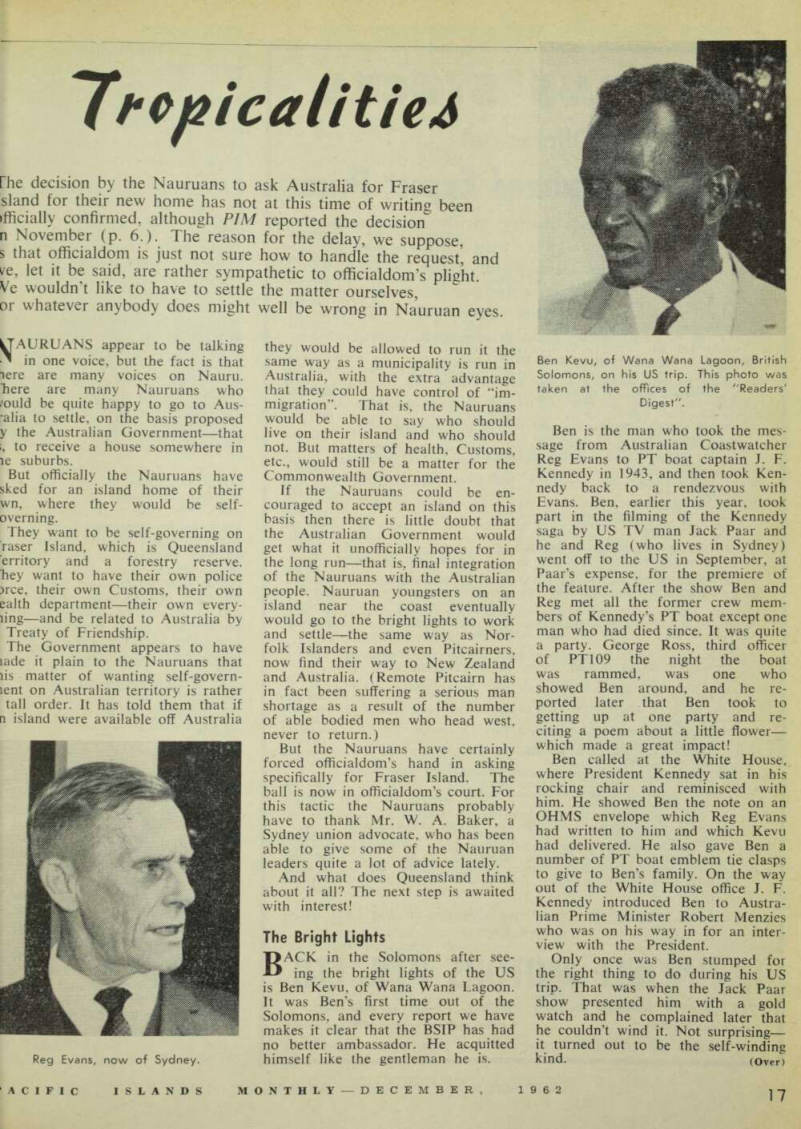
Reg Evans, now of Sydney.
Ben Kevu, of Wana Wana Lagoon, British Solomons, on his US trip. This photo was taken at the offices of the "Readers' Digest".
The Idealists WHETHER the Nauruans have heard of Bernard Stanbury and the Great Barrier Reef islands of Percy and Hummock Hill we don’t know, but perhaps all of them ought to get together.
We ourselves had never heard of Mr. Stanbury or those two islands until the other day when we got in the mail from London a roneoed handout from “S. Goodall (Press Officer) of Shepherds Bush” giving us the news that one of those two “warm, beautiful, exotic and fertile islands is to be the future home ol an international group of Idealists”, It seems that Mr. Bernard Stan bury, described as a London business man, and his wife, Sally, 24, an nounced last year in the persona! columns of The Times that they wen organising a small self-supporting community on a tropical island —i community in which (says the hand out) “money will be obsolete anc co-operation will replace competitior as the keynote in their lives”.
There are now 22 people in th( group and some of them will begii to head for either Percy or Hum mock Hill (the final decision hasn’ been made apparently) early nex year. But there are still vacancies fo: anybody mad enough to want to b< in it—which is the reason why th< public relations handout was hande( out to us. (They want people quali fied in agriculture, botany, medicine horticulture, diesel engineering, foo( processing and “teachers interested ii non-competitive education”, whateve that is.) What with independent nations am international groups of Idealists, th« Queensland coastline is not going t< be what it was.
Mister Sport
KEVAN GOSPER, former Olym pic runner (despite his fame h still gets his name incorrectly spellei with an “i”) is pretty pleased a being given the honour of managin the first Papua-New Guinea combine sporting team to compete interna tionally under the Territory’s ow banner—the team that competed a the Perth Commonwealth Games.
But it’s an honour he deserved, fc never has anybody so quickly am firmly established himself as a Guinea identity than Gosper, win had been in New Guinea less thai 12 months, when he was appointee Shell man in Rabaul.
“Kevan Gosper came just at th right time for New Guinea,” L© Michel told us while we drank
n and tonic together as the team ent through Sydney in early No ;mber. “He was the right man to ain our blokes and he got stuck to it. He’s worked remarkably ird in his own time. New Guinea’s cky.”
New Guinea is. But we couldn’t ;lp raising a smile at Les Michel’s Imiration for people who give up eir own time without stint. Michel mself didn’t earn his own title ! “Mr. Sport” for sitting behind his fice desk in Port Moresby.
Les Michel has been a sporting ime in New Guinea since 1949 hen he was discharged from the rmy there with rank of captain.
In Rabaul he was a leading light cricket, and he kept shining when 1951 he went to' Port Moresby, ir the last 10 years he has been esident of the Port Moresby ricket Association; but his interests in Ko Rugby League, swimming, nnis, athletics, basketball; just »out anything.
Eighteen months ago Michel was tending a dinner for the Port oresby Women’s Basketball Asse rtion, of which he is president, len Lady Cleland, wife of the P- G Administrator, made the remark at it would be “wonderful” if New uinea could send its own basket ill team to the Perth Games.
It was merely a dream. But Les
Michel decided that perhaps the dream could be a reality—P-NG to field its own team at international sport. A P-NG British Empire Games Association was formed—Les Michel as president—and everything fol lowed from there. The first success ful hurdle was to obtain interna tional recognition for P-NG.
In the last year P-NG sport has come of age—all as a result of that first dream. That shot at the moon unified the whole Territory, and in all the key centres sporting clubs and associations have been formed— boxing, weightlifting, athletic clubs (there are four athletic clubs in Port Moresby alone now) and a P-NG Athletic Association was established.
“Everything’s been the first because we started from nothing,” Michel told us.
The public kicked in with £B,OOO to send the Games team to Perth.
After Perth comes next year’s first South Pacific Games, in Suva, and after that—the Olympics perhaps.
When Les Michel is not being New Guinea’s “Mr. Sport”, he is secre tary of three Papuan rubber planting companies Kerema, Rubberlands and Maraboi.
The Hon. Peter AFRICA was something of an eye opener for the Hon. Peter Plow man, West Samoan MLA, who passed through Sydney in November on his way home to Apia after representing the independent state of Samoa at the British Commonwealth Parlia mentary Association convention at Lagos, Nigeria. Nigeria was most hospitable to the 141 delegates, who were shown all over the large West African State.
But on the way home, in Leopold ville, in the Congo, his group were held sternly incommunicado, mostly behind doors. “There is no doubt conditions are grim in the Congo,” he said.
In Bloemfontein, in South Africa, there was an unpleasant incident. Bad weather had forced their aircraft to land, but one member of their party, an educated American Negro with a medical degree, who as representative of a US organisation was distributing large gift sums for medical work in Africa, was segregated from the European party.
For the night he was allotted a grubby servant’s room at the back.
His fellow travellers were indignant, but the Negro shrugged philosophi cally and said it was a topsy turvy world.
Peter Plowman takes a keen in terest in West Samoa’s political and social affairs. He is chairman of the Public Accounts Committee and also has a Samoan title—he is High Chief Leilua Plowman, of Savaii. He has taken Western Samoan nationality.
Back home, High Chief Leilua Plowman will for awhile shed his official mantle to become plain Peter Plowman, successful trader and poultry farmer. His farm is supplying an increasing proportion of eggs con sumed in Samoa.
He is also specially interested in developing banana growing areas in Savaii for the Japanese trade. He says there is plenty of land, and what are needed are suitable port installa tions.
Fiji's Pretty Miss
ETA ULUVULA, Fiji’s “Miss Hibiscus” for 1962, seemed as if she had been used to reporters, photographers and TV cameramen all her life when she arrived at Sydney’s Kingsford Smith airport in November for her two-week holiday in Australia —one of her Miss Hibiscus prizes.
From the time she arrived at 8.30 a.m. until 10 a.m. she saw more flashbulbs and answered more ques tions than in any similar space of time before. But Eta remained un ruffled and charmed everyone.
We met Eta later at a big recep tion at the Pacific Hotel, Manly, her home for three days. The hospitality
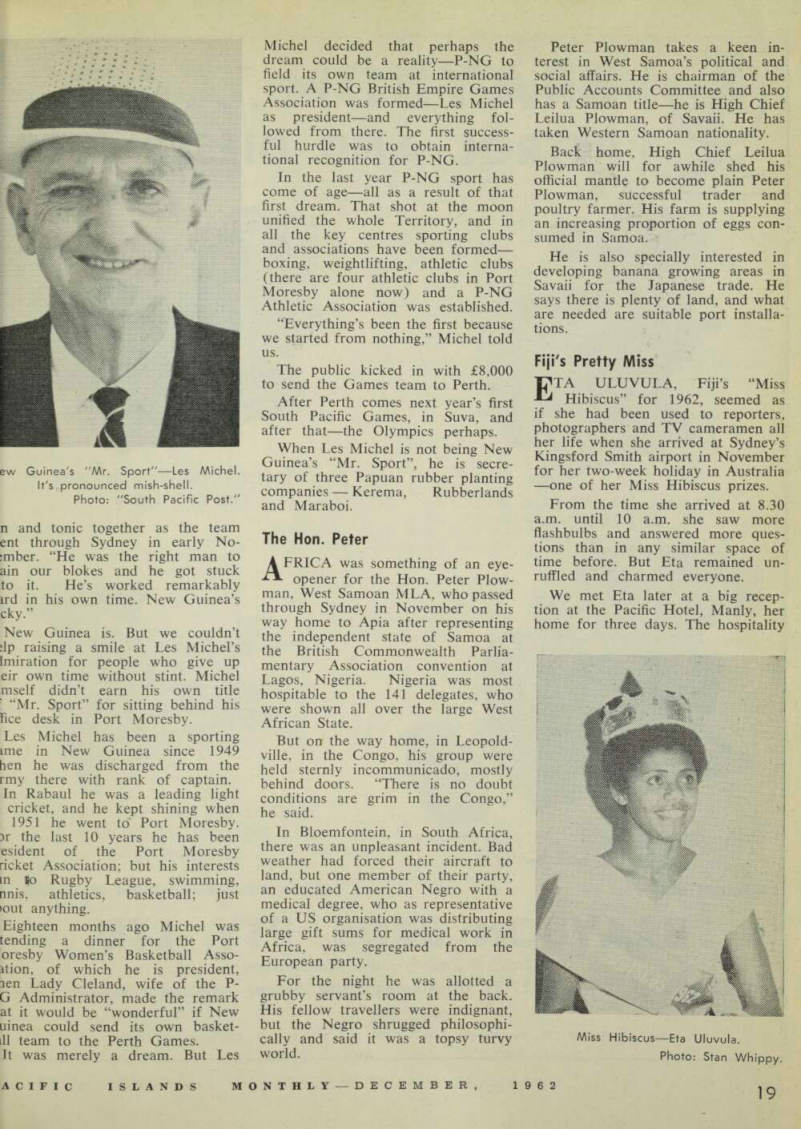
[?]ew Guinea's “Mr. Sport"—Les Michel.
It's pronounced mish-shell.
Photo: "South Pacific Post."
Miss Hibiscus—Eta Uluvula.
Photo: Stan Whippy.
-eally was turned on by the organ sers—and Sydney Press and Public delations were left in no doubt that Eta had arrived.
She told us that during her free lours of the day she had intended ;oing swimming at one of Sydney’s leaches that she had heard so much ibout but “it was a bit too cold”, [hat says little for Sydney’s climate ompared with Fiji’s, as it was one »f the finest and warmest days for ome time.
Keeping a watchful eye on Eta i Sydney was Ratu Joni Vuiyasawa, Fijian law student at Sydney Uni ersity. Joni had been asked to be n hand to give Eta moral support ut he assured us she did not need ny. Joni and Eta are old friends, oni attended the Queen Victoria chool, brother school to the Adi 'akobau School, where Eta was edu ated.
Joni was also a judge in the Miss [ibiscus quest of 1960.
“In that year,” said Joni, “second lace was filled by Miss Wendt who as runner-up to Eta this year. Any ne who can defeat Miss Wendt really jserves to win the title.”
Ithy Islands Lucre PILTHY, evil-smelling and dilapi dated” is a description applied the Fijian 5/- and 10/- notes. The ►mplaint was recently voiced by the a Chamber of Commerce, whose embers had apparently had to put ) with growls of tourists about the ate of the money they were some nes asked to handle.
The Ba Chamber decided to ask e Fiji Visitors Bureau to ask the easury to do something about it. icy considered that such notes were poor advertisement for Fiji.
The Commissioners of Currency plied that in the past year 712,300 serviceable notes had been with awn by Fiji banks, and the reason ly dirty notes continued in circu ion was that they never reached ; banks.
Fiji should cheer up. Its problem is neral. An American banker we ran o in Apia recently told us that sst Samoan banknotes were the »rst he’d ever seen. Said the banker: /here I come from the average life a dollar bill is reckoned at six mths. In Samoa a banknote jrages about two months. But what i you do but keep pulling them