Newspaper Sensationalism
p. 11 · Read in the full issue
Anger In New Guinea Over Newspaper Sensationalism
From a Mt. Hagen Correspondent Moves are being made in the New Guinea Highlands to combat the bad “Press” that New Guinea has been getting in Australia.
HE moves have followed indigna tion and even anger in the High- Js over articles in the Australian fspapers by journalists who make ng visits to the Territory. 4uch of what these “objective, on spot” reporters have been writing he worst kind of sensationalism, :d with untruths and half-truths virtually inviting agitators to ry on the good work. /luch of it appears to be directed he “white man”. Readers of these cles—which would be all readers Australian newspapers because / are widely syndicated—could be used for thinking that “white i” is a dirty phrase in New inea. hey could be excused for think that white men are exploiters and tiers and that the native people just waiting for the opportunity dck them all out. n Mt. Hagen recently, the Ear ’s and Settlers Association, the Re icd Soldiers’ League and the Dis t Advisory Council have all dis ced this disturbing growth of sen sualism. he District Commissioner, Mr. n Ellis, recently went so far as to that if “this adverse and untruth publicity in mainland newspapers illowed to continue, a very real ger exists to the political future he Territory”. peaking to the Western Highlands nch of the RSL recently, Mr. s said one recent series of articles appeared as the W'est New nea question was “being fed for all it was worth as a •ce of danger to the security of mainland”.
Taken in this light,” Mr. Ellis , “the series constituted an attack the Australian Administration of Territory in so far as the articles e directed specifically and entirely ards trying to prove that there ted in this Territory a strong and espread undercurrent of dissatis ion and ill-feeling on the part of natives against Europeans.
The conclusion they attempted to
infer, with, I am afraid, a consider able amount of success, was that we had failed in our Administration and were disregarding these dangerous attitudes on the part of the natives, which could result in an outbreak of something akin to Mau-Mau.
“This may appear ridiculous to us with our intimate knowledge of the Territory and the actual conditions existing here, but to the average Aus tralian reading these articles and see ing these pictures, such a conclusion was not impossible to reach.”
Mr. Ellis said another conclusion that could easily be reached was that many newspaper articles were part of a campaign to decry Australia’s achievements in the Territory, dis credit Australia in the eyes of the world and thereby force its with drawal.
“We are the last ‘colonial’ ad ministrators,” he said, “and as such there are many eyes turned towards us from the newly created nations of Africa and South-East Asia and none of these is friendly.
“To these peoples the word colon-
ialism is a dirty one and I can assure you that in the course of the years immediately ahead of us these nations will attempt to exercise stronger and continuing pressure, through the UN, to oust us from this country, without reference to the wants and the needs of the native people and without consideration of the effects that such an untimely withdrawal would have.”
Mr. Ellis said he felt the time was ripe for a counter publicity campaign to be launched, to repair the damage and to “bring clearly and forcibly home to the Australian public that the conditions existing in this Terri tory are precisely opposite to that inferred by recent adverse publicity.”
He added that unless the publicity was combated swiftly the time would come quickly when the Australian newspaper readers would have ac cepted the false picture and the task of correcting it would be immeasur ably more difficult.
One suggestion that has come up as a result of public discussion of this dangerous and vicious Australian newspaper trend is that New Guinea organisations should group together and employ their own Press officer, or a journalist who would write a series of articles giving the correct story.
Such a man could point out that the New Guinea people are aghast at any suggestion that Australians should leave. The natives realise it is impossible for them to reach their economic destiny without the Aus tralians. The general feeling between the native people and the Europeans, especially in the Highlands, is one of friendliness and mutual respect.
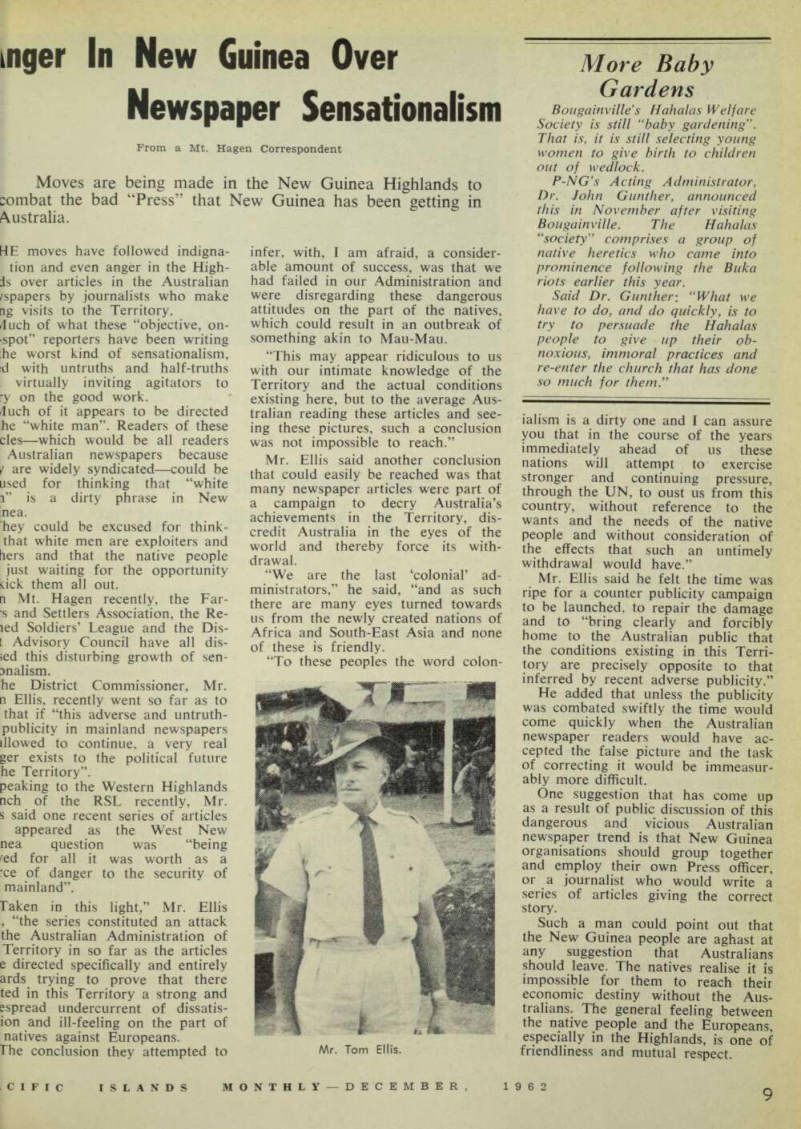
Mr. Tom Ellis.