Telecommunications
p. 10 · Read in the full issue
New Era In Trans - Pacific Telecommunications
A new era in telecommunications between Fiji, New Zealand and Australia will begin on December 3 when the second link in the Commonwealth Pacific Cable project (COMPAC) comes into operation.
THE new link will enable 12 high quality telephone conversations to be held simultaneously between Fiji and the other two countries. It will also provide facilities for the transmission of high-quality telegraphic and telex messages, and pictures The COMPAC project, estimated to cost £33 million, will eventually link Australia and Canada. When completed, it will provide 80 simultaneous two-way channels.
Each channel could alternatively be used for up to 60 telegraph or teleprinter channels or for the transmission of picturegrams, or music or voice broadcasts.
The first COMPAC link, between Auckland and Sydney, was officially opened on July 9 when the Australian Prime Minister, Mr. Menzies, and his New Zealand counterpart, Mr. Holyoake, spoke to each other by telephone.
The laying of the second cable link, between Suva and Auckland, began on October 17. It was carried out by the British Post Office cable ship Monarch and the repair ship Retriever, owned by Cable and Wireless Ltd.
The next two sections of the COM- PAC cable, between Fiji and Hawaii, and from Hawaii to Vancouver, will be laid by the newly-built British cable ship Mercury, which sailed for the Pacific in November.
These two sections of cable are expected to be put down by the end of 1963. The COMPAC cable will then
be connected by land-line across Canada to a new trans-Atlantic cable (CANTAT) between Canada and Great Britain, which was opened in November, 1961.
Following the completion of the COMPAC project, the cable ship Mercury will begin work on a £24 million project known as SEACOM.
This project will link Australia by cable with New Guinea, North Borneo, Singapore and Hongkong by 1967. .
The order of construction of SEA COM (South-East Asia-Common wealth) will probably give priority to the Singapore-North Borneo-Hong kong section.
From North Borneo (Jesselton), there will be a spur cable to Madang, New Guinea, which will link with a cable to Cairns, North Queensland, At Cairns, the system will be carried on a new inland route to Sydney, where it will join the COMPAC trans-Pacific system, The SEACOM cable will thus con nect the countries of South-East Asia not only with Australia but with New Zealand, Fiji, Hawaii, Canada and the United Kingdom, The opening of the Suva-Auckland link in this vast telecommunications project will mean the closure, after 60 years, of the Norfolk Island cable relay station.
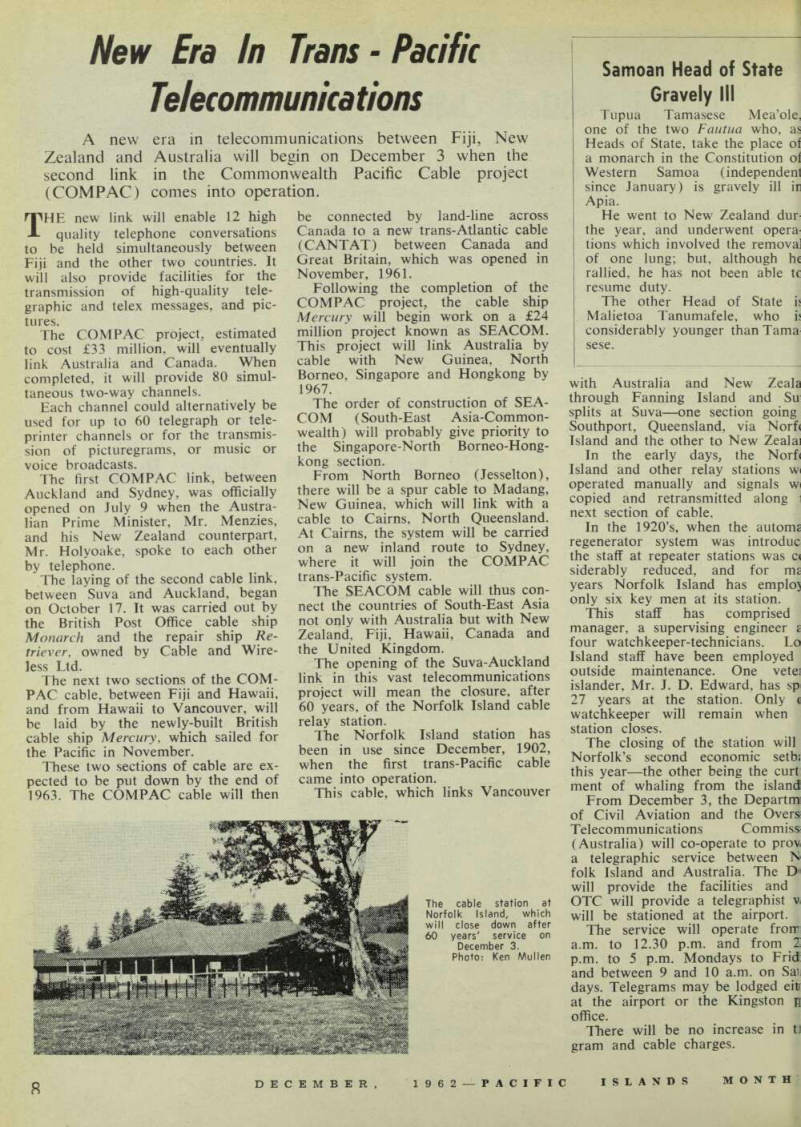
The Norfolk Island station has been in use since December, 1902, when the first trans-Pacific cable came into operation.
This cable, which links Vancouver
with Australia and New Zeala through Fanning Island and Su splits at Suva—one section going Southport, Queensland, via Norf( Island and the other to New Zealai In the early days, the Norf< Island and other relay stations w< operated manually and signals wi copied and retransmitted along i next section of cable.
In the 1920’5, when the automs regenerator system was introduc the staff at repeater stations was c< siderably reduced, and for ma years Norfolk Island has emplo) only six key men at its station.
This staff has comprised manager, a supervising engineer a four watchkeeper-technicians. Lo Island staff have been employed outside maintenance. One vetei islander, Mr. J. D. Edward, has spi 27 years at the station. Only e watchkeeper will remain when station closes.
The closing of the station will Norfolk’s second economic setbi this year—the other being the curt ment of whaling from the island From December 3, the Departm of Civil Aviation and the Overs Telecommunications Commiss (Australia) will co-operate to prov a telegraphic service between N folk Island and Australia. The D' will provide the facilities and OTC will provide a telegraphist v will be stationed at the airport.
The service will operate from: a.m. to 12.30 p.m. and from Z p.m. to 5 p.m. Mondays to Frid and between 9 and 10 a.m. on Sat days. Telegrams may be lodged eitr at the airport or the Kingston p office.
There will be no increase in ti gram and cable charges.
The cable station at Norfolk Island, which will close down after 60 years' service on December 3.
Photo: Ken Mullen