As the Bar-room Doors
pp. 7-8 · Read in the full issue
A 'New Look' New Guinea As the Bar-room Doors Are Thrown Open for All
From Correspondents in Papua-New Guinea Papua-New Guinea’s new liquor laws have brought about a big change in the Territory’s social habits—but no murders or mayhem. The first month of the new laws has ended with out any major incidents, but with a general quickening of drinking activity among the natives, who took the first week very quietly indeed.
According to some social workers there are signs that some families are going hungry while the men drink their wages, and there is apprehen sion that this practice will grow, causing domestic upsets. It is too early yet to report a trend. But people, particularly missionaries, with experience in other South Pacific islands where drink has been introduced, point out that the first few months are not really a test, as everybody is on their best behaviour. Trouble can develop later.
IHE new laws come into effect on November 2, the ordinance un r which they operate being a tem irary one. It will be reconsidered at other meeting of the P-NG Legis ;ive Council early in the new year.
The new laws lifted a total ban on ink for natives.
Both sexes, over 18, may drink ything they like on licensed pre ses, or on social occasions when jy are guests. But they may pur ase only beer to drink at home. ie laws apply to almost two mil n natives, but hundreds of thou ids of these are in wild areas icre they are never likely to be in ested in liquor.
The Acting Administrator, Dr. tin Gunther, went on the air on ; eve of D-Day to appeal to the od sense of the native population Dt to rush into hotels and drink to :ess just to use the new opportunity buy liquor.”
He also appealed to them to keep :ir liquor spending to a sum they ild afford without neglecting family ponsibilities. ‘There is nothing clever about be : able to drink,” he added.
Phe Secretary for Law, Mr. W. itkins, the same evening on the air dined the drinking laws and hours. told the new drinkers that hotels re open from 9 a.m. to 11 p.m. inday to Saturday and from 11 i. to 1 p.m. and 5 p.m. until 7 i. on Sundays.
Fie said stores with licences could 1 only a dozen bottles of beer at ime. Clubs “belonged to the mem ■s” and natives could not enter a
club unless they were members or invited by members. Clubs could re main open from 10 a.m. to 12 mid night daily.
He stressed that Legislative Coun cil members “would be interested in the way the native people were drink ing,” because they could alter the laws.
Most hotels in the main centres of Port Moresby, Lae and Rabaul re ported very quiet trading for the first day or two. On the first day at Rabaul a few natives wandered into the town’s two hotels, but at lunch-
time there was not a solitary one at the bars. Some filtered in after lunch and by late afternoon there were only a handful on one side of the bars, with Europeans on the other.
But trade picked up the first even ing, and after that Territory hotels reported a big increase in natives in the bars, while the Europeans re treated to the clubs.
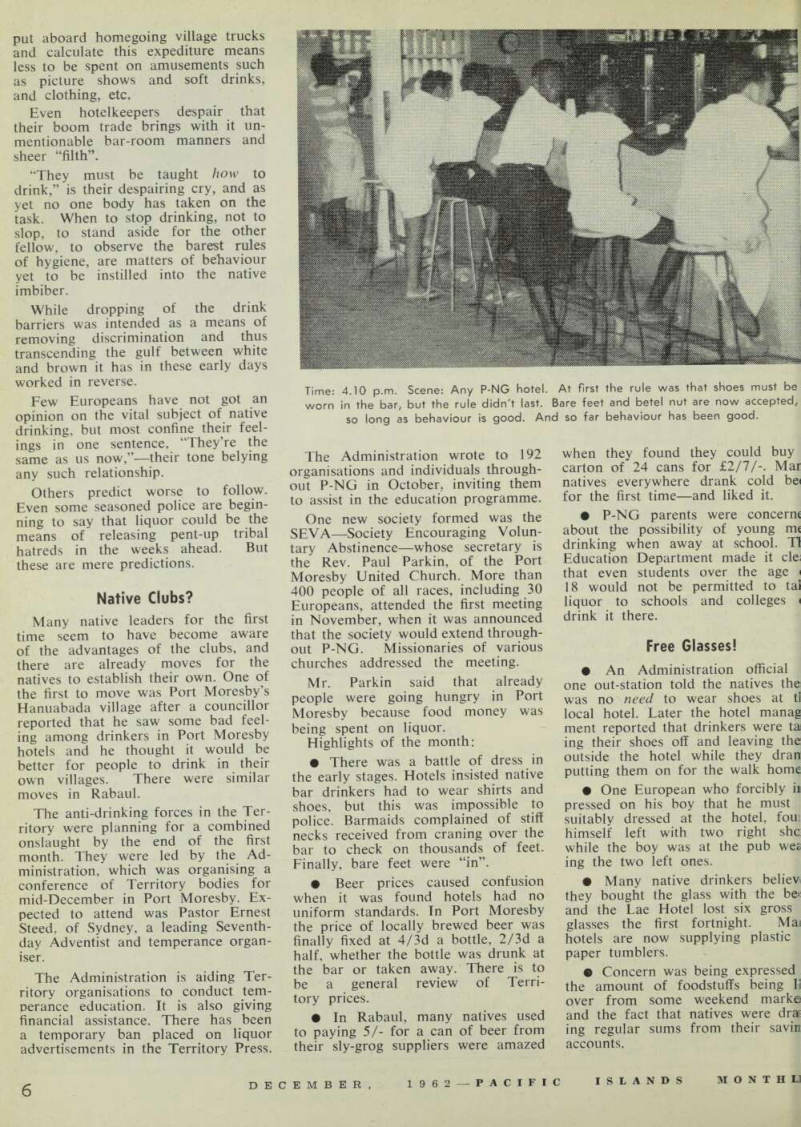
Hardened topers line up at the bar and cling tooth and nail to their preferred positions while those in the back clamor for attention. The scene is little different from Sydney’s legendary “swill” except that these drinkers are mostly barefoot (except those who charitably share their foot wear around), regard their drinking utensils of thin plastic as being as disposable as a coconut, so that one hotel lost 2,000 in one week, and think it no social error to upthrow before company.
One hotel admits to closing for hours at a time so that the bar-room can be swabbed out for another session. They’ve also had to close because of shortage of stock and there’s no gainsaying the increased custom hotels are enjoying.
As one manager put it, “Our tak ings have gone up 200 per cent.—and we’ll never ever be short of silver again”.
Not so happy are other town busi nessmen who have noticed a falling off in native trade. Most affected are those who previously catered for the sly grog trade and for whom few have sympathy. Others mentally tot the value of beer cartons being
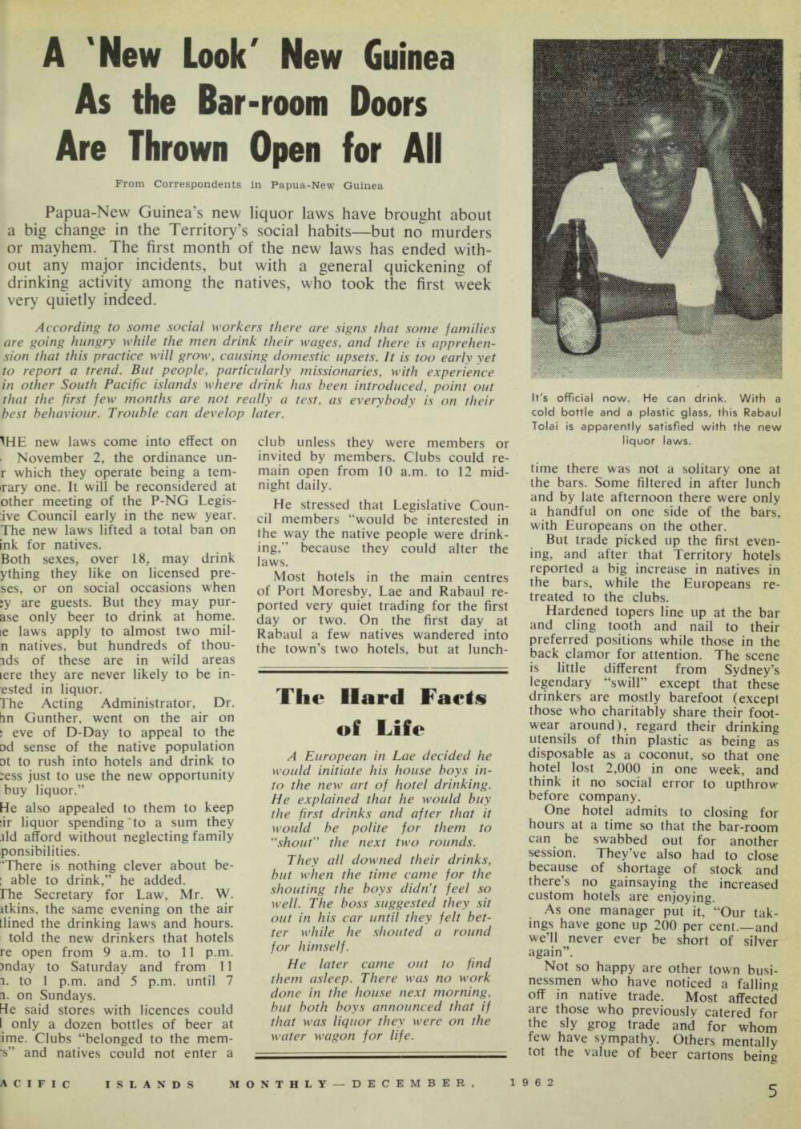
It's official now. He can drink. With a cold bottle and a plastic glass, this Rabaul Tolai is apparently satisfied with the new liquor laws.
put aboard homegoing village trucks and calculate this expediture means less to be spent on amusements such as picture shows and soft drinks, and clothing, etc.
Even hotelkeepers despair that their boom trade brings with it un mentionable bar-room manners and sheer “filth”.
“They must be taught how to drink,” is their despairing cry, and as yet no one body has taken on the task. When to stop drinking, not to slop, to stand aside for the other fellow, to observe the barest rules of hygiene, are matters of behaviour yet to be instilled into the native imbiber.
While dropping of the drink barriers was intended as a means of removing discrimination and thus transcending the gulf between white and brown it has in these early days worked in reverse.
Few Europeans have not got an opinion on the vital subject of native drinking, but most confine their feel ings in one sentence, “They’re the same as us now,” —their tone belying any such relationship.
Others predict worse to follow.
Even some seasoned police are begin ning to say that liquor could be the means of releasing pent-up tribal hatreds in the weeks ahead. But these are mere predictions.
Native Clubs?
Many native leaders for the first time seem to have become aware of the advantages of the clubs, and there are already moves for the natives to establish their own. One of the first to move was Port Moresby’s Hanuabada village after a councillor reported that he saw some bad feel ing among drinkers in Port Moresby hotels and he thought it would be better for people to drink in their own villages. There were similar moves in Rabaul.
The anti-drinking forces in the Ter ritory were planning for a combined onslaught by the end of the first month. They were led by the Ad ministration, which was organising a conference of Territory bodies for mid-December in Port Moresby. Ex pected to attend was Pastor Ernest Steed, of Sydney, a leading Seventh day Adventist and temperance organ iser.
The Administration is aiding Ter ritory organisations to conduct tem perance education. It is also giving financial assistance. There has been a temporary ban placed on liquor advertisements in the Territory Press.
The Administration wrote to 192 organisations and individuals through out P-NG in October, inviting them to assist in the education programme.
One new society formed was the SEVA—Society Encouraging Volun tary Abstinence —whose secretary is the Rev. Paul Parkin, of the Port Moresby United Church. More than 400 people of all races, including 30 Europeans, attended the first meeting in November, when it was announced that the society would extend through out P-NG. Missionaries of various churches addressed the meeting.
Mr. Parkin said that already people were going hungry in Port Moresby because food money was being spent on liquor.
Highlights of the month: • There was a battle of dress in the early stages. Hotels insisted native bar drinkers had to wear shirts and shoes, but this was impossible to police. Barmaids complained of stiff necks received from craning over the bar to check on thousands of feet.
Finally, bare feet were “in”. • Beer prices caused confusion when it was found hotels had no uniform standards. In Port Moresby the price of locally brewed beer was finally fixed at 4/3d a bottle, 2/3d a half, whether the bottle was drunk at the bar or taken away. There is to be a general review of Terri tory prices. • In Rabaul, many natives used to paying 5/- for a can of beer from their sly-grog suppliers were amazed
when they found they could buy carton of 24 cans for £2/7/-. Mar natives everywhere drank cold be< for the first time—and liked it. • P-NG parents were concernc about the possibility of young rm drinking when away at school. 11 Education Department made it cle; that even students over the age < 18 would not be permitted to tal liquor to schools and colleges < drink it there.
Free Glasses! • An Administration official one out-station told the natives the: was no need to wear shoes at tl local hotel. Later the hotel manag ment reported that drinkers were tai ing their shoes off and leaving the outside the hotel while they dran putting them on for the walk home • One European who forcibly ii pressed on his boy that he must suitably dressed at the hotel, foui himself left with two right she while the boy was at the pub wes ing the two left ones. • Many native drinkers believ\ they bought the glass with the be<; and the Lae Hotel lost six gross glasses the first fortnight. Mai hotels are now supplying plastic paper tumblers. • Concern was being expressed the amount of foodstuffs being 1J over from some weekend marke and the fact that natives were draE ing regular sums from their savin accounts.
Time: 4.10 p.m. Scene: Any P-NG hotel. At first the rule was that shoes must be worn in the bar, but the rule didn't last. Bare feet and betel nut are now accepted, so long as behaviour is good. And so far behaviour has been good.