Cook Islanders Plan Own
pp. 143-144 · Read in the full issue
Museum and Library
From W. H. Percival, in Rarotonga Islanders in the Cook Group are making a belated, but strenuous effort to establish their own public library and museum.
IQR many years the more thought ful inhabitants have been aware the need for such a cultural centre, it efforts in the past to establish ie have failed because of lack of oney and a suitable site.
Today, the need for a library and useum is greater than ever. The tpulation has increased and, al ough more Islanders are learning iglish at school, they have little iportunity for reading English after iving school.
Visitors to Rarotonga are also in easing and some of them require cess to reference books while en ,ged in academic work.
Besides this, much of the historical aterial of the Cook Group has al ady been lost, and there is a danger at what remains will also vanish iless a museum is established.
Since the coming of the white man, e most valuable and interesting tifacts, such as canoes, heathen >ds, weapons and tools have been ipped away to overseas museums.
Some Cook Islanders have thought ssly destroyed such things them- Ives, as when Mauke Islanders cut ) some old, double-hulled sea-going moes for use as coffins in 1933.
Most young people in the Cook lands know little or nothing of their lands’ history, a sad state of affairs »r a once proud people who have sen termed “The Vikings of the acific”.
During the past 18 months, a iovement for the preservation of ie past has arisen. Backed by the esident Commissioner, Mr. A. O. iare, it includes several prominent
>cal personalities.
As land is difficult to obtain in arotonga, especially in the port of .varua, Makea Nui Ariki, CBE, a oman of high rank, who is rominent in political and social ircles, gave some of her family land t Avarua for the building of a cul iral centre.
The site is part of the land known s Taputapuatea, on which stands the jined palace of the Makea family nd the remains of a marae, an open-, ir temple of heathen days.
Taputapuatea is bound up with Rarotongan history. It was there that the Union Jack was first flown—in a successful attempt to prevent thel French from annexing Rarotonga in* 1888.
The site has now been cleared of bush and Mr. Kenneth Mills, a New Zealand Ministry of Works architect and a former Resident Agent of Mauke Island, has drawn up plans for the library and museum free of charge.
He designed an attractive, modern building of low cost and large area, with provision for future additions.
Windows mounted between steel studs will form part of the library walls, giving the maximum of natural light; internal walls will be movable, allow ing the floor areas for museum and library to be adjusted as experience dictates.
Space has been allowed for displays of artifacts, models and photographs of Polynesian subjects and for the projection of films and slides.
Some interesting artifacts have al ready been given for future display, including the “Avarua Adze”, found in a garden plot some years ago.
This is a perfect specimen of a ceremonial adze, one of the best ever found in Polynesia.
In November this year, an archaeo logical team from New Zealand’s Canterbury Museum, led by Dr.
Roger Duff, will visit Rarotonga.
The expedition’s chief purpose will be to fix a more accurate date for the island’s early settlement, but any objects unearthed during their dig will also be of great interest to the Cook Islands’ Library and Museum.
The library will have books for both reference and lending, with space for 2,000 reference works and 4,500 other books.
There will be storage space for a further 1,000 books, and future ex tensions will accommodate another , 3,000.
Initially, the library will serve " Rarotongan needs, but when book I stocks build up, boxes of books will f be distributed to the outer islands.
It is planned to work in close con junction with the New Zealand National Library Service, so that books can be exchanged regularly.
Efforts will be made to accumulate a reference library dealing mainly with Polynesia.
The lending library will be stocked with books written in fairly simple English so that young people through out the Cook Group will have the chance to read and so increase their understanding of English, A reading room, with seats for 30 readers, will be open in the evenings and will prove a boon to Islands’ students following up their school studies with correspondence courses.
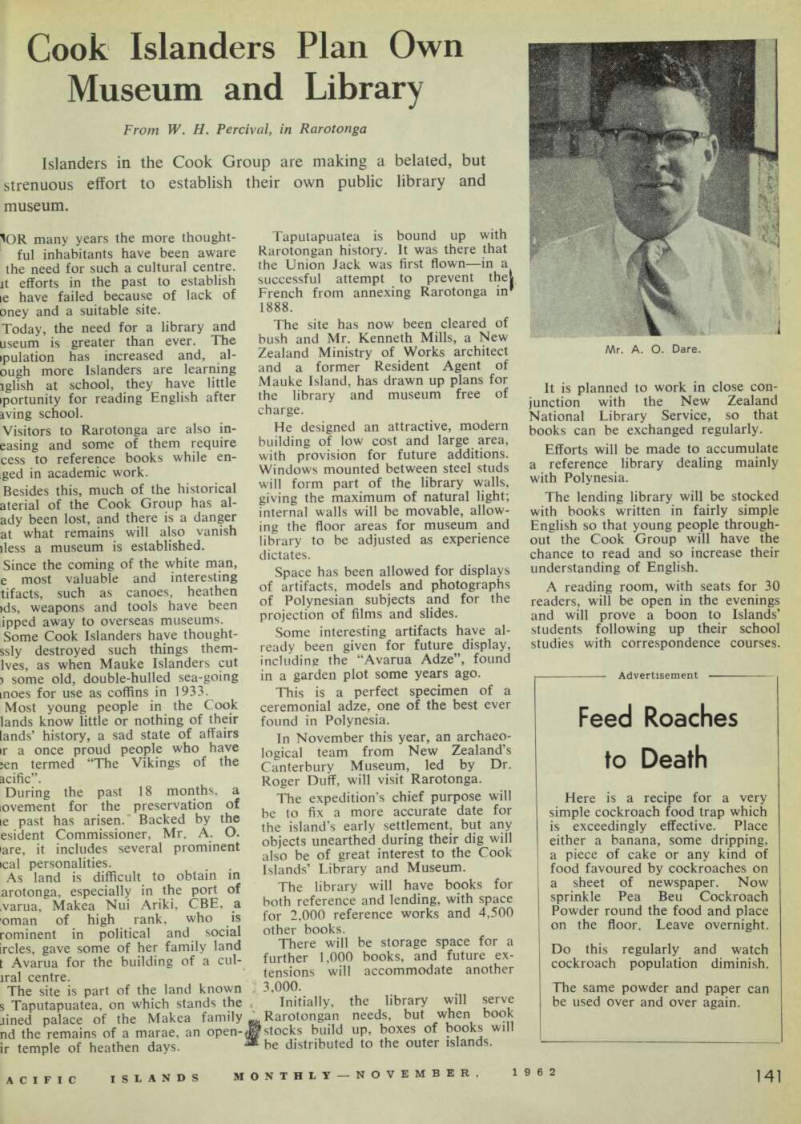
Mr. A. O. Dare.
It is hoped that a trained libraria will be found to set up a system t fit in with the National Library Sei vice in New Zealand.
A Cook Islander will then b trained in New Zealand as a librariai The building’s total area will b about 5,000 square feet, with prc vision for an extension of 1,00 square feet. Its estimated cost i £B,OOO. A further £4,000 will be rc quired for books and equipment.
The total of £12,000 would seer modest enough for such a project i most countries, but Cook Islander; incomes are low and to them th figure is formidable.
The Cook Islands Legislative As sembly has offered a subsidy of £ for every £1 raised by public sub scription over three years.
During the first financial year end ing March 31, 1962, a target figur of £2,000 was raised by the public.
This year, however, the committei is finding it harder to raise the secom £2,000.
To succeed, they need the suppor of all Cook Islanders and others in terested—including those living ii New Zealand.
The Secretary, Library an« Museum, Rarotonga, would b« pleased to receive contributions.