Up Painting
p. 128 · Read in the full issue
Gauguin's Son Takes Up Painting
A CCORDING to a report from London, Emile began painting last year when a Madame Giraud bailed him out of Papeete gaol, toobl him to her home, provided him with paints, brushes and canvases and en couraged him to paint. The result was some colourful paintings ol flowers and landscapes.
Until then he had shown no interest; in art—not even his father’s, but he had cashed in on his father’s fame by offering himself as a subject foi tourists’ photographs on the Papeete waterfront at so much a click.
In an editorial on the new Gauguin paintings, the London Daily Express said recently: “For much of his 62 years, Gauguin’s son Emile has led an idyllic if unfruitful life on Tahiti. Suddenly he turns to paint : ing and the canvases which arrive from the Pacific produce immense excitement among art lovers.
“It is a remarkable demonstration of the force of heredity; important! perhaps, for the world of art. A considerable talent, untutored, isola* ted from the stream of thought and technique, could bring a fresh, even unique, quality to painting.”
Mr. Jacques O’Hara, proprietor ol( the gallery where the new paintings? will be shown, has described them as “primitive”, “childlike almost” and something like those of the Australian aboriginal painter the late Alben Namatjira.
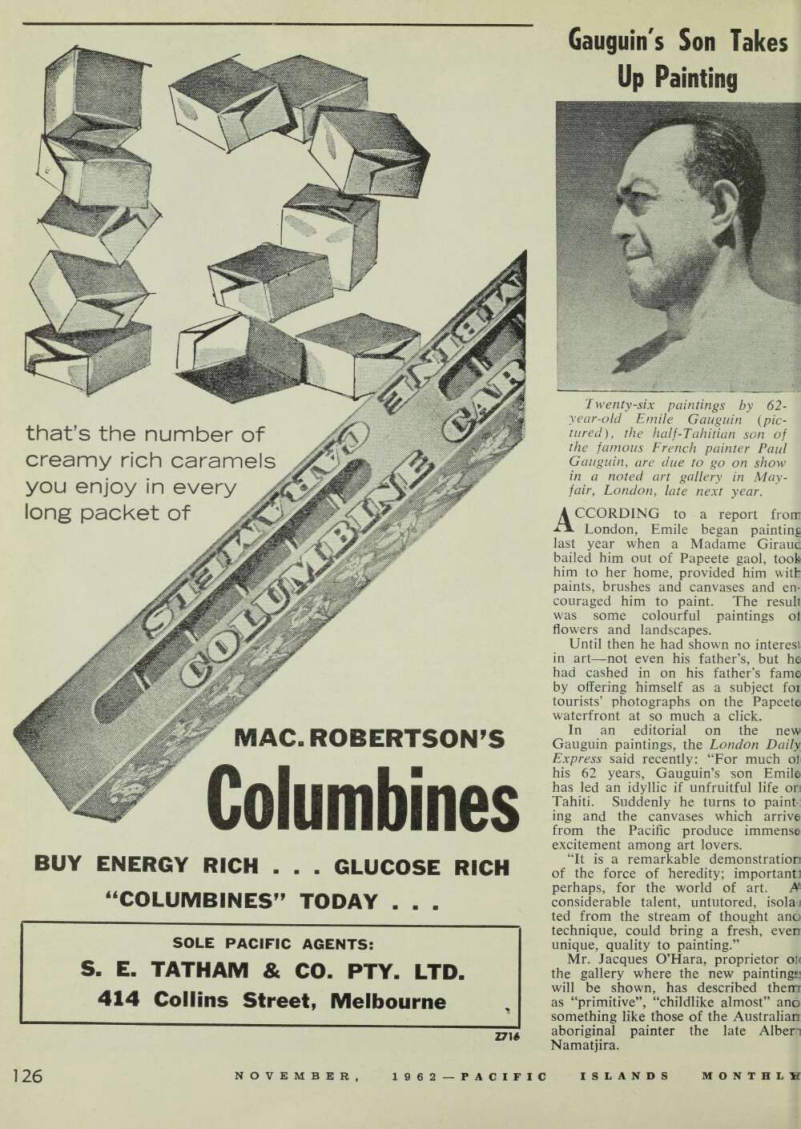
Twenty-six paintings by 62year-old Emile Gauguin (pic tured), the half-Tahitian son of the famous French painter Paul Gauguin, are due to go on show in a noted art gallery in May fair, London, late next year.