Magazine Section
pp. 81-86 · Read in the full issue

Pacific Islands Monthly
Bsip’S Western Isles Were
Worth Fighting For
By Martin Clemens
One reason I am rather fond of the wonderful, island studded lagoons of New Georgia and other places in the Western Solomons is that I fought for them during the war, although I did not see them until the fighting finished.
[THEN at last, after fighting every I inch of the way to help get jm back from the Japanese I was le to tour round in my former panese barge, or by aeroplane, I and they had been worth fighting r.
It was therefore an enjoyable ex rience for me to visit those islands ain recently following my visit to >niara for the 20th anniversary lebrations of the landing of the US arines on Guadalcanal.
As on my earlier visit to Malaita escribed in last month’s PIM), I ivelled from Honiara in the Coral leen. As far as Yandina, the ship is rather full of Lever’s people who d also been to Honiara for the an yersary celebrations.
I had hardly known Cape Marsh, as Yandina was known before the war, and was delighted when Lever’s manager, Mr. L. W. Ungless, offered to take us for a drive while the ship turned round.
I learned that the Russell Islands, formerly Banika, Lingatu, Pepisala, and several other plantations were now all under one management, run in several units.
Mr. Ungless had served with Lever’s in the Congo and West Africa. He knew his coconuts.
Lever’s have been pioneering a coconut palm from Bellona Island, which not only produces a heavier yielding nut, but a much shorter tree, which makes for easier and more effi cient harvesting. Besides using this
for replanting their own plantations, I was told they had produced and sold over 32,000 of the new strain to local producers.
Lever’s now have 20,000 acres in this one area. We were shown 2,000 acres of recently cleared virgin scrub.
Even with the heaviest equipment this has been a formidable task.
Lever’s timber expert put up his hands in horror at the beautiful timber trees which had been dozed over and lay a-burning! This area is being replanted with the new nuts.
One of the problems in planting the area was the huge quarries which had been dug during the war for road metal, and which had been left with vast quantities of metallic odds and ends.
Although these had been well picked over, useful items were still to be had. We saw a mound of Coca- Cola, vintage 1944, which I was told was still palatable.
Ammunition dumps were another problem. They were still being picked over by salvage experts.
Then there were the cattle, which had been left to roam wild in 1942 and whose progeny, red, black or brindle has survived the American in vasion.
Fencing has now been repaired and replaced, new stock introduced, and
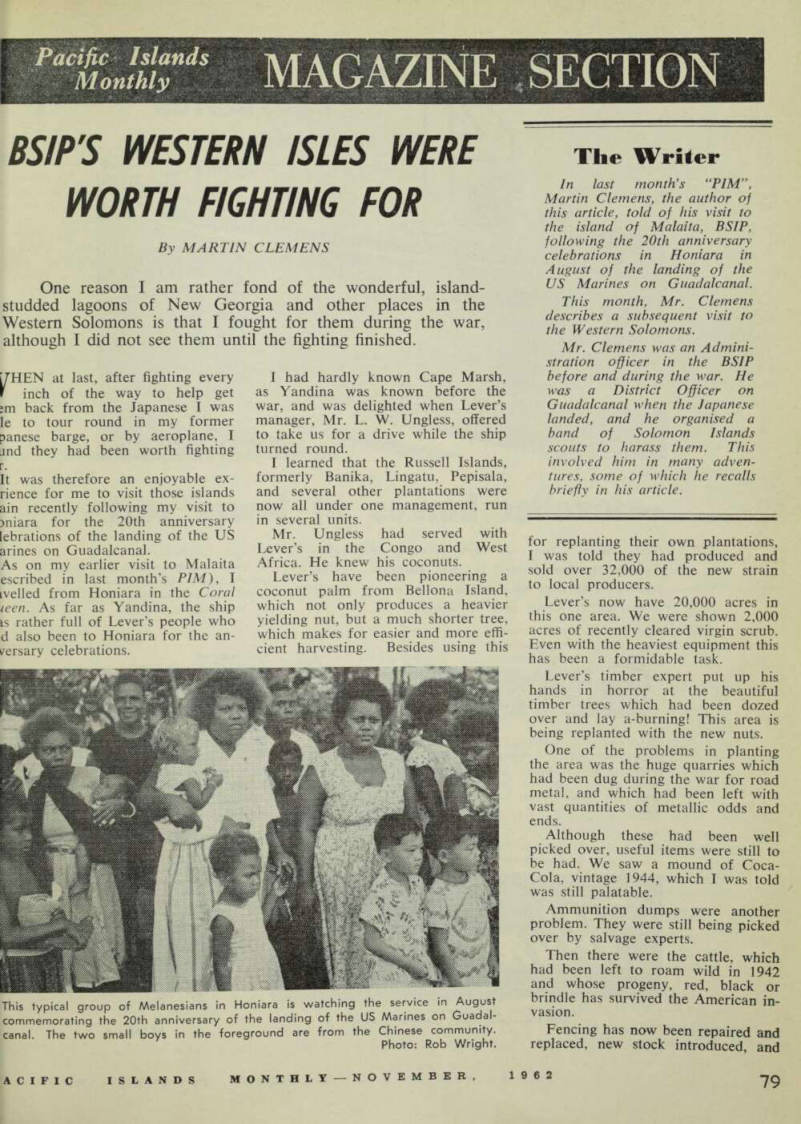
This typical group of Melanesians in Honiara is watching the service in August commemorating the 20th anniversary of the landing of the US Marines on Guadal canal. The two small boys in the foreground are from the Chinese community.
Photo: Rob Wright.
the herds are building up. They are a thoroughly mixed lot—Zebu, Here ford, Angus and Shorthorn —but Lever’s cattle man is getting them under control, although he has to train most of his staff to ride.
There are 3,000 cattle to be mustered and marked, and they hope to build them up to about 10,000.
A variety of research problems is being tackled in co-operation with Government, including the grow ing of cover crops for grazing. Pea nuts are also to be tried as an inter crop, as well as cocoa.
Mr. Ungless can get around and see what is being done by car, for there are 100 miles of good road throughout the area.
Dawn next morning found us steaming up the Blanche Channel, with wet, watery-green Rendova on the port bow, its top, as often, smothered in cloud.
As we passed the entrance to the plantation I thought back to a day in 1943. It had been the same wet sort of morning, and that narrow passage looked like a death trap.
Luckily we knew it wasn’t, as Dick Horton and Robbie, the Coast watchers, had sent scouts down to make sure.
Then we saw Roviana Lagoon with all its myriad islands shining green, as the sun shone through. Going through the passage in the reef, one could still see holes which had been blown by shell, or bomb.
We landed at Kokengelo, the Methodist Mission wharf at the west
end of the runway. Everything had been bare when 1 last saw it, but now Kokengelo hill was covered, green, and with new buildings dotted about.
To meet some natives who had served in the campaign, we piled into an ancient truck belonging to the mission, and drove down the runway to Lambeti.
The jungle had grown back to its edges, and it was hard to imagine that 700 planes had once been parked in that jungle.
I could see that we were not going to find very much to remind us of the war days.
Lambeti, now a pleasant village, is the Sub-District headquarters. I found there some well remembered faces, including Willie Paia, who had been one of the foremost scouts, Another was Kitchener Wheatley, once a doctor, who now runs stores and plantations, as did his father be fore him. He lives on Hombu Hombu island, my headquarters once the fighting was over, w e v j s j te( j Hombu Hombu in the launch of the Roviana Council, and anc hored at a fine new wharf. The area we j ia d occupied had been re planted with new coconuts. . , , .
Kitchener was planning a new v^ ier l f ea !. shack had been, At the back, I saw the rusty remains of a Jap barge which had been the first P ost - war Distric t vessel.
One or two other well-remembered vessels were also quietly resting on
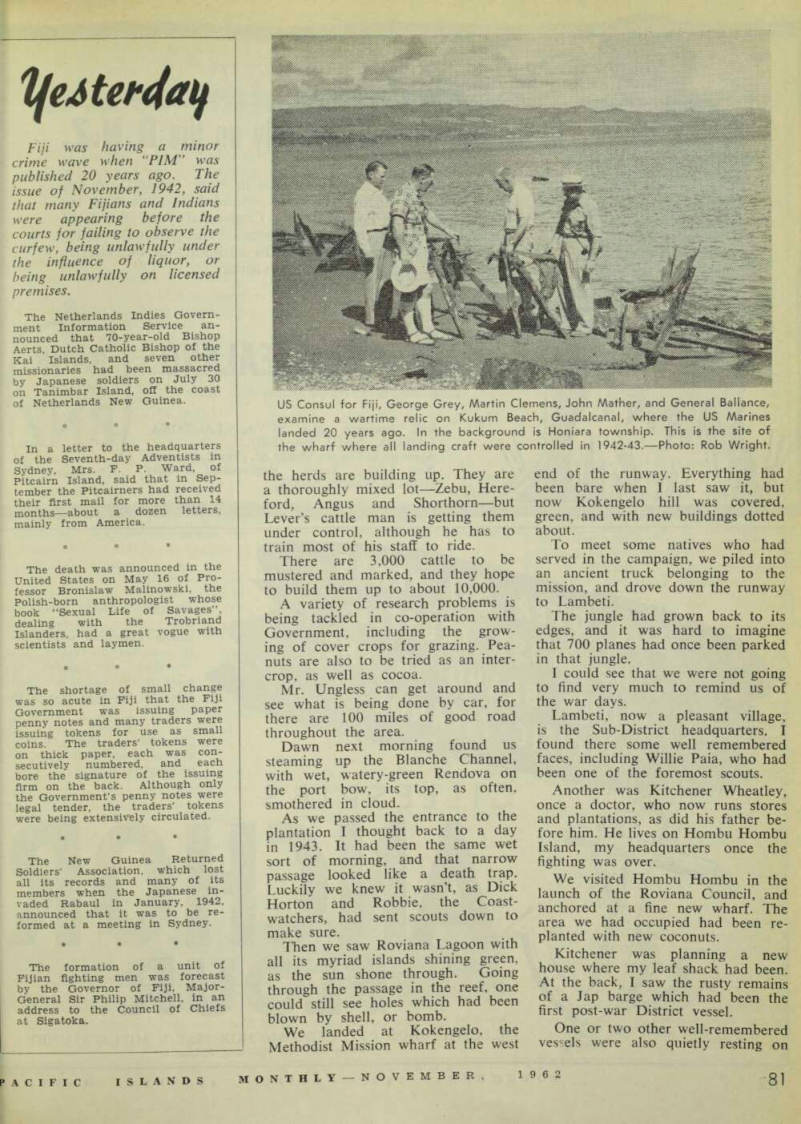
US Consul for Fiji, George Grey, Martin Clemens, John Mather, and General Ballance, examine a wartime relic on Kukum Beach, Guadalcanal, where the US Marines landed 20 years ago. In the background is Honiara township. This is the site of the wharf where all landing craft were controlled in 1942-43. —Photo: Rob Wright.
the bottom, their work done. This was my favourite island.
Back at Lambeti, I met one of the teachers at the Mission school, who had driven a launch between Munda and Hombu Hombu in 1943-4. The primary school had 150 children, and the senior primary about 300.
I also talked to Jonathan Keri, the Kolombangara man who helped ar range President Kennedy’s return to Rendova from Reg Evans’ hideout.
He was now a Council member.
We went by launch again down to Ilangana Point, which had been the main landing once Munda had be
come a base. It is now a pleasant village, but I was told there were still plenty of malarial mosquitoes.
The reason is that behind the vil lage there is still a vast pile of wrecked aircraft.
Salvage experts have been melting down some of the aluminium, but it seems that until the whole pile is hammered flat, there will still be malaria.
We just managed to get back to the Coral Queen by launch at the time we had appointed for sailing. It had been a rush around, but I had had time to see that good work is
being done by the local council, that copra is being produced and is bring ing money *back, and a better share of the good things of life.
Sakiri the headman told me that tax, which had been £1 before the war now averaged £4. All this was borne out by the lack of canoes, and the number of launches and small cutters one could see about.
On to Gizo, which we reached just before sunset, I met eight of my old native stalwarts. I knew all their faces, but it took some time to get all their names.
Among them was old Andrew Langbaea, wearing glasses, and nearly blind.
“Me happy too much for hear ’m Masta belong me bye bye come,” he said. “Now me look ’m you me happy too much.
“You me two fella go war 1942- 45, spose you die, me die too. You me lucky too much. Me old man now, got ’m pension, no pay tax, son married. Me lease plantation ’long
The town of Gizo is "small and cramped, and rather jammed in along the shore, without much planning".
Sepo, place b’long coastwatcher for Gizo.”
He was well provided for, and happy at our reunion. He told me about Prince Philip’s visit, and how he had been interested in his war experiences. He had told him of our adventures on Guadalcanal, and how we had lost 400 men in one minute in a bombing raid.
Later in the evening we attended a party at the house of the District Officer, Ken Cross, and met a num ber of the European officers working in the District. They all seemed to be devoted to their tasks, but Gizo gave me the impression of being small and cramped, and rather jammed in along the shore, without much town planning.
Before I left the West in 1945, I had laid out a spacious headquarters at Munda based on well built up roads, about 10 miles of them, and utilising such things as concrete hard standings.
I had been convinced then, as I still am now, that Munda was the freshest and healthiest spot in the whole area. It can also be reached through the lagoons, north, south and west, and, it has the airfield.
Old Hands Insisted However, the old hands—the Euro pean planters and traders from pre war days, most of whom have now gone—insisted on the move back to Gizo.
With the possibility of an inter island air service taking shape, I feel they have done the West a dis service, and we may yet see a move back to Munda for the district centre.
It is, after all, far nearer the centre of population, which is the usual determining factor in these matters.
Next morning I sat under the trees near the District Office with my old scouts and heard how they had been getting on.
One thing they all wanted to say, was how pleased they were with the local councils—how they felt they were now able to do something prac tical for their people.
One, Tambouri, was hoping to persuade the Choiseul Council to build a road right round their island.
They were all planning for the future, and we talked of the forth coming campaign against malaria.
They all agreed that unless coun cils followed up the WHO effort and kept villages clean of undergrowth and rubbish, it would be in vain.
There is no doubt that the coun cils, if well guided, will achieve a great deal.
Later in the morning we visited Titiahs, on the west side of Gizo, where a number of Gilbertese had been resettled.
They had been there for more than two years, but had found the change in diet difficult to accept.
Although they had had great help from the Agricultural Department in planting coconuts, a few local natives could help even more by telling them when to fish for each variety of fish, what baits to use, which trees to use for particular purposes and which wild fruits to use for food. It will take them a long time to find out these things for themselves.
At 2.30 p.m. we set sail for Blackett Strait.
Jonathan Keri pointed out Plum Pudding Island where President Ken nedy first scrambled ashore. One could see the reef down which he wandered to Sagarugombe, a tiny islet, before he swam westward and was carried down to Olansana Island.
He and his crew were lucky not to have been tipped out in more open waters.
We continued on through Blackett Strait past Vila Vila, Lever’s plan tation where the Japs had had an
airfield. This was now all replante: with coconuts.
I remembered steaming up frori Arundel in USS Birmingham, a ligt cruiser, followed by three others, a., doing 15 knots in the dark.
In the operations room one coulJ see on the radar screen the jagge; patches of coral as we passed them..
As nightfall approached we slower down for the entrance to Bairok Harbour which had once been strongly defended landing barge re lay station. From there the Japs hai sent the “Tokyo Express” each nighi with reinforcements for the troopc fighting us on Guadalcanal.
We photographed Enogai, whic: the 4th Marine Raider Regiment hai held in order to attack the Japs.
Behind I could see the rugged ter rain over which Andrew and I had marched from Munda tJ find out what had happened to thr Marines, who had lost radio touc.: with us.
It is benighted country, and no onr has resettled it since the war.
Bairoko was the last place to be visited in my trip to the Western islands—a trip of many memorio and many pleasant reunions.