Why Should “Colonialism”
pp. 75-79 · Read in the full issue
Be A Dirty Word?
What does colonialism mean to the people of the British Colony of Fiji? Mr. L. G. Usher, publisher of The Fiji Times, put the position clearly and with more than unusual interest in a Cession Day address at Levuka in October.
CESSION Day is a public holiday in Fiji and ceremonies are held at the monument at Nasova, Levuka (the former capital of Fiji). It was there that on October 10, 1874, King Cakobau of Fiji and his chiefs ceded the archipelago to the British Crown.
It has been administered as a Crown Colony ever since.
In his address Mr. Usher told how 29 years before, as headmaster of the Levuka Public School, he and the late Cyril King had worked to provide the memorial. They had climbed all over Ovalau Island, on which Levuka is situated, seeking a big stone with a reasonably flat sur face to carry the plaque. The face of the rock had to be laboriously ground down by hand.
Mr. Usher told how on the even ing following the unveiling of the memorial at Nasova, in 1935, there had been a dinner in the Levuka Town Hall. One of the speakers, the late Ratu Sir Lala Sukuna, had looked back over the 60 years since Cession and had asked what the coming of British rule had brought to his people.
“It was a very frank survey, and it wasn’t by any means all compli mentary,” said Mr. Usher.
Ratu Sukuna's View “There never is perfection in human affairs, and Ratu Sukuna was too honest a man and too impatient with hypocrisy to be bothered with flattery or with undeserved praise, “In his speech that night, having surveyed the bad with the good, he summed up something like this: “ ‘I have left to the last the most important thing which Cession brought to the Fijian people. It gave us a common duty, and through a common loyalty it gave us unity. That great gift far outweighs any faults there may have been in these 60 years of British rule’.”
Mr. Usher continued: “Unity through a common loyalty. That was the great gift that came through Cession, now nearly 90 years old.
“It is, I believe, the lasting thing
which we must hold on to today, when the population of Fiji has be come much larger and more diverse, and the need for a focal point around which unity can be maintained is more urgent than ever. ‘The old Fiji was a land of war ring groups and intense rivalries.
Cession gave one Queen, one loyalty, and through these things a unity which had not hitherto been known.
“You find this same theme re curring over and over again in the things that were said before Cession, and at Nasova on that first Cession Day.
“The spirit of cession, that spirit which quickens the legal word, is in the message which the Council of Chiefs sent to Sir Hercules Robinson on September 28, 1874: “ ‘We give Fiji unreservedly to the Queen of Britain, that she may rule us justly and affectionately, and that we may live in peace and prosperity.’ ”
Mr. Usher said there were abroad in the world today an overworked phrase and a dishonestly used word.
“The tiresomely overworked phrase is ‘the winds of change.’ The word is ‘Colonialism,’ ” he said.
“The ‘winds of change’ has been used as an excuse for forcing new forms of government on peoples, whether or not they want them, or appreciate them, or are prepared for them by training and gradual build ing of administrative strength, and intelligent planning in advance.
“ ‘Colonialism’ is a scare word which is supposed to signify oppression and injustice and evil.
“In the case of Fiji, ‘Colonialism’ means, quite simply, the system of administration by the British Colonial Office through a Governor appointed by the Queen. It means law-making by the Legislative Council and ad vice on policy matters by the Executive Council. It means the machinery of government, centred on Suva and spread throughout the Colony.
“It means the elections which are to take place next year on a much enlarged roll. (Over)
“It means the freedom of speech yhich enables the people of Fiji to peak their minds and, if they wish, o criticise those in authority, without icing in danger, as citizens of some if the ‘independent’ countries are, of icing arrested and imprisoned with lut trial and probably beaten up.
“It means gifts totalling some £5,000,000 by the taxpayers of Britain to the people of Fiji—gifts hat have given us wharves and roads md schools and hospitals and better adio and telephone communications md, in the making of these things, obs for thousands of Fiji people.
What the Word Means in Fiji “For Fiji, Colonialism means the British system of justice, which pre lumes a man to be innocent until le is proved—and proved beyond ioubt —to be guilty, and is then, and hen only, liable to punishment.
“All these things, to us in Fiji, are Colonialism.
“Cakobau and his fellow chiefs de iberately and proudly chose this ?rand of Colonialism as a way of government of Fiji.
“Don’t imagine I am claiming per fection, or unfailing wisdom, in the administration of Fiji in the past 90 years, or today. The country has been governed by men, not angels.
“But the fuss that is made by the noisy demagogues about oppression and injustice and callous exploitation of Colonial people is, to us in Fiji, completely unrealistic —it sounds just plain silly.
“It is in the United Nations that
the demagogues are to be heard in fullest cry.
“I was very interested to hear Esiteri Vakalala say, when she came back from an international conference of youth organisations recently, that she had been taken aback by the ‘lobbying’ by pressure groups seeking to influence the election of officers. The thing was quite foreign to her experience.
“She was not the first Fijian to be shocked by the way things are done at meetings of modern international bodies.
“Ratu Sir Lala Sukuna was ch? 5 . 6 ? in 1950 to form part of the British delegation to the United Nations com mittee which deals with the affairs of non-self-governing territories, “It was an honour he greatly valued, but it brought to him great disillusionment. He didn’t mind so much the anti-colonial speeches of the Communist nations and their satellites. He expected them, and wrote them off for what they were worth—propagandist ranting with political ends in view, “What did shock him profoundly
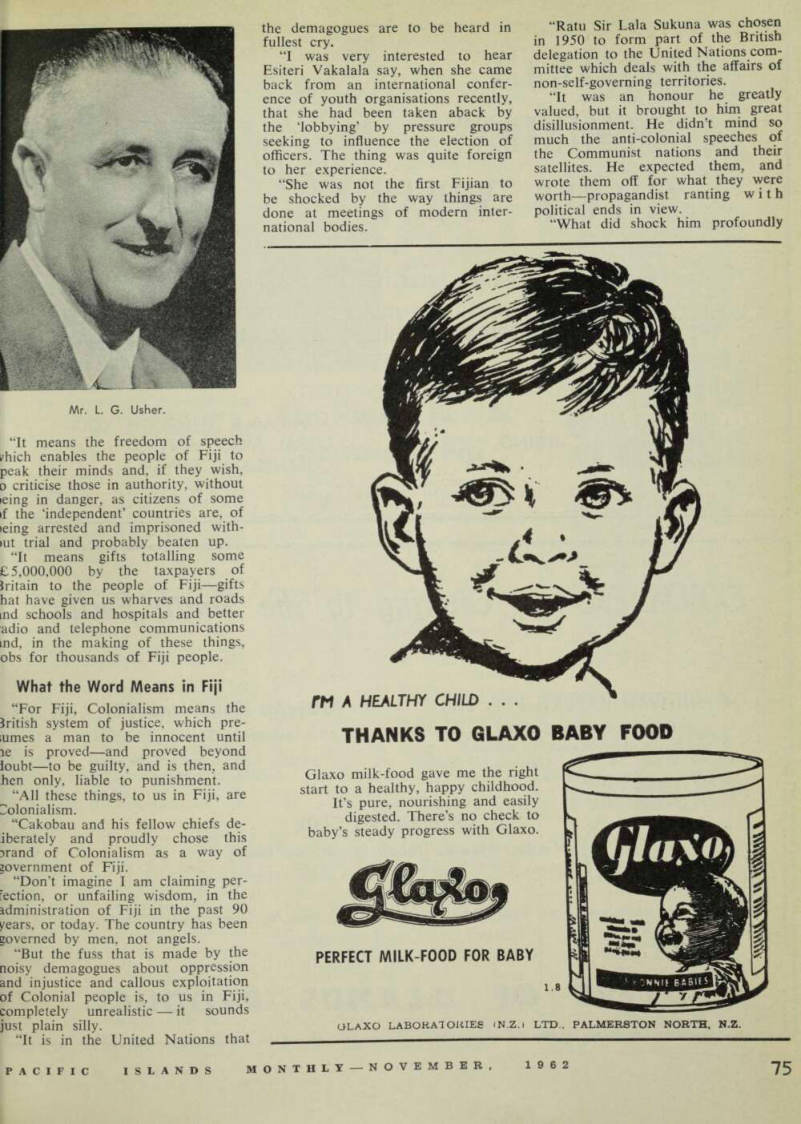
Mr. L. G. Usher.
was the bargaining for votes that went on outside the meeting rooms, “ ‘You support me on this and I’ll play ball with you on that.’ That sort of thing.
“It was very different from the straightforward approach of the Fijian chiefs at Cession: ‘We give Fiji jnreservedly.’
“The winds of change can, and do, jlow; but there is no need to mis ;ake the huffing and puffing of self seeking propagandists for such winds, md to lie down flat before them.
“Solid things things like th e stone at Nasova which symbolises the jroud and willing cession of Fiji to he British Crown—aren’t blown ;asily away by even the strongest winds.
“The stone weathers with time. It changes its appearance, becomes nodified in shape, perhaps even has jits knocked off it now and then.
“But, fundamentally, it remains he same —a stone from the hills of 3valau, something from and belong ng to Fiji, and able to be wholly de stroyed only by violence from out side.
“Let us not be afraid of change.
Let us not be afraid to modify our way of life and to do it drastically f necessary, if it be for the good of Fiji. But let us do it because we wish t. and not because it is dictated by )thers or is fashionable elsewhere.
“Above all, let us, as the anniversary if Cession Day comes round again in his year 1962, make up our minds o resist the destruction of that solid hing, the unity that has been brought o Fiji by a common loyalty, a oyalty whose foundations lie in the session of this land in 1874 to Queen Victoria and those who succeed her.”
Visiting Fiji in October were three members of the Com monwealth Parlia mentary Association.
From left, Mr. Bryant Godman Irvine; his wife; Dame Patricia Hornsby-Smith; and Mr. Ellis Smith. See below.
Photo: Rob Wright.