Surfers Package Deal
p. 71 · Read in the full issue
Sydneysider Goes Walkabout Surfers Package Deal Fun In The Sun
If you are a wild colonial empire-builder, the chances are that the Gold Coast to you means the White Man’s Grave, ivory and elephants and old topees. If you are an Australian it means something else again.
IT’S a dozen or so miles of sand dunes and surf; architecture based on paint in squares and diamonds of red, yellow, orange and blue; juke box music and screeching amplifiers; sunburn and heated pools and tight packed bodies, stretch-pants and bikinis and real-estate booms.
Fifty miles south of Brisbane, it begins at the southern end of staid old Southport, and stretches along the Queensland coast to the New South Wales border, with Surfers Paradise its piece de resistance. It’s the sort of place where nite-club spells night club; where you are begged to Nes’l Inn Ova Nite; and where there are more Alohas and Ohios and Miamis than coloured beach umbrellas.
Neon lights can be measured by the mile; fish-and-chip shops and “take-away food” establishments by the dozen lot.
In its own pint-sized way, this is Florida over again. Shoddier, less chic, to be sure, but the beginning is there. Scenically, both are minus quantities but are blessed by sun, warmth and geographical accident; the real estate men have done the rest.
Brashly Named
A few years ago the brashly-named Surfers Paradise was an old hotel built around a private miniature zoo.
Today, building jostles building in a frantic effort to make use of every square inch of narrow coastal strip.
Pools, just for the sake of being pools, are poked into odd corners, all with their quota of umbrellas and swim mers. Motor traffic seethes up and down the narrow streets.
It is perhaps one of the less re laxing places in the entire continent, but each year thousands of Austra lians go there to do just that. The flashing neons, the take-away meals,
the close proximity and the continual blare of sound seem to do something to modern man, including modern Australian man—produce a sense of security; do away with the necessity for thinking or making conversation.
It is particularly popular with extroverts, Middle Europeans and young people—because whatever else you can say about Australian resorts, in comparison with their American counterparts they are at least peopled largely by the young who can wear a bikini without blushing for their bulges and who can part with £6O for a two weeks’ holiday without turning an economic hair.
Caravanserai At special times such as May and September school holidays, and at Christmas, Surfers swells to burst ing point and then it’s sometimes a matter of you paying your money and taking your chance.
You may be shuffled into what is locally referred to as the “bird cages,” a florid caravanserai that looks like three layers of egg-crates with sliding glass fronts, described by an adver tising blurb-writer, who has never slept in them, as “soundproof suites.”
There’s a 4 ft cat-walk in front of each layer that supplies the only means of exit and entry and is also a place to sit and take the airs; and communication with the ground is by outside, iron-runged stairs which twang like overwrought violin strings at the bounce of teenage and small fry feet.
Here, before 10 o’clock each night, when most people have full stomachs, you are asked to think what you want for next morning’s breakfast, write it out and take it to the office.
Come the dawn, a clutch of four, panting women lug that food, egg by egg, and tray by tray, up the
flights of stairs from ground level to 250 hungry customers.
Or you may be further south at Broadbeach, where the big hotel is held by some to be “too far out of things” (meaning the centre of Surfers, which is all of two miles away), where the management has recently compensated for this by changing it over largely to package deal holidays—a typist’s annual de light and highly desirable for family parties.
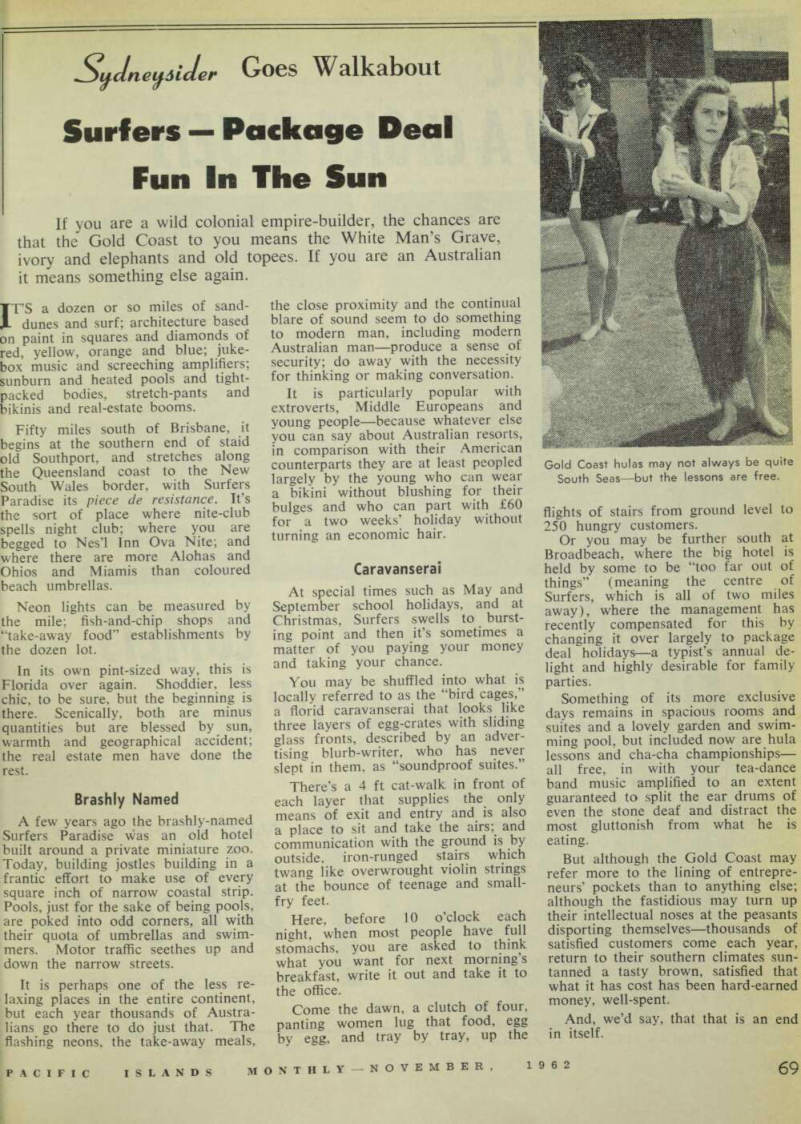
Something of its more exclusive days remains in spacious rooms and suites and a lovely garden and swim ming pool, but included now are hula lessons and cha-cha championships— all free, in with your tea-dance band music amplified to an extent guaranteed to split the ear drums of even the stone deaf and distract the most gluttonish from what he is eating.
But although the Gold Coast may refer more to the lining of entrepre neurs’ pockets than to anything else; although the fastidious may turn up their intellectual noses at the peasants disporting themselves —thousands of satisfied customers come each year, return to their southern climates sun tanned a tasty brown, satisfied that what it has cost has been hard-earned money, well-spent.
And, we’d say, that that is an end in itself.
Gold Coast hulas may not always be quite South Seas —but the lessons are tree.