Territories TALK-TALK
pp. 63-67 · Read in the full issue
Sporting activities in P-NG are becoming an important feature in the general life of the Territory. From what I gather from the sporting sections of the P-NG newspapers, this same feature is a good additive in the general racial
integration campaign.
IHE November Commonwealth Games in Perth have definitely /en a fillip to P-NG sportsmen, and wouldn’t surprise me if some of r local Territorians did not make very good showing. If my memory rves me right it was a Canadian dian who won the marathon in the ympic Games some fifty-odd years o.
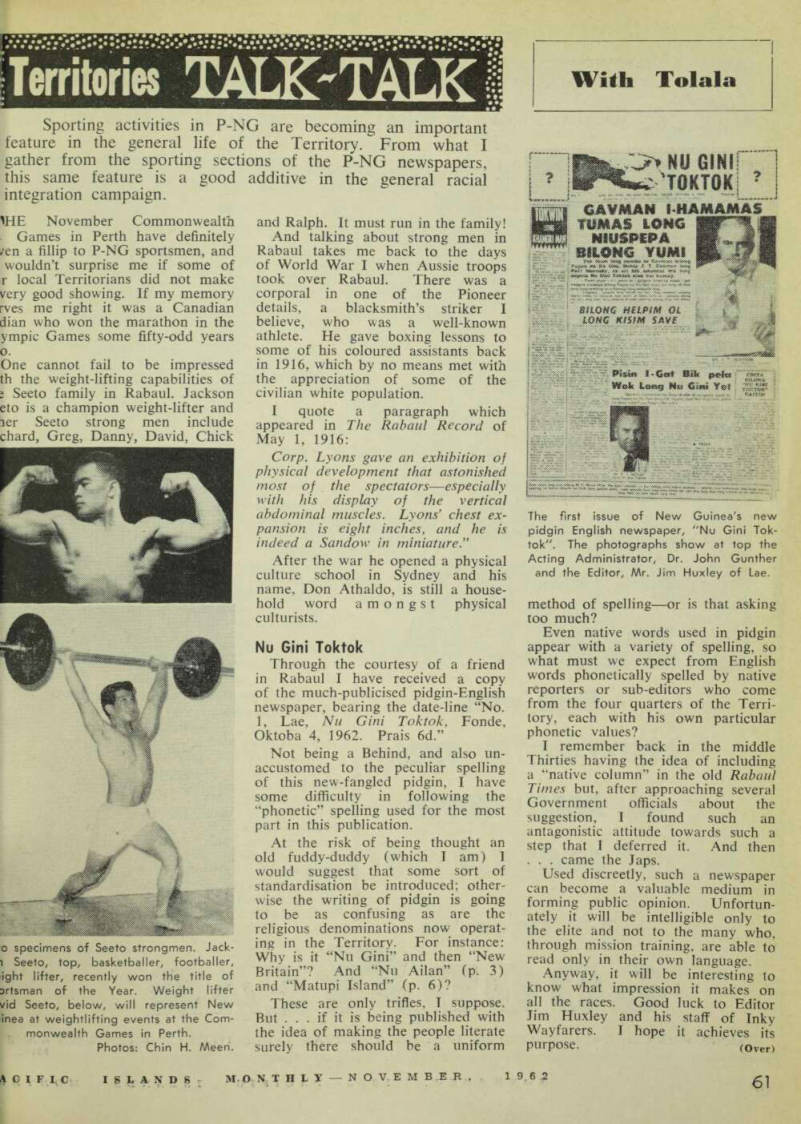
One cannot fail to be impressed th the weight-lifting capabilities of j Seeto family in Rabaul. Jackson eto is a champion weight-lifter and ier Seeto strong men include chard, Greg, Danny, David, Chick
and Ralph. It must run in the family!
And talking about strong men in Rabaul takes me back to the days of World War I when Aussie troops took over Rabaul. There was a corporal in one of the Pioneer details, a blacksmith’s striker I believe, who was a well-known athlete. He gave boxing lessons to some of his coloured assistants back in 1916, which by no means met with the appreciation of some of the civilian white population.
I quote a paragraph which appeared in The Rabaul Record of May 1, 1916: Corp. Lyons gave an exhibition of physical development that astonished most of the spectators —especially with his display of the vertical abdominal muscles. Lyons’ chest ex pansion is eight inches, and he is indeed a Sandow in miniature.”
After the war he opened a physical culture school in Sydney and his name, Don Athaldo, is still a house hold word amongst physical culturists.
Nu Gini Toktok Through the courtesy of a friend in Rabaul I have received a copy of the much-publicised pidgin-English newspaper, bearing the date-line “No. 1, Lae, Nu Gini Toktok, Fonde, Oktoba 4, 1962. Prais 6d.”
Not being a Behind, and also un accustomed to the peculiar spelling of this new-fangled pidgin, I have some difficulty in following the “phonetic” spelling used for the most part in this publication.
At the risk of being thought an old fuddy-duddy (which I am) 1 would suggest that some sort of standardisation be introduced; other wise the writing of pidgin is going to be as confusing as are the religious denominations now operat ing in the Territory. For instance: Why is it “Nu Gini” and then “New Britain”? And “Nu Ailan” (p. 3) and “Matupi Island” (p. 6)?
These are only trifles, I suppose.
But ... if it is being published with the idea of making the people literate surely there should be a uniform
With Tolala
method of spelling—or is that asking too much?
Even native words used in pidgin appear with a variety of spelling, so what must we expect from English words phonetically spelled by native reporters or sub-editors who come from the four quarters of the Terri tory, each with his own particular phonetic values?
I remember back in the middle Thirties having the idea of including a “native column” in the old Rabaul Times but, after approaching several Government officials about the suggestion, 1 found such an antagonistic attitude towards such a step that I deferred it. And then . . . came the Japs.
Used discreetly, such a newspaper can become a valuable medium in forming public opinion. Unfortun ately it will be intelligible only to the elite and not to the many who, through mission training, are able to read only in their own language.
Anyway, it will be interesting to know what impression it makes on all the races. Good luck to Editor Jim Huxley and his staff of Inky Wayfarers. I hope it achieves its purpose. (over)
[?] specimens of Seeto strongmen. Jack [?] Seeto, top, basketballer, footballer, [?]ight lifter, recently won the title of [?]rtsman of the Year. Weight lifter vid Seeto, below, will represent New inea at weightlifting events at the Com monwealth Games in Perth.
Photos: Chin H. Meen.
The first issue of New Guinea's new pidgin English newspaper, "Nu Gini Tok tok". The photographs show at top the Acting Administrator, Dr. John Gunther and the Editor, Mr. Jim Huxley of Lae.
hose ROW ;tters Some time ago there was some dis ission in PIM about the despatch f letters from prisoners in Rabaul uring the first year of the Jap ccupation there and the receipt of lem by the addressees. I said I had xitten such a letter, which I under ood had been dropped from the air y the Japs over Moresby but it had ever reached its destination.
The other day I had the oppor inity of seeing one of these letters hich arrived safely. It was from le Chief Warden, R. L. (“Nobby”) lark, to his wife in Australia and is ow in the possession of his daughter, largot. It was dated “11th Feb lary”, and the Japanese year “2602” ad been used by the diplomatic Nobby”, which of course is luivalent to 1942. Certain dates and ames had been carefully carved out y an energetic censor, probably an aissie.
I was glad to see that screed, xitten in “Nobby’s” copper-plate alligraphy and to know that at least ne letter arrived safely.
Philatelic uery On the subject of letters let me ring up a query I received some me ago from Basil Challis (an old 4, now residing in Adelaide but as een as ever where postage stamps nd matters philately in general are Dncerned).
He tells me he has received a hotostat of an airmail cover from a allector in England. The “cover” envelope, to the uninitiated) is ddressed to “Otto Soldwedel, Esq. /o Postoffice, Wau, New Guinea loldfields, Mandated Territory of lew Guinea, Australia”, and was osted in Hamburg, Germany, on 5/10/36.
It carries an airmail sticker (“Mit uftpost”) and is endorsed: “By Air lail: Amsterdam/Niederlandische idien/Port Darwin/Port Moresby/ /au, NG”. It carries rubber ampings of “Mandated Airlines td.” and “Guinea Airways Limited”.
Basil Challis writes: “I have no nowledge of an aerial service >arwin to Moresby. I remember uite vividly Guinea Airways starting ieir regular flights from Lae/ alamaua/Wau/Moresby in Feb uary, 1932”.
Any comments from old-time air len?
Lebensraum"
From time to time we are given ome alarming figures by statisticians
as to the growing density of popula tion in many countries, due to our more advanced medical science and its application to the more “back ward peoples”. Whether this is a camouflaged advocacy for the speed ing up of War 111, before these areas become over-populated, is anyone’s guess.
But one aspect of the situation that does occur, no doubt to many, is the fact that primitive tribes who suddenly find their population in creasing to such an extent that their present land holdings are insufficient to their requirements, naturally look further afield with envious eyes and calculating minds. Even as Hitler
did in the days when he clamoured for “Lebensraum!”
The scarcity of land will not worry us here in Australia —not at least for a few years. But I notice there has already gone up the cry in NG for more land in certain areas where population is on the increase.
In NG Times-Courier of October 3, a news item appears concerning a “tribe living on the island group of Tanga, off Namatanai, New Ireland” which “had such a population in crease over recent years it may soon have to start looking for new land on which to settle”.
In and around Rabaul some
lives have made claims to land nich was ownerless and classed as x>wn land in the German time.
Situations may arise causing ibarrassment to an administrating thority, whose policy is one of peasement, if this practice of land uming becomes general.
The “Winds of Change” are sponsible for some marked altera >ns in P-NG conditions.
In the old League of Nations :rms of Mandate (Article 3) it was t down specifically that “the supply intoxicating spirits and beverages the natives shall be prohibited”, lis has now been tossed overboard a gesture for integration.
Are the old land laws to be :ated in a similar manner, despite i UN Charter (Article 76 (c)), lich reads: “Encourage and respect iman rights and fundamental ;edoms for all without distinction race, sex, language or religion, d encourage recognition of the :er-dependence of the peoples of the irld”?
Appeasement must not become ch an attribute that it will cancel t justice. ie 64-Dollar lestion The take-over in West New ainea has created more interest the man-in-the-street than most ternational incidents, not excluding e Common Market wrangle. In zt speculation as to its future percussions almost equals specula >n as to the winner of the Mel •urne Cup!
Opinions of John Citizen vary ac rding to his temperament and rspective; his knowledge or ignor ce of actual conditions existing in country so different from Aus dia.
Will the West New Guineans be bjected to the mailed fist treat snt from Soekarno and his minions, d so harden their reaction to the Ice-over? Or will they, with usual )pical lassitude, adopt a laissez ire attitude and take the line of ist resistance?
Some will adopt the former; some e latter. The sophisticates, or the :te, may form cells of a rebellious iture; the majority—the primitives -just couldn’t care less. In fact ey probably don’t know what it is ey should care about.
There is, however, a danger (to y mind) of Indonesia adopting
such a policy of paternalism towards the WNG people as will even out-paternalise the treatment now in operation in our own Papua-New Guinea. They would do this to demonstrate to the world at large what should be done for the back ward races in order to lift them out of their primitive rut. For example: Adopting the low-caste Malay as a lingua franca for the elite (so much easier than a European language); an intensive health and hygiene campaign and a window-dressing economic development.
There would be no need for a colour desegregation campaign. Like
the Japs in NG during the war: “We are of one colour”. In fact there could be a general softening cam paign (paid for probably by the Kremlin) which would also favour ably impress the East New Guineans and prepare them for any possible association, engineered by a few dis gruntled elite, with their West New Guinean colleagues.
FOOTNOTE : I notice a Sydney afternoon newspaper has decided to refer to West New Guinea as “West Irian” in future. One wonders if it is its intention to refer to Germany as “Deutschland” and Finland as “Suomi”.