tropicalities
pp. 35-45 · Read in the full issue


DW that the Samoans have their independence, what have they done to that famous shrine, ?ert Louis Stevenson’s old home, Vailima?
J how is RLS’s tomb, perched up there on the of Vaea, being treated these days?
Ve went along to have a look recently, quite nnounced. Our verdict: If anything, both are / looked after better than ever. Vailima, of rse, has been practically rebuilt since the time RLS, and until independence in January it always used as the home of the High Com sioner.
ow it’s the Government residence visiting VlP’s, and also a kind of utive suite for special occasions p level conferences and such, tors can inspect Vailima only a card from Prime Minister aafa. The brick fire-place RLS ; is still a feature of Vailima, and Samoans still keep the writer’s :hair by the side of it—a memor little picture which we snapped, it nobody needs a card—just ty of energy—to climb to the )on Vaea. The trail leads off i outside Vailima’s main gates, ■om time to time it becomes over m but the job of cleaning it up len given to the gaol prisoners ives”, as one Samoan urchin de ed them the day he helped heave push us up that “Road of Loving •ts”). You don’t need to be a ntaineer to get up, but if your s are slippery you will find it ult to get a decent foothold in ;s. le tomb is a popular focal point visitors from the regular Union
> and from cruise i, and we predict the slaves will con ; to make it ac ble to them for y years yet.
LS would be pleased enow the Samoans
treat visitors ily, despite their official insis : that they are not interested in uraging tourism. What they mean tat they don’t want any large tourism, like Honolulu gets, for of losing their identity. They’ll loubt change their minds when settle down, and realise that are more advantages than dis titages in the tourist trade.
Dutch Losses E Dutch taxpayers are not going to get any refunds for the £lOO - they’ve spent in West New ea these last few years. Further i they are going to have to
swallow their gall at the thought of the huge slice of that money that will be handed to Indonesia next May as a free gift in the form of roads and buildings. There is nothing they can do about it—there is nothing in the agreement that says that Soekarno has to pay a penny for all that im proved real estate.
But the Dutch have moved to fore stall one eventuality. They’ve been working overtime at The Hague lately on the compilation of a booklet listing just what public works the Indo nesians are getting. This will be dis tributed to the world before May so
there won’t be any chance of Soekarno later claiming the Indo nesians built everything including the 141st meridian.
Already the Indonesians are talking as if the Dutch had never done a single thing for Indonesia’s Papuan brothers, as indicated by the state ment of Dr. Subandrio, Indonesian Foreign Minister and now Minister for West New Guinea, which he made in Djakarta on October 8.
Dr. Subandrio told newsmen, ac cording to an official Indonesian handout, that Indonesia planned soon to build in West New Guinea “50 houses, a university, 50 elementary
schools, five high schools, two hos pitals and a sports stadium”.
Considering that up to October 1, no Indonesian could get anywhere near West New Guinea without being
shot at, the Foreign Minister certainly did a slick job of deciding West New Guinea’s specific requirements!
Incidentally, although the Dutch have taken an inventory of their former roads and buildings, no
body got the time to make a detailed list of the Government’s typewriters, office equipment, photographic gear, pencil sharpeners and odds and ends.
A few former New Guinea Dutch in Sydney the other day were ruefully discussing this omission, and re membering some of the excellent pieces of office equipment they had only recently received.
They concluded that with the state of flux that West New Guinea will be in for the next nine months, not even the Indonesian Government had a hope of getting its hands on some of the more portable items of this stuff. (Over)
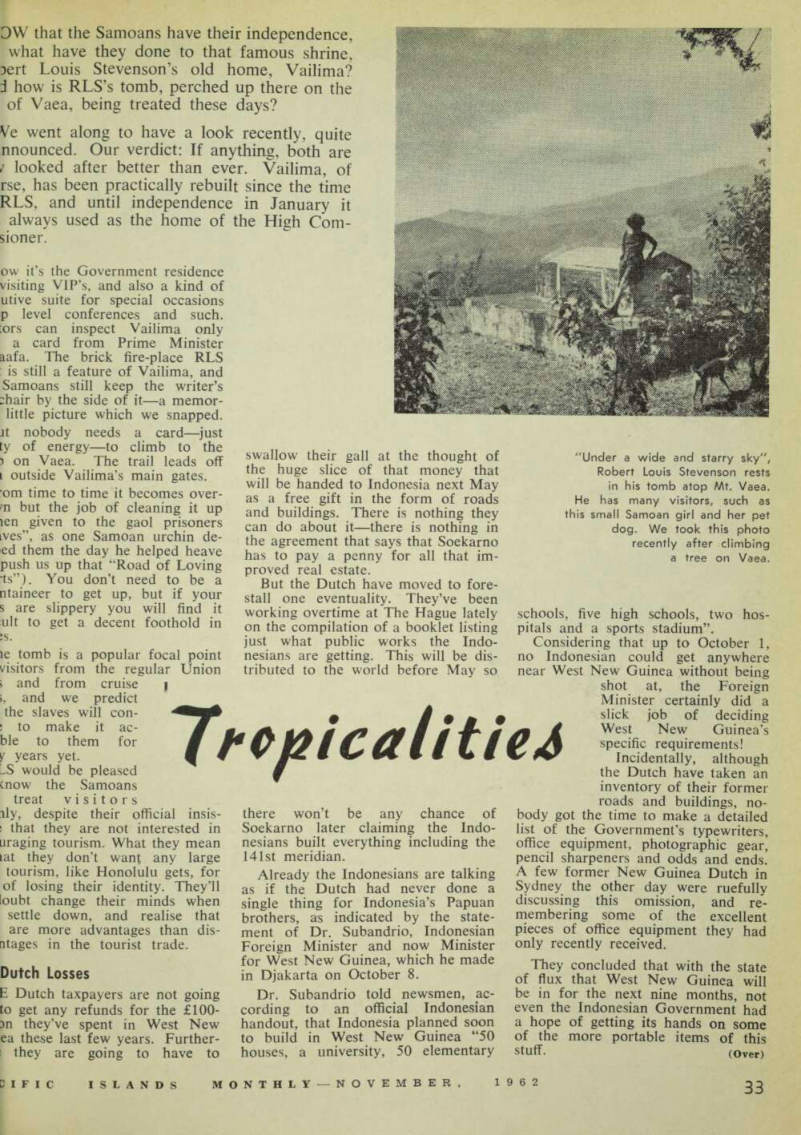
"Under a wide and starry sky", Robert Louis Stevenson rests in his tomb atop Mt. Vaea.
He has many visitors, such as this small Samoan girl and her pet dog. We took this photo recently after climbing a tree on Vaea.
Nobbiest IE man at the controls of a whopping great DC7c which we id ourselves flying in the other turned out to have an off-duty by as man at the controls of a □r Fiji hotel company, aptain Georee A. Wilson, of tie, who after 20 years and 17,000 ig hours, is almost as well known :he South Seas as Captain Joe ihard (who these days is in ada) is chairman no less of Nadi’s Mocambo Hotel. And another pany he is interested in, Pacific tings Ltd., operates the Sky ge, right at Nadi airport. r e got to talking to Captain
George. He told us that both com panies had a mixed bag of share holders—all little people from both sides of the Pacific and from Fiji.
About 10 per cent, of the shareholders in Pacific Hostings also have interests in the Mocambo company.
Sky Lodge was begun two-and-a half years ago. In 1961 Fiji Holdings was formed, and this company bought the Mocambo from Barry Philp last January. The two hotels compete, and when we mentioned this to Cap tain George he said that as far as he could see it was a good thing.
However, he agreed that the Mocambo was designed to catch the luxury trade. The intention was to build the Nadi area up, and the whole of the Great North West with it, so that this part of Fiji could be an ideal place for a holiday in itself— with the Mocambo as headquarters, naturally. In short, the Mocambo aims to topple the Korolevu Beach Hotel from its place—if it can.
Back on the ground a few days later we booked in at the Mocambo, with its 45 acres, swimming pool, 24hour room service, 63 air-conditioned rooms, etc., and chatted to manager Glen Durbin, an American like Cap tain George.
He showed us architect’s plans for big extensions —giving the hotel more rooms and more facilities, such as bowling and putting greens. So it looks as though the hotel picture in the Great North West is going to get interesting soon. (Over)
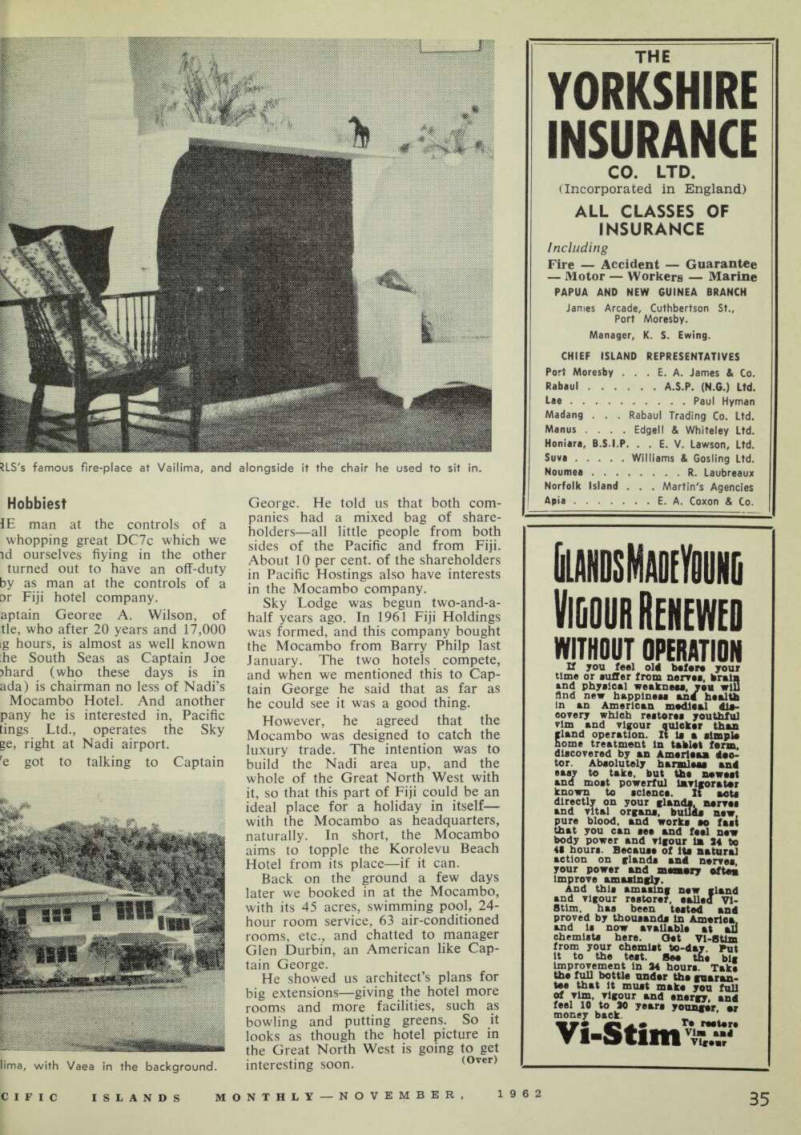
RLS's famous fire-place at Vailima, and alongside it the chair he used to sit in.
lima, with Vaea in the background.
louth Seas to Deepfreeze
LOLO —a cream made from the coconut—is one of those exotic iouth Seas dishes that has charmed enerations of visitors to the Pacific.
Tie other day we ran into a Fiji usinessman with plans to share 1010 /ith the rest of the world—via the eepfreeze cabinets of the super markets.
He has been experimenting and fanning for two years, and we gather dIo is just about ready to go on tie market. Samples have gone to Jew Zealand and America. They ave the appearance of a coconut :e cream.
Lolo can be kept frozen for months, iken out and sliced for use and then ut back in the freezer. Once out of le freezer it won’t keep for long.
According to the promoter, 1010 is ist the thing with hot chocolate, as fruit or vegetable with another dish, i fruit salads and pies, as a salad ressing or in a soup when boiled, latson Lines have been using it itely as a coconut cream for prawn urry.
Coconut cream—it has different ames in different islands, but every where it is an important part of in igenous cooking—is usually made by rating the coconut flesh, mixing with r ater and straining. What comes out thick cream, and it does in fact antain everything that the coconut as to offer. What is left is merely le fibre of the coconut flesh, which as no nutritional value (nevertheless, ley are working on a scheme to use le fibre, with an additive, as fowl ;ed).
l onderful Aggie's
PHROUGH the mail the other day L came a couple of photographs om a high-ranking New Zealander, ith this note: “I have no vested in vest whatever, but some time ago lere was considerable discussion as > the comforts of hotels in Western amoa. I do not know Mrs. Aggie Ixey very well personally but I
think she deserves a little publicity in view of the amount of trouble she has gone to to increase the comforts in Western Samoa.”
The photographs show the new “chalets” and swimming pool recently installed at Aggie Grey’s famous Apia hotel. We agree on the publi city. Aggie’s is wonderful. We stayed there ourselves when we were in Apia the other day and we told Aggie— and son Alan—to their faces that Aggie’s was one of the nicest in the South Seas.
The Islander NEW ZEALAND Secretary for Islands Territories, Mr. J. M.
McEwen, was in Noumea in October
—on the job as Alternate Senior NZ Commissioner with the South Pacific Commission. Before that we ran into him in Suva, Apia and Pago Pago.
He had just been to Penrhyn and Rarotonga, Mr. McEwen could be anywhere in the South Seas at any time—but wherever he is he will have a group around him, asking his ad vice, telling him a sad story, slapping him on the back, asking him about a mutual friend, or just enjoying a drink. Jock McEwen must be the best-known and most popular public servant in the South Seas.
The secret of his success is his long experience with Islanders and Islands life. He knows the ropes because he has gone through them. He also sur rounds himself with staff who are old Islands hands.
If you run into Jock McEwen some time, as you will, take our tip and encourage him to tell a few stories. They’ll probably go some thing like this: “That word ‘paradise’ is relative, like most things. The Pacific is para dise—naturally. There are always ad ventures in Paradise. But in the Cook Islands they refer to New Zealand as paradise, so where are you? As a matter of fact, there is one island in the Pacific which I honestly believe to be the last Pacific paradise. For 364 days of the year they are happy
Aggie Grey's hotel, Apia, with the new swimming pool in the foreground.
on coconuts and fish, and on t: 365th they are happy on fish and c conuts. The name of it? Sorry.
I told you I wouldn’t hear the end it from the rest of the Islands, won I?”
He also tells the story of the Re dent Commissioner who felt Welliß ton was giving him a bad deal some particular problem. He wrote strongly worded memo to the S* retary for Island Territories givl one hundred reasons why the mat: had to be attended to urgent!
Months passed. There was no rep In the fullness of time the Re dent Commissioner was promoted Secretary for Island Territories, at the first piece of business he foil in his basket was his own memo. T new Secretary read it, snorted, a promptly dictated one hundred a one reasons why the job couldn’t done.
New Guinea's UAM WE haven’t heard if any of i delegates to the present sessi; of the United Nations were i pressed by a letter they received frr an organisation calling itself 1 United Australia Movement, but are willing to take a bet that won’t be the last letter they’ll ceive from the same direction.
UAM is the brainchild of Bn Miles, an energetic Sydney solicit with a propensity for getting into limelight in the courts. In the ft short months since the Movemr first drew breath last February, UA has won more than its share of pi( licity, although most people who hti heard about it probably couldn’t you exactly what it was.
Bruce Miles is not exactly s r t himself.
“It’s a thing that got going ato read a lot of The Sydney Moc ing Herald leaders and letft:
J. AA. McEwen.
► the editor,” he told us in pdney. “It seemed to me that lybody in Beecroft and Killara lew what to do about the New uinea question, but what did New uinea people think? Nobody ever sard from them. As a matter of ict, we hear very little even now, ;spite our interest in the question.”
Mr. Miles’ interest resulted in a ;w of his legal friends organising a iceting in Port Moresby, It was lostly attended by professional iople. They decided that what New uinea wanted was representation in ederal Parliament.
“This was elementary,” said Mr. tiles. “Imagine 25,000 Australians id 1,500,000 New Guineans without voice!”
They also decided that UAM ould have only about 100 members here is no membership ticket or any ses) and that part of its platform ould be to press for New Guinea ► become the seventh state of Aus alia. Only about 25 of the 100 lembers are in NG.
“This seventh state thing is a kind f catchcry,” said Mr. Miles. “State ood is the top of the mountain, and e would be happy if we could climb alf-way up—that is, by achieving an ected representative in the Austra an Parliament for NG.”
The UAM took this matter to Mr. [asluck, Minister for Territories, hey were very well received, and Ir. Hasluck put the view to Cabinet. !abinet rejected the proposal on the round that appointment of an MHR ould be inconsistent with the Gov rnment’s intention to give indepen ence to NG.
That seemed to end that, but UAM ill gets in the news in other ways. ;s recent letter to UN pointed out lat the UAM was determined to stablish a permanent constitutional nk between P-NG and Australia, as ; was determined to see that the eople of the Australian Trust Terri iry did not, as the West Papuans ad, “fall into the hands of the ercest and noisiest aggressor”.
Lately the concepts of UAM have been accepted by another group of which Mr. Miles is also the president —the Liberal Forum—which is a breakaway Liberal Party. The Forum decided recently to run candidates in the next Federal elections, and to in clude in its platform the seventh state idea. A branch of the Liberal Forum will probably be started in New Guinea, Some people predict that the UAM will disappear entirely and that the Forum—a straight-out political party
—will take its place. In the mean time, UAM still has some support in NG, although less than it did at the beginning of the year. It probably won’t achieve anything—-but it shouldn’t cause any harm either.
Chickens Home to Roost
SOME unruly chickens, carelessly
let loose by the Fiji Government in the shape of a new Liquor Act, have come home to roost in an em barrassing way. (Over)
Bruce Miles.
Suva officials, obeying the de ulonisation dictates of the Colonial ffice, decided that Fiji’s liquor laws tust be reformed. All racial barriers gainst drinking had to be re loved.
When the new law was going trough Legco, the Fijian and Indian tembers objected to the permit sys m being removed from Fijian and idian women—permits for them had t remain. The Government, anxious » get the bill through, allowed the nendment.
But the social life of Fiji bubbles ith evening parties, where the omen of all races join their men dk happily in a modest drink.
Imagine the consternation when it as announced by the Attorney eneral and the Commissioner of olice that if any Indian or Fijian omen, whether at a hotel, or a rivate house, or even at Govern icnt House, accepted liquor without liquor permit, she, and the waiter ho served her, and her host, or the Dtel licensee, would be prosecuted, hat was the law, said these officials.
Undoubtedly, the embarrassed overnment would have carried the ling back to Legco; but The Fiji imes came into the picture. It Dinted out that the new law had sen supported by all official and un- Kcial members of Legco—and that, i any event, it was a first-class [ample of the racial discrimination hich the Government said it wanted f avoid.
The Government said there was no sed for fuss—any reputable woman >uld get a permit without trouble.
The newspaper retaliated by show g in detail the procedure followed . granting permits; an application, a >lice report on the applicant, ref ence to a committee which formally msiders the application, etc.
The muddle has not been solved. lough to Raise the Roof I7E haven’t anything against pub ▼ lie relations men. They are good iends of ours. But some let their ithusiasms run away with them—as ith this horrible sample that reached ar desk the other day from the akers of galvanised roofing, who ive recently used it in Rabaul: “During the 1937 eruption, when new volcano, Vulcan, thrust its way 5 out of the sea in the waters of abaul harbour, ash and soil were led up to 10 ft on the roofs of all [hidings in town. Most collapsed hen accompanying torrential rains ided weight to the debris.
“Should history repeat itself it will rovide an interesting test for both loggs’ roofing and for the modern
type of steel truss construction on which it is supported.”
Sure. Sure. Very interesting experi ment and Rabaul residents must be all enthusiastically waiting for it to begin.
All Moonshine “If you have debts and you don't pay them, you might as well not have them." —Francois Rabelais, 16th century French humorist.
AT the recent sittings of the Cook Islands Legislative Assembly, members suggested a Rabelaisian method of dealing with a debt of £178,060 owed by Islands citrus
growers to the New Zealand Govern ment.
They said that as the debt couldn’t be paid, the best thing to do was to ask the NZ Government to forget it.
The £178,060 is owed under the Citrus Replanting Scheme, which was inaugurated in 1954 with the aid of a loan of £115,000 from the NZ Government. The loan carries 5 per cent, interest, and the debt is getting bigger every year.
Under the scheme, plot owners agreed to use three-quarters of the proceeds from their fruit to wipe out their debt to the NZ Government.
This seemed practical enough because it was estimated that shipments to NZ
'ould increase in a geometrical pro ression from 72,000 cases in 1954 > 195,000 cases in 1962 and so on.
But in fact it has been quite dif erent. The shipments have fallen tiort of the estimate on a rising scale rom 17,000 cases in 1954 to about 0,000 cases this year.
Commenting on this sorry state of flairs in the Assembly, Mr. L. L. tailey said Cook Islanders would ave no faith in industrial and agri ultural schemes if they only pro ceed debts and did not raise living tandards. He therefore suggested hat the NZ Government be asked o wipe out the debt.
Several other speakers agreed with dm after putting forward a variety of easons for the failure of the scheme. :he most novel reason came from reaukura Roi. He said the scheme tad failed because the people had be ieved in the man in the moon.
“Twenty years ago,” he said, “the lolicy was to shake the oranges down rom the tree, then ship them. Plenty if money came back and there was 10 debt.
“Then new ideas came in from the noon—as all people know, very lever people live on the moon —and he growers were told that the nethods in practice were no good, hat that they must replant, in itraight lines so many feet apart, and 10 on.
“Then the debts started to come.
“Russet oranges, which used to be ihipped and brought good prices, vere not allowed and we were told hat the buyers wanted good, clean, jeautiful, golden oranges.
“Then any with cracked skins were lot allowed to be shipped, and those with spots were stopped.
“A man could pick 200 cases from lis trees and not even ship 100 cases. \nd so the debt got bigger. All the growers got into a bigger and bigger lole.
“Then the idea of a cooler came ip which would help the growers a ot. Then we were told that if we lad a bigger ship, that would also ielp. Then, that a juicing factory would be of more help.
“Now what can we think? Is it be cause of these projects that we are in debt? Is it because of disease? I don’t think so.
“I think it is because of us—the people who believed in the man in the moon!”
Co-Incidence Department
ITS a small world, or something.
Miss Pat Robertson who operates a newsagency business in Lae, New Guinea, has sent us this item to add to our files on million-to-one chances:
“Recently when down in Brisbane on holidays, I walked into one of those places that make rubber-stamps in Edward Street and asked them if they had one with ‘Please add ex change’ already made up. I wanted it for doing my accounts down there as I’d left mine in Lae. The girl pro duced one and said that it would probably do if I cut off some of the writing. She got a stamp-pad for me to try it out and I was utterly sur prised to see the following:
Please Add Exchange To All
Cheques Except Lae Banks
Terms Net Cash 30 Days
“The girl was quite staggered when I explained to her that I lived in Lae and that I wouldn’t need to cut any thing from it.”