Indonesia Quickly Consolidates
pp. 17-19 · Read in the full issue

In Dispirited West N. Guinea
The pouring rain and the cold silence in which the United Nations flag was hauled up to replace that of West Papua in Hollandia on October 1 might well be an omen for the future
of this dispirited territory.
HTHIN a few weeks of the ' UNTEA token take-over, it was nous that the Indonesians will be complete control long before the get date in May, 1963. Already lonesian key personnel in the Ter >ry outnumber UN personnel.
Vithin a few hours of the flag sing on October 1, a party of 80 [onesians landed so unexpectedly Hollandia that most of them ended ;ping on the floors of houses re tly vacated by the Dutch. Of this ty about 20 were journalists, in ding journalists from Russia, jchoslovakia and Poland who “just ipened” to be visiting Indonesia.
Vith this advance guard was In lesia’s Deputy Foreign Minister, . Soedjarwo Tjondronegoro, who nediately put West New Guinea [ the world right on a number of tiers concerning the shape of igs to come.
Mass Migration
ndonesia would probably start a >s migration to West New Guinea r, although they had no designs the eastern half of New Guinea, said. He expected no problems ti those Papuans who had ex ssed their bitterness over the sell- A delegation of 20 of them were Indonesia in October and they e, he said, “talking very nicely”. liis delegation, led by Herman ioi, who only in late September expressing sentiments of fiery onalism at the National Congress ting in Hollandia, later returned WNG, professing itself “im ised” by what it had seen in Dja ;a. his is the only utterance of uan leaders that has seeped out WNG since October 1. Nothing been heard publicly of the dele on of three Papuans, Womsiwor, we and Kaisiepo, who left Hol lia for the United Nations in mid tember with the intention of ob ing the Australian and United es attitude to the debate on the
West New Guinea take-over and consulting with “our African friends”. [Womsiwor is reported back in Biak “off politics”. Jouwe and Kaisiepo, with their wives and families, are living permanently in Holland.] Following their UN visit only one small African voice was raised in the United Nations on their behalf. In mid-October a West African delegate from Upper Volta accused Indonesia of blackmail in WNG.
But in spite of these few kind words, no observers in or out of West New Guinea, see much chance of the Papuans ever achieving the indepen dence their nationalistic leaders have been talking about in recent years. It seems unlikely that the spirit of nationalism, which was born too late in any case, will now survive the seven months under UNTEA admin-
istration much less the seven years under Indonesia before they are given a chance to vote at the 1969 plebiscite.
The stampede withdrawal of the Dutch; the ineffectual efforts of the United Nations to provide an admin istration by mustering no more than a couple of score key personnel to replace 2,400 Dutch; and the Indo nesian rush to take up the slack, have put paid to any hope the Papuans had of saving much from the debacle.
The only people who know where they are going in this situation are the Indonesians and they lost not even one hour after October 1 in getting their propaganda machine into full operation.
Independence for Papuans in 1969, they have made it clear, is quite a different thing from what indepen dence means to most people. Free dom, they say, came to the Papuans on October 1 when they “joined their compatriots in the rest of the Indo nesian archipelago in the ranks of a free and liberated nation”.
The nationalist movement in WNG has been dismissed contemptuously.
The Papuans will be allowed to con tinue political activities so long as they are not subversive but there was no need for them as WNG is really “a part of Indonesia”.
The West New Guinea flag, which came in to being at the same time as the New Guinea Council, was hauled down on October 1 and subsequently declared illegal, not by the UN Tem porary Executive Authority which seems to have allowed it to continue to be flown in some places, but by Indonesia, seven months before it officially takes over the Territory.
Probably nothing illustrates the In donesian methods more strikingly than the time and effort they have ex pended over what on the surface
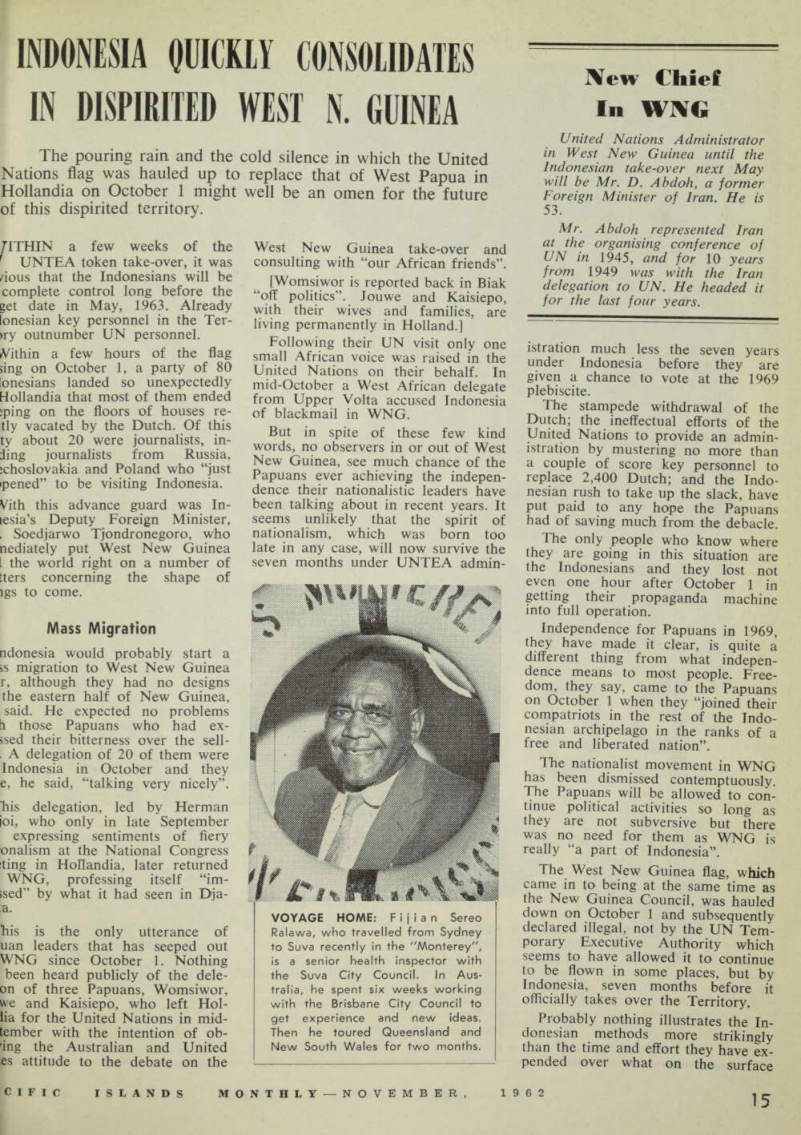
VOYAGE HOME: Fijian Sereo Ralawa, who travelled from Sydney to Suva recently in the "Monterey", is a senior health inspector with the Suva City Council. In Aus tralia, he spent six weeks working with the Brisbane City Council to get experience and new ideas.
Then he toured Queensland and New South Wales for two months.
ms like the childish nonsense of is. First, there was their moral tory in getting the UN to agree to isting their own flag in WNG by end of this year—the target date by Soekarno in 1961 for the ac sition of the former Dutch terri y. Secondly, there has been their icern for the removal of what they I the “so-called” Papuan flag. fhe West Papuan flag, so-called or , has flown besides the Dutch flag WNG for the last 18 months and 5 regarded by the budding Nation als as a symbol and rallying-point. could be argued that the Indo ians might have used more guile their brain-washing by allowing flag to remain in existence. The t that they have stamped it out early probably proves nothing but ir pretty acute appreciation of the ikness of the Papuan nationalists survive the current period of con ion. ‘robably the most significant gam of the Indonesians in the early :ks of October was the announce it that 2,500 Indonesian school :hers will go to WNG; and that a Iding programme for 50 new nentary schools, five extra high X)ls and a University will begin )nce —the foundation stone of the versity to be laid on October 28, onesia’s Youth Pledge Day.
While the instant-University can be dismissed at this stage as propaganda, the 2,500 Indonesian school-teachers cannot. It is through the youth, the schools, and the common language of Malay, spoken alike by Indone sians and the 350,000 Papuans under Administrative control, that Indonesia will put her permanent iron hold on the Territory.
Both President Soekarno and Foreign Minister Subandrio have al ready spoken about vast developmen tal activities in WNG and although they are a great deal vaguer about these than they are about their pro jected brain-washing drive, it is ob vious that there will be super-human efforts made by Indonesia to justify her existence in the Territory by elaborate window dressing.
The only question at the moment is whether the dressing is likely to be permanent or whether, after the place is firmly in the Indonesians’ grip, they will allow it to degenerate again into a poor, depressed and primitive country.
Meantime, the only people who are likely to be free are the 300,000 in the primitive interior who have never come under Dutch influence. Some of these at the end of September took an opportunity to demonstrate their wild ways by murdering 80 mission natives while the UN talked plati tudes back in Hollandia.
There probably is some sort of moral in the fact that these people are going to be allowed to continue their Stone Age existence for some years yet, not caring who has title to WNG; while their more civilised brothers on the coast are going to be exposed to all the frustrations and mental confusion that the 20th cen tury can devise.
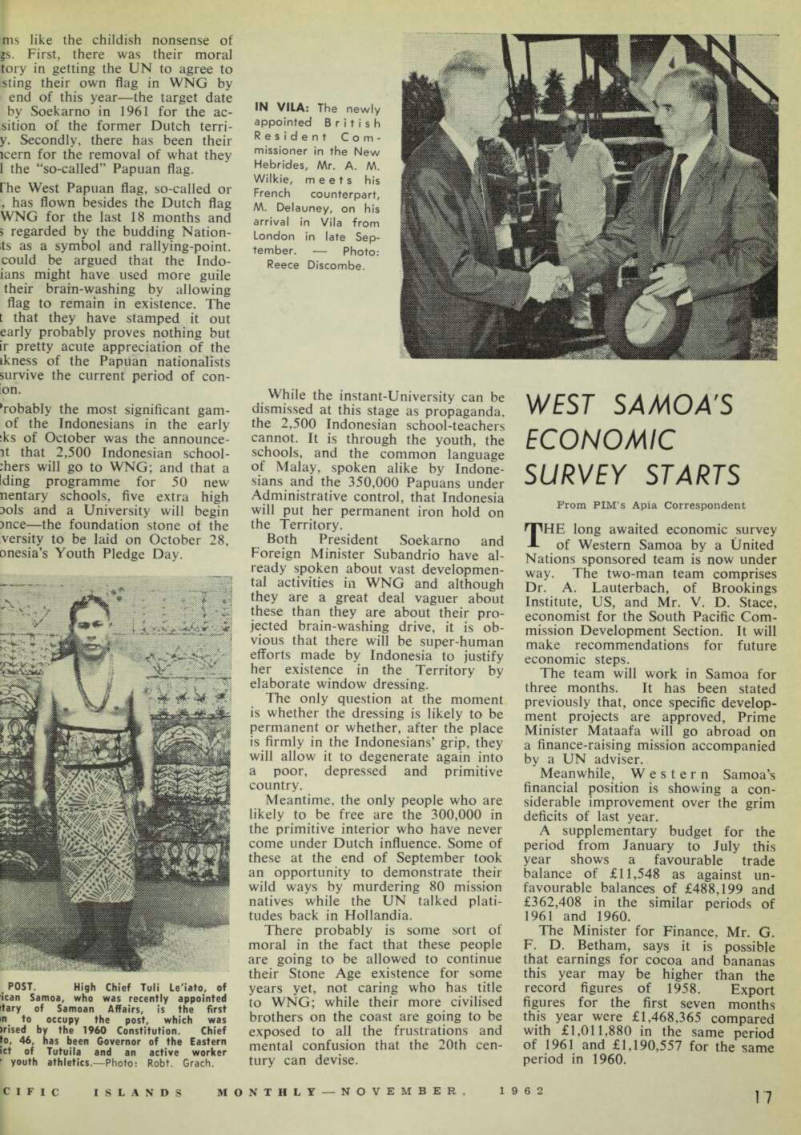
POST. High Chief Tuli Le'iato, of lean Samoa, who was recently appointed etary of Samoan Affairs, is the first [?]n to occupy the post, which was [?]rised by the 1960 Constitution. Chief to, 46, has been Governor of the Eastern [?]ct of Tutuila and an active worker youth athletics.—Photo: Robt. Grach.