Epic Of Minerva Reef
pp. 13-150 · Read in the full issue
Stirred The World
When two starving, emaciated men reached Fiji’s Kadavu sland on a makeshift outrigger on October 14 with news that he 35 ft. Tongan yacht Tuaikaepau had been wrecked three nonths earlier on Minerva Reef, 300 miles away, and that 13 urvivors were still there, a cynical world stopped in its tracks or a moment.
[E story of the remarkable out rigger voyage and of the rescue sufferings of the survivors made d headlines. The story had icnts of heroism, tragedy, priva and human endurance seldom lied in the Pacific. noted Sydney journalist corn el the story to a Greek epic, and Fiji Times, whose reporters and ographers were mainly respon for the world coverage, said in ditorial that it was “likely to be ; one of the enduring stories of against the sea”, itch of the credit for the lack irid sensationalism in the news-
paper accounts was due to Richard Prescott, a Tongan compositor on The Fiji Times, who acted as inter preter for newspaper reporters when the survivors reached Suva. Prescott steadfastly refused to embroider on details of the drama given him by the survivors.
The drama, in which five lives were lost, began on July 4 when the Tuaikaepau, owned by Tofa Ramsey, of Nukualofa and skippered by Tevita Fifita, left Nukualofa for Auckland with an all-Tongan crew of 16.
Three days later, the yacht went aground on Minerva Reef, about 260 miles south-west of Nukualofa, when moonlight on the reef caused it to be mistaken for clear water.
Towards morning of July 8, the yacht began to break up and the men made for the wreck of a Jap anese fishing boat that they could see in the half-light.
Home For Three Months This wreck, which has apparently never been reported, was about a mile away. It became the home of the Tuaikaepau’s men for more than 90 days and provided them with materials that helped keep them alive.
The Tongans were able to save only a small quantity of food and water from their own ship. The food lasted until July 17, then the sur vivors had nothing to eat except fish, crabs and shellfish caught or picked up on the reef.
As the survivors had only one match between them, someone stayed on watch all the time after a fire was lit and kept it burning with tim ber taken from the Japanese wreck.
Fresh water was distilled from sea water boiled in a 44-gallon drum— the steam being drawn off into a kettle with a piece of hose.
Enough fresh water was usually obtained to provide each man with half a cup a day.
When the Tuaikaepau was reported
overdue at the end of July, the RNZAF carried out an unsuccessful search from Auckland ranging as far as the Kermadecs.
After the shipwrecked men had vainly waited on Minerva Reef for two months, their captain decided to build a boat and go for help him self.
The boat, a masterpiece of make shift craftsmanship, was a credit to one of the survivors, Tevita Uasale, a carpenter, who was responsible for its design.
Erroneously described as a raft in the first reports, the boat was 18 ft long and 4 ft 6 in. wide at the beam.
It had an outrigger fixed to the hull by three strong pieces of timber and was braced with galvanised iron strips.
It was made from part of the boom of the wrecked Japanese fish ing ship.
It was so stoutly built that it could probably have held six people.
The men were handicapped in building it by lack of a saw, but they had a hammer and nails, and wood which somehow had to be cut to the right size.
They also had a knife, about the size of a table-knife, serrated on both sides. They used this to mark the timber where they wanted to cut it, and then they laid irons heated on their fire over the marks.
Using nails sharpened at the end as chisels, they cut away the burnt wood, then repeated the process till they had gone far enough through to break it.
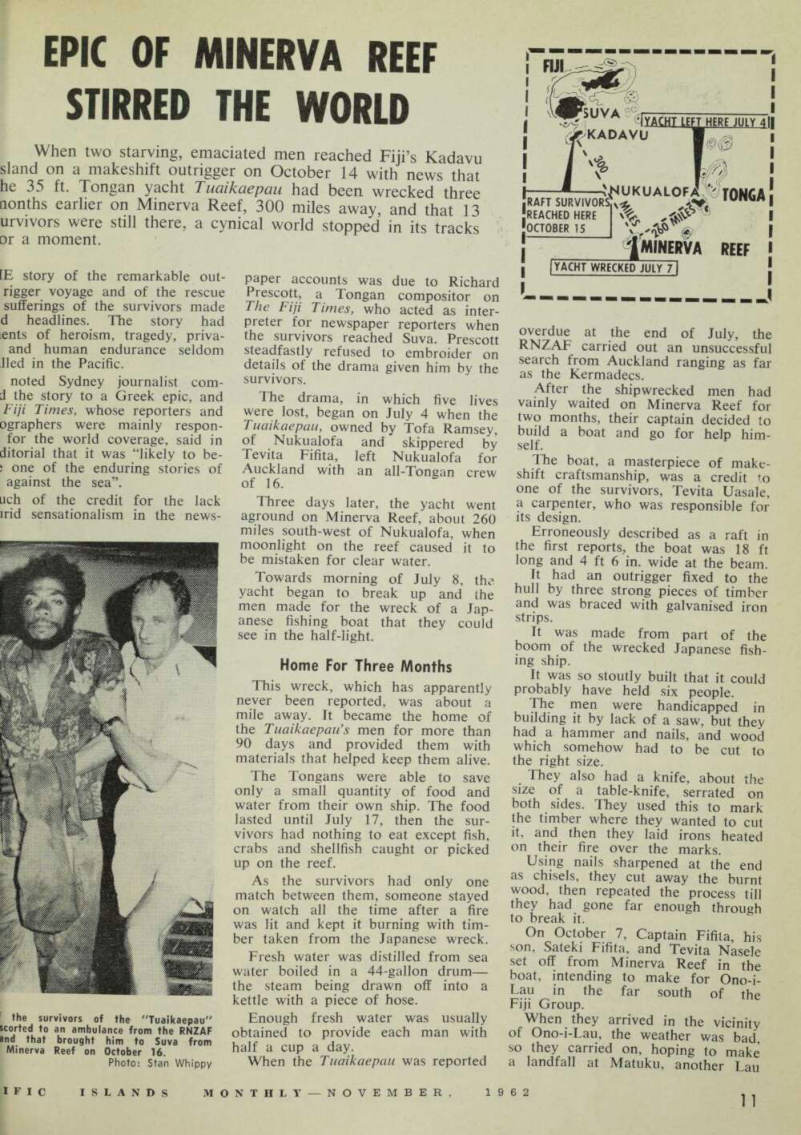
On October 7, Captain Fifita, his son, Sateki Fifita, and Tevita Nasele set off from Minerva Reef in the boat, intending to make for Ono-i- Lau in the far south of the Fiji Group.
When they arrived in the vicinity of Ono-i-Lau, the weather was bad so they carried on, hoping to make a landfall at Matuku, another Lau
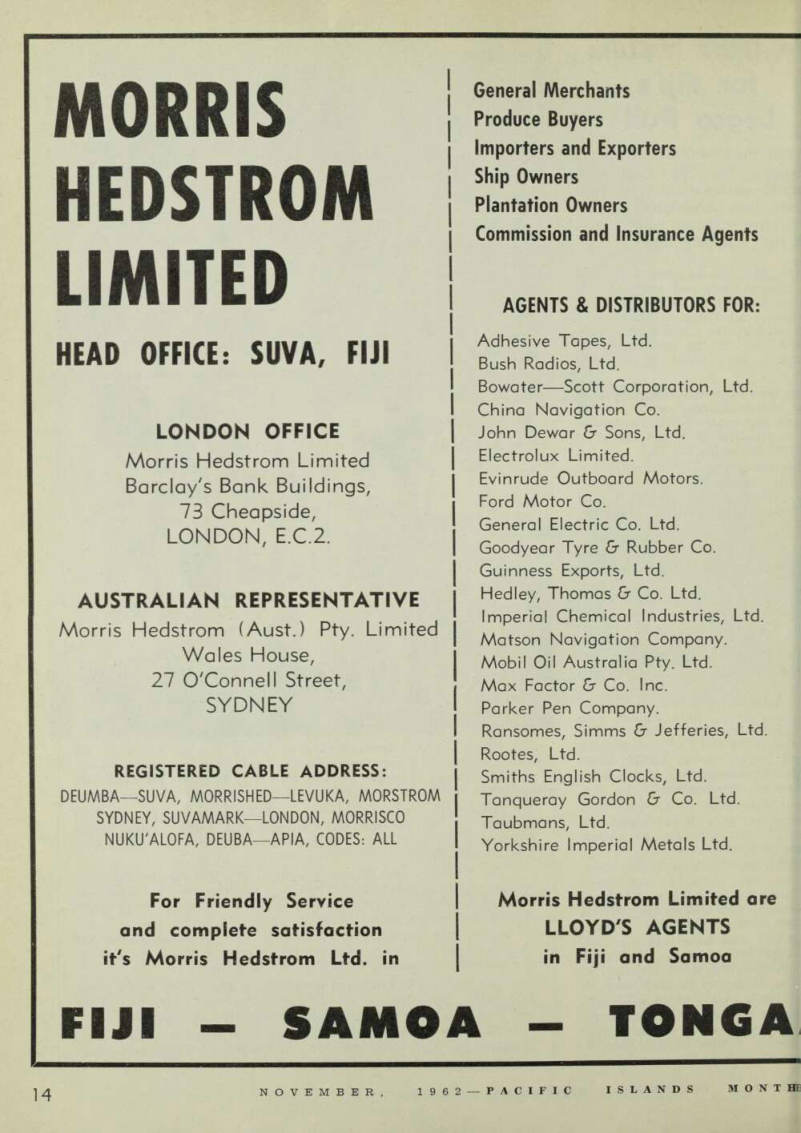
the survivors of the "Tuaikaepau" scorted to an ambulance from the RNZAF and that brought him to Suva from Minerva Reef on October 16.
Photo: Stan Whippy
island. Captain Fifita dared not steer a due north course from the neigh bourhood of Ono-i-Lau because of the danger of hidden reefs.
Near Matuku the men again ran into bad weather, so they continued on a north-north-west course, which eventually took them to Kadavu.
On the craft they had a rough chart painted and cut with nails on a piece of board, plus a compass and a sextant, and were able to keep some sort of course.
Captain Fifita, a practical seaman, knew he dared not miss Kadavu for if he did there was no chance of making a landfall till the Solomons.
Anything beyond Fiji was out of the question for they were without water, and had virtually little food.
They left Minerva Reef with pieces of cooked octopus and shark, and about a quart of drinking water.
Both were finished two days after they left.
Two days later, they caught a sea bird which they had to eat raw, and they also caught a fish, but as it was poisonous, they threw it back.
On October 14, the three men sighted Kadavu and steered close in shore to make sure they were not carried past, apparently because they could not rely too much on their makeshift sail and rudder.
A mile and a half offshore their craft, which had stood up to 350 miles of varying weather in the open sea, suddenly capsized as they turned into a passage in the reef. The three men had no option but to swim for the shore.
Tevita Uasale forged ahead of the other two, and looking back saw
Tevita Fifita trying to help his son who appeared to be in difficulties.
Uasale turned round to go to their assistance, but his captain called out to him to go on. There was heroism and sound reasoning in this for if the two men had weakened and perished in trying to save Sateki, no one would have been left to tell the world of their comrades on Minerva Reef.
Uasale followed this order, and when he was able to stand on his feet he turned round and saw Tevita Fifita and his 22-year-old son saying a prayer.
Tevita Fifita and Sateki kissed and then Tevita left his son to die. When he, too, turned round when he was able to stand on the sea bed about 100 yards further on his son had disappeared.
On landing on a small island on the south side of Kadavu, Captain
Fifita called on his last reserve strength to climb a coconut tree knock down coconuts.
He and his companion dranH milk of 29, then swam about] yards to Kadavu proper.
Taniela Delai, of Nacon Naceva, Kadavu, the first mat sight the two castaways, said latl received such a fright that he n ran away.
The men wore banana II round their waists, life jackets had long beards.
The two survivors had walked four miles from wheres had landed. Josaia Tokarua rJ turaga-ni-koro of Nacomoto (hea the village), took the Tongans his village and allocated a s? bure for them.
When the villagers learned
(Continued on page 148)
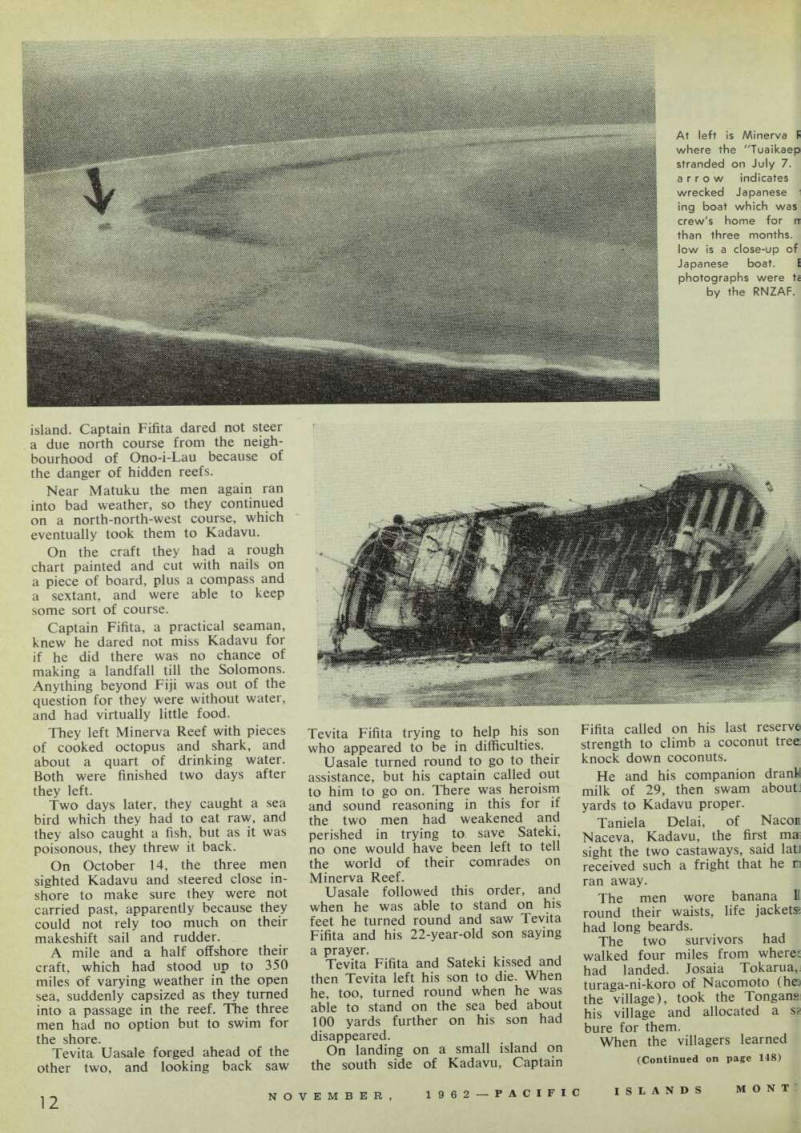
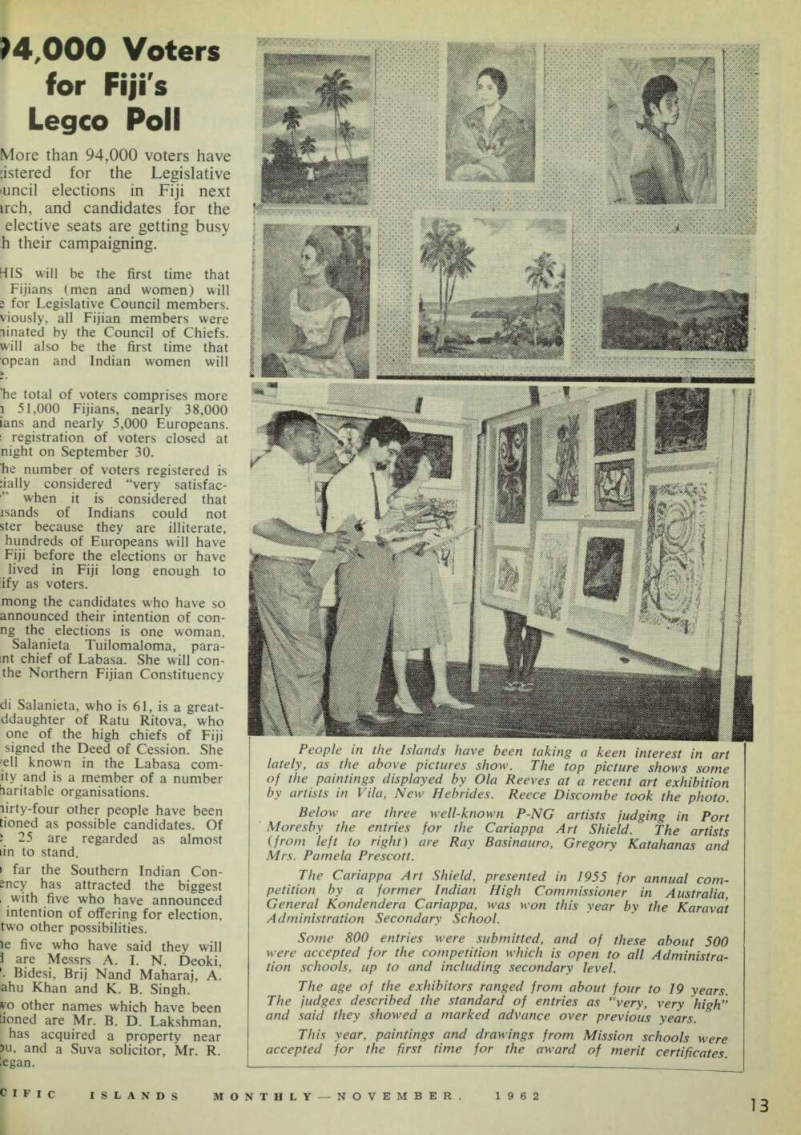
At left is Minerva [?] where the "Tuaikaep stranded on July 7. arrow indicates wrecked Japanese ing boat which was crew's home for m[?] than three months, low is a close-up of Japanese boat. [?] photographs were t[?] by the RNZAF.
the men at Minerva Reef they flashed a message to Suva and rescue opera tions were started immediately.
A Sunderland flying-boat set out for Minerva Reef from Suva that evening and by the light of flares dropped food and water. The crew saw some of the survivors jump into the water to retrieve the supplies.
About midday next day another Sunderland alighted in the lagoon at Minerva Reef, some distance from the Japanese ship. Using a rubber dinghy they picked the survivors up, the five fittest men first, then made another trip for five stretcher cases.
On their third and last voyage the men in the dinghy had the sad task of picking up the body of a man who had died the day before.
Back at Laucala Bay some of the survivors were helped into waiting ambulances; others had to be carried to stretchers.
At the CWM Hospital medical and nursing assistance was waiting for them, also comfortable clean beds.
As the men had not eaten proper food for so long they were fed sparingly. Two of them were so weak that they had to be fed intra veneously.
In Tonga, there was excitement.
tinged with sadness, when news of the rescue of the men reached Nuku alofa.
Excitement rose at the prospect of family reunions, but there was sad ness for those who did not live through the ordeal.
Ala, the wife of Captain Fifita, who had stubbornly refused to hold a mourning feast for her husband, said that after hearing that the yacht was missing, she was confident that good news would be received.
She said she felt that the loss of her son, Sateki, as any mother would feel, but was proud that he gave his life to help his shipmates.
Captain Fifita and Tevita Vasele remained at Kadavu for three days before flying to Suva in a Sunder land to join their comrades in the CWM Hospital.
At the hospital, Captain Fifita strode up and down the ward shak ing hands with them all. Tears came to his eyes as he warmly embraced another son, Talo Fifita, who had re mained at Minerva.
The Tongans had a constant stream of visitors while they were in hospital and received many gifts of money, cigarettes, clothing, and other comforts.
Search for Body Meanwhile, Kadavu Islanders un successfully searched for the body of Captain Fifita’s son. However, they did find the capsized outrigger, which they towed to Nacamoto.
Captain Fifita said in Suva that when he left Tonga on July 4 he weighed 20 st. 8 lb. He estimated that when he arrived at Suva his weight was down to about 13 st.
For endless days on Minerva Reef he had to maintain strict discipline
among the remainder of the cast ways, a task which became more ar more difficult as the men began i despair of their chances of rescue.
He said the minds of some of tJ men started to wander, and all the could talk about was their home and their families.
Captain Fifita also had a trag story to tell about Fatai Fetiaiki, th first man who died on Minerva Re« —24 days after the shipwreck.
The captain had conducted prayer meeting and when it was ove Fatai still appeared to be praying c asleep.
Fifita then asked the men if the had any food and one said he had piece of fish left from a previou meal.
When the man tried to give the fis; to Fatai, he was found to be dead.
Fatai was buried in a grave i coral sand on the reef.
When two men died on the sami day some days later no one ha« sufficient strength to scrape grave for them, so the captain had thi bodies wrapped and cast into the sea The two men were Sione Sikemet and Sione Lose.
Fetiaiki Pulu, whose father sun vived, died the day before the firs: Sunderland arrived over the reef.
The 12 survivors of the Tuaikem pan, flew back to Nukualofa in s Royal New Zealand Air Force Sunt derland flying-boat on October 22.
Queen Salote proclaimed a public holiday to welcome the return of the castaways, and to remember the five men who died.
The 10 men who were rescued from Minerva Reef are Ve’etutu Pahului Soakai Pulu, Vaingina Unga, Fin© Feuiaka, Toia Paa Bloomfield, Sips Fine, Finau Laione, Talo Fifita,i William Fa and Saia Peni.
The makeshift outrigger in which three m[?] made the 300-mile voyage from Minerva Re to Kadavu. Kadavu Islanders found it whi[?] searching for the body of Sateki Fifita.
Tongan flag firmly fixed to the bow w later given to Captain Tevita Fifita Photo: Stan Whip
Clean-shaven after their ordeal, Captain Tevita Fifita (left) makes Tevita Uasele comfortable on an ambulance stretcher at Laucala Bay on their arrival from Kadavu. Uasele with Captain Fifita and his son, Sateki Fifita, made the 300-mile outrigger voyage from Minerva Reef to Kadavu. Sateki Fifita was drowned at the end of the journey.
Photo: Stan Whippy