Wreckage May Shed Light On
pp. 9-10 · Read in the full issue
34-Year-Old Sea Mystery
Special to the Pacific Islands Monthly A piece of wreckage found at Vanikoro, in the southern Solomons, may provide the first clue yet to the disappearance )f a famous Danish sailing vessel 34 years ago.
IE wreckage, a much-worn piece of board about 11 in. long bear the word “Kobenhavn”, may have le from a lifeboat of the five ited Danish sailing ship Koben n which disappeared without trace a voyage from Buenos Aires to itralia in December, 1928.
Tie Kobenhavn, then the world’s ;est sailing ship, was described at time as “the finest sailing ship r built”. esides officers and crew, she was ying 70 cadets, many of whom e members of the most prominent ilies in Denmark, kobenhavn, with a stroke through “o”, as on the wreckage, is the fish spelling of Copenhagen. l native of Vanikoro gave the ckage to Mr. Reece Discombe, of
Vila, New Hebrides, when Mr. Dis combe was at Vanikoro last June in vestigating the possibility of salvag ing a cargo of jettisoned brass. Mr.
Discombe, a New Zealander, is a deep-sea diver and motor engineer.
Vanikoro is the island where the Boussole and Astrolabe, the two ships of the famous French navigator La Perouse, were wrecked in 1788. Mr.
Discombe in recent years has taken a leading part in two expeditions to Vanikoro to search for the wrecked ships, and on occasions he has asked the natives to keep for his inspection any wreckage they might find washed up, in case it could give him a further clue to the La Perouse vessels.
When the wreckage with “Koben havn” on it was handed to him the name did not mean anything to him.
But he brought the piece of wood
back to Vila and in October referred the matter to PIM.
When PIM research disclosed the possible connection with the missing sailing ship, Mr. Discombe sent the piece of wreckage to PIM in Sydney so a check could be made.
A move to identify the name plate through Danish authorities was being made as this issue of PIM went to press.
“I don’t know how long the piece of wreckage was at Vanikoro, or just where it came from,” said Mr. Dis combe in Vila in October. “It has some paint stains on it, and I believe it may have been lying around a shed at Vanikoro for some time. It looks to me as if it came from a lifeboat.
It’s too small for the main name plate.”
There have been many wrecks on Vanikoro over the years but no ship called Kobenhavn is known to have been lost there.
The sailer Kobenhavn left Buenos Aires on December 14, 1928, to load
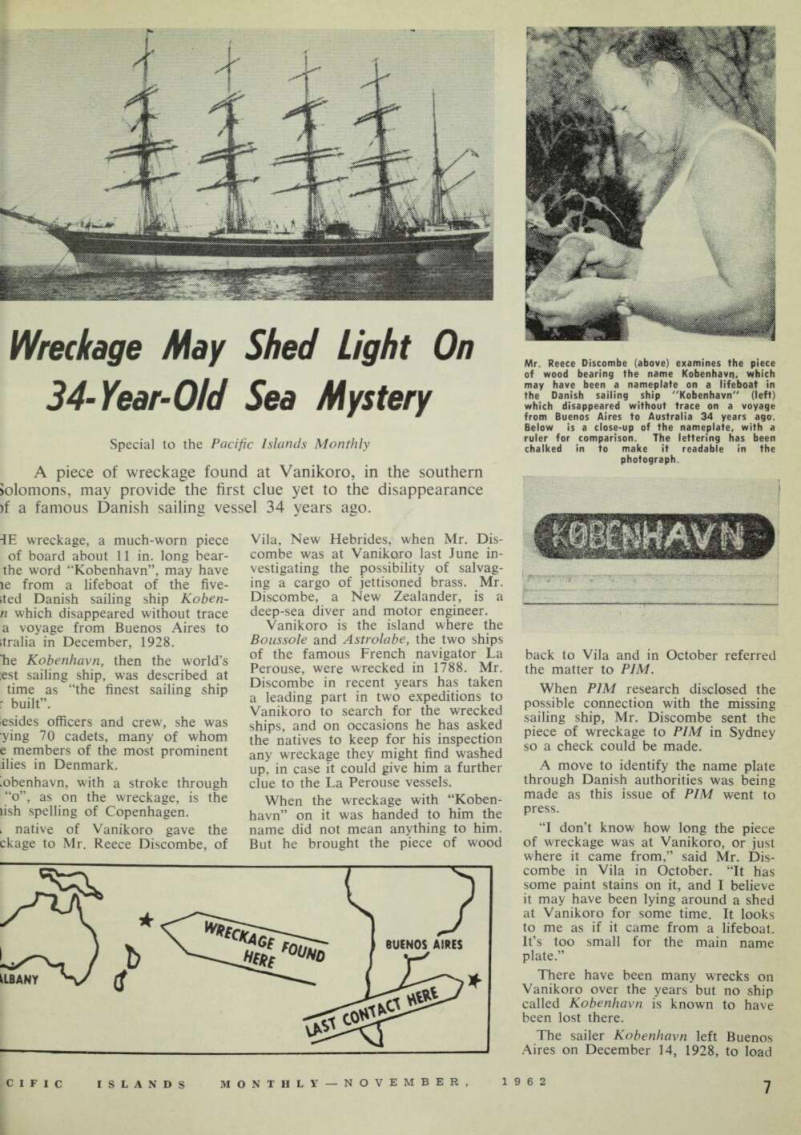
Mr. Reece Discombe (above) examines the piece of wood bearing the name Kobenhavn, which may have been a nameplate on a lifeboat in the Danish sailing ship "Kobenhavn" (left) which disappeared without trace on a voyage from Buenos Aires to Australia 34 years ago.
Below is a close-up of the nameplate, with a ruler for comparison. The lettering has been chalked in to make it readable in the photograph.
wheat for Great Britain at a Victorian or South Australian port.
She was a steel vessel of 3,901 tons, built at Leith, Scotland, in 1921. Her owners were the East Asiatic Steam ship Co., of Copenhagen, which used the ship as a training vessel for cadets entering the merchant marine.
The ship was fitted with a 640 hp diesel engine, and in favourable con ditions she could do 15i knots.
The voyage to Australia should have taken her about 40 days.
Six days after leaving Buenos Aires, the Kobenhavn spoke by radio with the steamer William Blumer in 33 deg. 5 min. South latitude and 34 deg.
West longitude.
She was never seen or heard from again. No wreckage was found, despite serches by four ships and an aircraft extending over five months.
The Kobenhavn's last known position (which was almost half way between Buenos Aires and Tristan da Cunha Island) suggested that the ship was making for Australia by the Cape of Good Hope route.
If this route was, in fact, followed and the ship met disaster somewhere in the Southern Ocean, it is possible that wreckage could have drifted to Vanikoro on a current that moves up the east coast of New Zealand from the Roaring Forties.
On the other hand, if the ship had been making for or had changed course for Cape Horn and had been wrecked after entering the South Pacific, wreckage could have drifted to Vanikoro on the Humboldt and South Equatorial Currents.
All searches for the Kobenhavn were based on the assumption that the ship had taken the Cape of Good Hope route.
The first search was made in early April, 1929—nearly four months after the ship had disappeared.
In the next few months ships sur veyed such places as Prince Edward, Crozet, Kerguelen, Gough and Am sterdam Islands, the west coast of Africa, big sections of the South Atlantic and Southern Ocean, and 1,500 miles of coastline between Western Australia’s North West Cape and Albany. An aircraft helped in the search of the West Australian coastline.
The West Australian searches were prompted by the theory that the Kobenhavn may have been carried up from the Roaring Forties by a cur rent that sweeps northwards along the West Australian coast.
There was a report that the Koben havn was seen in distress off Tristan da Cunha island in January, 1929, but this was later proved to be wrong.