Pacific Shipping And Cruising Yachts
pp. 107-122 · Read in the full issue
Cruising Yachts
A new passenger shipping service will be introduced be ween Australia and New Zealand from April next year when he 13,350-ton liner Remuera will begin running between Wellington and Sydney.
IE Remuera was recently bought by the New Zealand Shipping ipany Ltd. Formerly called iia, she was used on the Atlantic between Liverpool and New k. She has been completely rets he trans-Tasman service will be extension of the liner’s present between New Zealand and ain by way of the Panama Canal :h began recently. resent plans are for one transman trip in April and two in ;ust. The trans-Tasman crossing xpected to take 2i days. he ship will stay only a day in oe y—arriving one morning and helemuemfa one-class vessel ying 350 passengers.
End Of The Jawbreaker:
Nederland Line Royal Dutch 1 liner Johan van Oldenbarnevelt, wn familiarly to thousands of tralians as the J.V.O. because of unpronounceable name, will be idrawn from the round-the-world
service after completing her trans- Tasman schedule on February 3, 1963.
This means that the scheduled voyage between Sydney and Tasmania from February 3 to 9 and all subse quent sailings between Australia and Britain or the Continent have been cancelled.
The J.V.0., which has carried thousands of Australians between Australia and the Continent, will be used as a floating hotel in Fremantle for the Perth Empire Games in No vember. Her fate after being with drawn from the round-the-world ser vice because of old age, has not been decided.
• Six Injured In Fires: Six
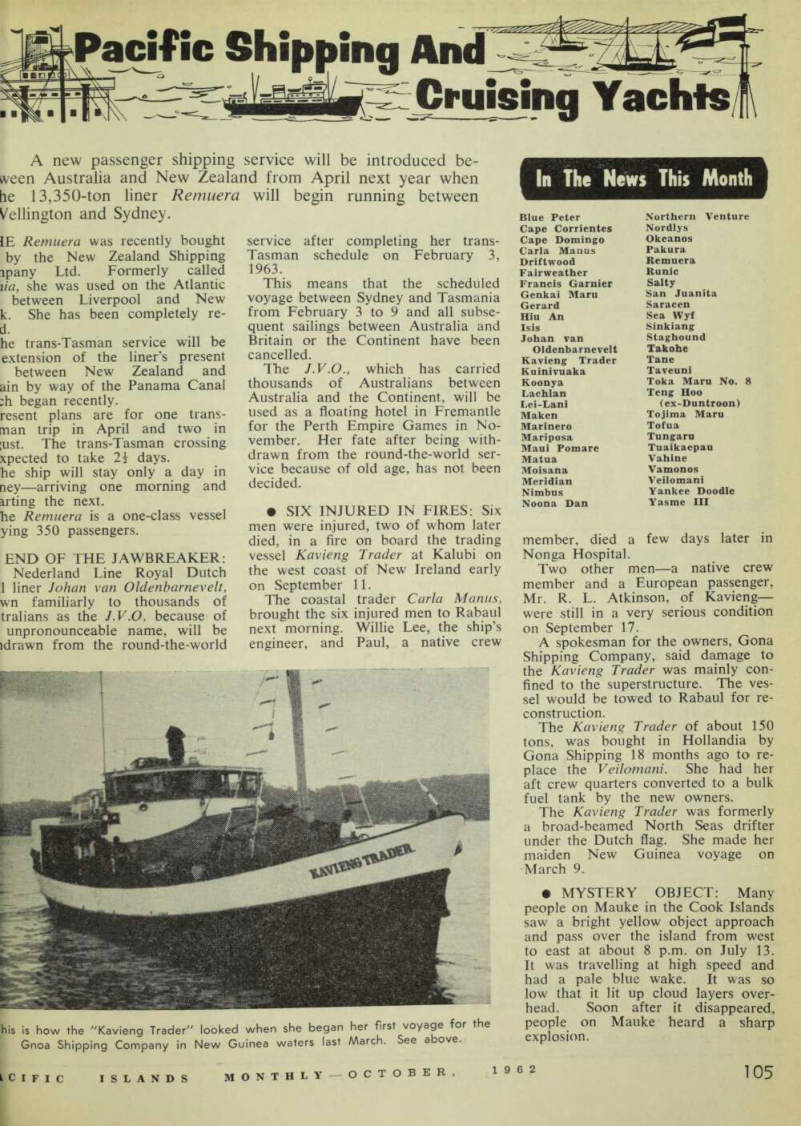
men were m Jured, two ot whom later died, in a fire on board the trading vessel Kavieng Trader at Kalubi on the west coast of New Ireland early on September 11.
The coastal trader Carla Manus, brought the six injured men to Rabaul next morning. Willie Lee, the ship’s engineer, and Paul, a native crew
member, died a few days later in Nonga Hospital.
Two other men—a native crew member and a European passenger, Mr. R. L. Atkinson, of Kavieng— were still in a very serious condition on September 17.
A spokesman for the owners, Gona Shipping Company, said damage to the Kavieng Trader was mainly con fined to the superstructure. The ves sel would be towed to Rabaul for re construction.
The Kavieng Trader of about 150 tons, was bought in Hollandia by Gona Shipping 18 months ago to re place the Veilomani. She had her aft crew quarters converted to a bulk fuel tank by the new owners.
The Kavieng Trader was formerly a broad-beamed North Seas drifter under the Dutch flag. She made her maiden New Guinea voyage on March 9.
• Mystery Object: Many
people on Mauke in the Cook Islands saw a bright yellow object approach and pass over the island from west to east at about 8 p.m. on July 13.
It was travelling at high speed and had a pale blue wake. It was so low that it lit up cloud layers over head. Soon after it disappeared, people on Mauke heard a sharp explosion.
His is how the "Kavieng Trader" looked when she began her first voyage for the Gnoa Shipping Company in New Guinea waters last March. See above.
Typhoon Trouble: Auck
man Jim Shortall, who is well rn to many people in the Pacific, :ularly in shipping circles, has having a bout of typhoon trouble f. ie s.s. Hui An, in which Jim is ng as radio operator, was ored outside Yokkaichi, Japan, n August when Typhoon Thelma k. The ship dragged both ors for several miles and finished n a sandbank. thought the ship was a goner about half an hour,” Jim said note to PIM from Yokkaichi. were taking quite a battering, huge seas breaking right over mdge. he wheel-house, chart-room, ► room and my cabin were is deep in water and I expected portholes to burst in with the y seas at any moment. For tely, the wind and sea went down lly, but some companion-ways washed away and there was a I deal of water damage.” n said that after a week stuck he sand, a modern 1,000-ton ige tug helped to get the ship it after 1,450 tons of coal had i discharged into lighters. [his area is just hell for ship at this time of the year,” Jim t on. “The typhoons all origin around the Marianas-Carolines-
Guam area, and move mainly in a generally north-west, then north-east direction, curving up to cross Japan.
The South Pacific has nothing on this area for storms.”
Jim also sent news of three ships, formerly well known in the South Pacific, which are now operating in the Far East. They are the Maui Pomare, Pakura and Duntroon (now Tong Hoo).
The Maui Pomare, which used to run between New Zealand and the Cook Islands, is now on a weekly service between Hongkong and Kaohsiung, Formosa. The Pakura, whose former port of registry was Napier, NZ, is running a regular service be-
tween Hongkong and Phnompenh.
And the Tong Hoo, which, as the Duntroon, was a passenger liner on the Australian coast, is now carrying passengers and cargo between Hong kong, Singapore and Penang,
• Another Japanese Ship
AGROUND: The Japanese fishing ship, Toka Maru No. 8, which was stranded early on September 1 at Qelelevu, in the Ringgolds, about 220 miles from Suva, was the third Jap anese fishing vessel to be lost on Fiji’s treacherous reefs in the past 12 months.
The mother ship, Tojima Maru, directed another fisher, the Genkai
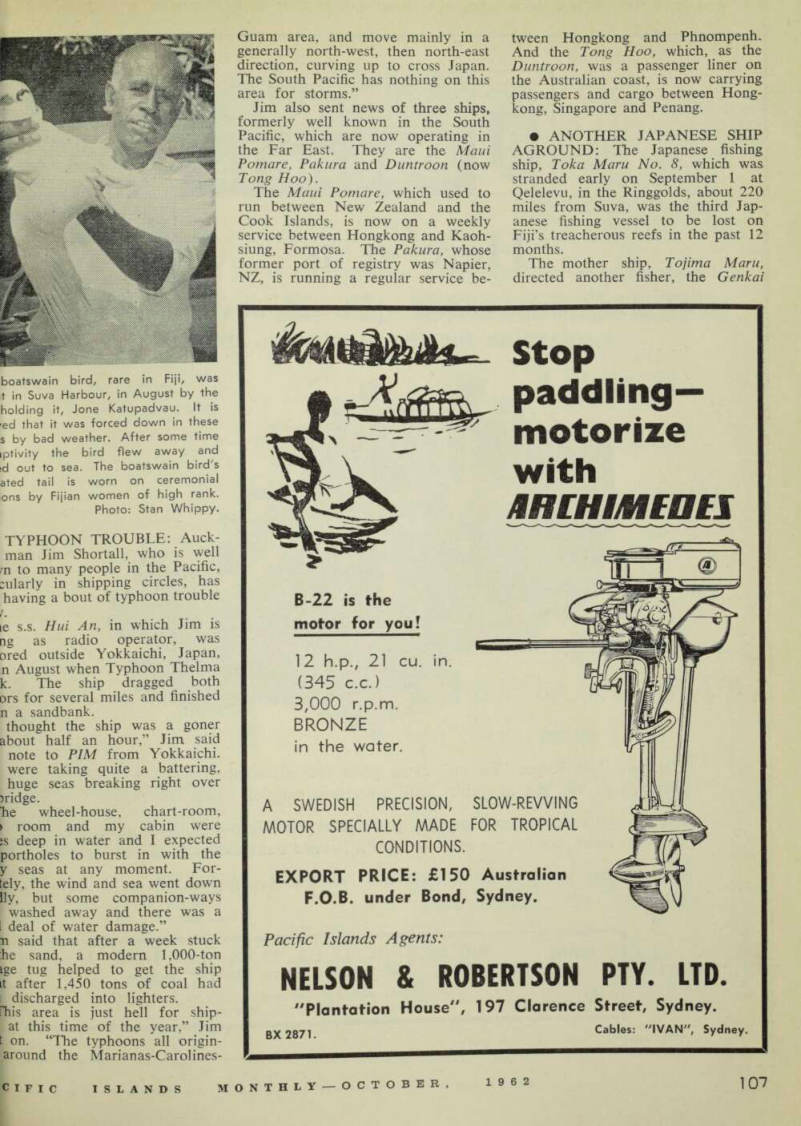
boatswain bird, rare in Fiji, was [?]t in Suva Harbour, in August by the holding it, Jone Katupadvau. It is [?]ed that it was forced down in these [?]s by bad weather. After some time [?]ptivity the bird flew away and [?]d out to sea. The boatswain bird's ated tail is worn on ceremonial ons by Fijian women of high rank.
Photo: Stan Whippy.
i, to the scene to pick up the Toka Maru’s wooden hull was r holed. e police, no doubt remembering jassing of a Fijian in the Koyei t, which stranded off Beqa, and missing goods from the Asahi i No. 8 off Sigatoka, quickly ed all unauthorised persons to away from the Toka Maru No. [ September 2, an official party, •rising District Officer Peter West 1, a livestock officer, Mr. Mathe and a police constable ap :hed Toka Maru. iat night they saw a light flashing the direction of the ship, but [ they replied to it they got no piisable signal in return. sxt day officials went out to the and found her deserted. No was seen that night, i September 4 they stripped all rical gear from the ship, and that : saw a light burning brightly and ily. Mr. Westwood commented: ms uncanny.” hen it was suggested that Fijian »ers might have gone on board, Westwood said: “There is no at Qelelevu, the sea was rough, it is a long way to swim.
Ve took bearings on the light, next morning the same bearing us the position of the ship. could find no explanation for light.” delevu (shown as Nggele Levu ome maps) is 35 miles east of jastern extremity of Vanua Levu. as in this vicinity that the crew- Joyita was found in 1955 after lad disappeared on a voyage from , to the Tokelaus.
I Aftermath Of War:
ers from the Royal New Zealand rey ship HMNZS Lachlan ex led 11 mines recently at Funafuti, bert and Ellice Islands Colony. ) mines were exploded after being covered in the shallowest of Funa
futi’s five reef entrances. The United States Navy laid the mines in 1942.
The Lachlan later sailed for Suva for supplies and left again for Funa futi on August 20 to investigate an other of the atoll’s reef entrances. The ship is also carrying out a survey of the area.
• Another Dead Marine:
A bottle containing a message thrown overboard from the Mariposa on Oc tober 26, 1959, was picked up on the beach at Nangu Village, Santa Cruz, in June. A Swiss passenger had thrown it overboard when crossing the
equator near the Gilbert Islands in 165 deg. 30 min. West Long. • BUSY PORT: The annual re port of the Fijian Customs Depart ment shows that the Port of Suva had its busiest year on record last year when 349 overseas vessels, totalling 2,252,000 gross tons, used the port.
This was the first time the gross ton nage had exceeded 2i million.
• Cargo, Passenger Rates
UP: Shipping companies operating between Australia and New Zealand and the Pacific islands have increased
"Saracen" of the Crusader Line is now [?]g at Rabaul en route from New Zea [?] Noumea and TPNG to Singapore.
Zealand trade to the Territories has [?]ased considerably now that cargo ships make regular calls.
cargo rates and passenger fares, increases operated from Sep ■r 3. increase of Al 5- in the Aus •Fiji cargo rate made the rate '6 a ton Sydney-Suva and 1/6 a ton Melbourne-Suva. 3 general cargo rate from Fiji ;w Zealand by the Union Steam Company rose by 5/- a ton, and la freight rates by 6d. a case, isenger fares in the Matua and i were increased by about 10 snt. Examples of the new fares Suva-Auckland, £F32/4/-; Suva alofa, £FI3/7/-; Suva-Apia, via alofa, £F27/5/-; Suva-Suva in Tofua, via Nukualofa, Vavau, Pago Pago and Apia, /18/-.
Shed Stalemate: Govern
officials and business leaders in have held several inconclusive ngs lately to try to agree on the and location of a storage shed xport produce from Suva, ten plans for the new Suva f were drawn up, apparently no decision was made about a shed to the loading berths. ►w the Development Commis r, Mr. Eric Bevington, hopeful hiding up a big export trade in mas with Japan, wants a shed,
open at the sides, close to the new Walu Bay berth.
Naturally, he does not want the shed for bananas exclusively as Fiji has been slowly building up a minor export trade in such items as ginger, dalo and other perishables.
Businessmen agree that a produce shed is necessary, but so far they have not been prepared to agree that there should be an open shed at Walu Bay.
A shed, open at the sides, and close to the Walu Bay berth would be ideal for produce. The lorries could drive straight in, wait there overnight if necessary, and drive up to the ship’s side when called on to unload. This would reduce handling to a minimum, would prevent fruit “sweating” in a closed shed, and would make for easier handling. All sides agree that Fiji bananas at present pass through too many hands between the grower and the ship’s hold.
• Air-Sea Rescue Station:
American Samoa’s Governor Lee has asked the US Coast Guard to con sider establishing an air and sea rescue station at the new Pago Pago inter national airport. Governor Lee told a PIM correspondent recently that the station could provide sea and air search facilities for Tonga, Fiji, the Cook Islands and the Tokelaus be sides Samoa. The Governor has also strongly recommended that the US Weather Bureau establish an office at Pago Pago.
• Research Expedition:
The Danish research vessel Noona Dan got away to Rennell and Bellona Islands on August 13 after being held up in Honiara, BSIP, for nine days by a severe influenza epidemic. Mem bers of the expedition will carry out anthropological, sociological, linguis tic and geographical research in the two islands, besides studying the islands’ fauna. The expedition m
eludes Dr. Wolff, leader; Dr. S. H.
Elbert, Dr. Torben Monberg and Mr.
L. Christensen. Rennell and Bellona, which are 100-odd miles south-east of San Cristoval, are of particular in terest to scientists because the people are Polynesians and not Melanesians like most Solomon Islanders.
© Line Quits Trade: The
German-owned RAO shipping line, which trades in New Zealand as the Tasman Pacific Service, has with drawn from the New Zealand-Fiji trade because of “lack of induce ment”. Ships of the line most fre quently seen on the New Zealand coast in the past have been the Cap Domingo and the Cap Corrientes.
• Up For Sale: The Mv
Tungaru, a 120 ft. 111-ton steel welded vessel, which was acquired for the Government Trade Scheme in the Gilbert and Ellice Islands Colony after the war and is now run by the Wholesale Society, was up for sale by tender in August. She is no longer required because of the re newal of the Government and Whole sale Society fleet over the past four years. A report from Tarawa on August 22 said several potential buyers were interested in the vessel.
• For New Britain Coast:
Jacobson and Brutnall, who have been operating the MV Lei-Lani be tween Rabaul and Manus ports since February, have brought the 85 ft.
Moisana from Steamships Trading Co. for work on the New Britain coast and Manus. Mr. H. Brutnall, who will be the skipper, was due to take delivery of the ship in Port Moresby about the end of August.
• Easier To See: The Suva
harbour authorities are testing a new method of illuminating marker buoys.
The top mark on the Thurston Patch buoy has been covered with a material sent from New Zealand
LAST? Scenes like this have been [?]ar to passers-by on the waterfront abaul. New Guinea, lately. This [?]s a 170-ton tug boat recently car as deck cargo aboard the "Schelde [?]" en route to Hollandia. Ships have carried aircraft and military supplies, with the Indonesian take-over this of support to NNG has obviously finished.
Local and visiting vessels in Avatiu Harbour, Rarotonga, in late August were from left to right: "Apanui" and "Taveuni", owned by D. C. Brown, the yachts "Marinero", of San Diego, "Takohe", of Blenheim, NZ, and "Yasme", from the UK. Also in the anchor age but out of sight was "Driftwood", of Los Angeles.
ii has a metal base and has been :d to reflect light in the same ns the new reflecting paint so that uoy will be more clearly visible ?ht.
Big Catches: The 45 Ft
rnment fishing vessel San ta, which arrived in the BSIP Australia in May, has landed al of 15,885 lb of dressed fish oniara, valued at £1,200, since ?egan operations. Some of this caught by local fishing co itive societies, for which the San \ta acted as mother ship, using two deep-freeze units to bring catches to market. The San ita has also been used as a train ihip for local fishermen and has ucted preliminary surveys of ig grounds. The San Juanita’s * was to have been changed to ithing else beginning with “S”, so far none of the names ;sted has been accepted, and she probably remain San Juanita. At , some of the locals think it is late to change her name at this : of her new career.
Shipment From Aus
TRIA: The MV Sinkiang arrived 'arawa, GEIC, on September 4 the first direct shipment from ralia for some time. The ship to spend the following six weeks jEIC waters recruiting for the sh Phosphate Commissioners.
SAFETY AT SEA: Legislation iffect greater safety at sea and ontrol British-owned shipping is g considered in the New Hebrides iwing meetings held in the British :e, Vila, at the end of August, -owners or operators from five ids attended the meeting and •ed advice.
Effort To Impress Visi
TS: The Norfolk Island Agricul l and Horticultural Society has i trying to organise a better-than show this year to impress the passengers scheduled to arrive at island in the cruise ship Wangan on Show Day, October 17. The mittee believes the show is an ex ;nt way of showing visitors what island and its people are capable and that if the visitors are im ised the island will get valuable licity.
> Runic Salvage Plan: The
le-masted 120 ft auxiliary schooner 'ard is due to sail from Sydney in ober to begin salvaging the £2i lion 13,587-ton freighter Runic, ch ran aground in February, 1961,
on Middleton Reef, 120 miles north of Lord Howe Island. Two Sydney contractors, Messrs. K. Selvinen and J. Louis, have formed a company, Runic Pty. Ltd., to do the salvage work. Mr. Selvinen has stated that the Gerard can carry 225 tons of scrap metal a trip, and that it can make the voyage to Sydney in 60 hours. Salvage work could take from six months to two years, depending on the market for scrap metal. Mr.
Selvinen said the Runic was still in good condition and high on the reef.
The Gerard , which is 40 years old. was formerly on the potato run between Sydney and Tasmania. She will carry 3. crew of nine.
• Fiji Look-See: P. And O.-
Orient Lines, whose passenger ship business has been in the doldrums
for the last year or so, sent its marine superintendent, Captain R. B. Stan nard, VC, DSO, and deputy passen ger superintendent, Mr. R. W. Glass ford, to Fiji late in August to look things over.
Their first call was at Savusavu, and then, after a brief stop at Suva, they went on to Lautoka to meet representatives of the tourist industry and businessmen, At Savusavu they inspected the wharf facilities and saw many of the tourist attractions.
The P. and 0.-Orient men made it clear that any plans the line may have for expansion of cruises are not con fined to Fiji. C3pt3in St3nn3rd S3IQ.
“We have not stopped looking every where in the South Pacific for places of interest for cruise tourists. We think that Fiji’s islands as a whole
themselves to further investiga as places of general interest.” aptain Stannard said his line ted to add more opportunities for engers to discover the Pacific. \ did not necessarily mean that would take their ships every re, but there could be calling es, where the passengers could id a holiday before they were ed up again. iVe want tourists to see these other itiful places and that is why we here, not just to choose specific es as ports of call, but to have meral look about,” Captain Stan l said.
Dne of the uses of cruising is that irings people to a place. They )me interested and decide to re -1 for a longer holiday.”
) Man Overboard: A Man
ped overboard from the British ip steamer Northern Venture le she was heading to New Cale ia from Japan early in September. zr the ship had signalled Noumea ; the man was missing, a French ry Lancaster prepared to conduct search. But before the plane Id take off, the ship signalled in that a note had been found in man’s cabin that he intended to 2 his life by throwing himself rboard, and the search was called
Ft Cutter Refloated: The
ter Kuinivuaka, which sank about ee months ago off Prince’s Wharf Suva Harbour, was refloated on
September 12. Two fishermen, Messrs. S. K. Singh and R. Singh, of Wainibokasi, Fiji, have bought the cutter.
• Coral Bank Dis
COVERED: The French naval vessel Francis Gamier had the unpleasant experience of discovering a coral bank on a recent voyage to the Chesterfield Islands, half way be tween Australia and New Caledonia.
South-east of the Chesterfields, the navigator found only six fathoms of water under the keel where the chart showed 200. The Francis Gamier returned to Noumea in mid-Septem ber.
News Of Cruising Yachts
• BLUE PETER, Bill Phillip’s 63-ton motor yacht, was expected to leave Suva in the third week of September for a cruise to the outer islands of Fiji, Futuna and Wallis Islands, Western and American Samoa, the Phoenix Islands, Hawaii and her home port of San Diego, California. Mr. Phillips bought the yacht in Hongkong three years ago and sailed her to the United States.
She arrived in Suva in June, where she remained in the charge of two Filipino crew members while Mr.
Phillips and his wife, who had been sailing with him, flew back to the United States. Mr. Phillips later returned to Suva alone. Mrs. Phillips was due to return on September 10 for the cruise home, but had not returned by the 13th. Two Suva men, John Bower and William Smith, were to be members of the crew as far as Honolulu. The Blue Peter has steadying sails and a spinnaker in case of engine trouble.
• The Cancellation Of This
year’s Sydney-Noumea yacht race, the end of which has been a feature of New Caledonia’s Foundation Day
[?] early morning scene at Lautoka showing smoke from the six stacks of the CSR gar mill, and an overseas ship alongside the new wharf. Lautoka may be added the list of calling places for P. and O.-Orient cruise ships in the Pacific following [?]e visit of two of the Line's officials to Fiji in August. See this and previous page.
Photo: Rob Wright.
■ations on September 24, caused disappointment in Noumea, race, which was inaugurated in New Caledonia’s centenary was cancelled when only three s entered. However, there seems 1 some joy on the horizon for lea yacht lovers. PlM's Noumea spondent understands that a Zealand yacht club may or -2 a race from Auckland to tiea next April.
FAIRWEATHER, 58 ft. Ameri schooner, skippered by Mrs. am Adams, arrived in Port ;sby from Santo, New Hebrides, ud-August in the course of a 1 cruise which had then lasted ;ars. Mrs. Adams took over as er in Auckland at the end of when her husband flew back to JS on business. Other members e crew on leaving Auckland were ;ons Rick, 20; Jon, 17; Pat, 12; laughter Sue, 12; plus Vern Han -31, navigator; Harold Stephens, ournalist; Melanie Cox, 19; and Pettigrew, electrical engineer. :k Adams said in Port Moresby the crew was very happy and had been no trouble. They the idea of a woman captain, e Fainveather’s plans were to in Port Moresby for about two s, then sail on round the world Phursday Island, Darwin and ipore. The crew expected to be a for another three years. ie Fairweather began her voyage Florida. Places visited include iulco, Mexico, the Marquesas, New Zealand and New Cale i.
KOONYA, an all-steel Alan e design from Sydney, arrived lonolulu in August after a 19passage from Nuku Hiva to Hilo, aii, with Les Squires, skipper, Dyson, Alan Stuart and David Squires reported a routine pas- He intends to continue to brnia.
NORDLYS, 71 ft American oner, has returned to California i Honolulu and the South Pacific.
OKEANOS, Joe Pachernegg’s t staysail schooner ( ex-Kona and mfleet) is likely to be seen in Jouth Pacific again soon. Okeanos pleted her trip from Wewak, via /o, to Los Angeles on August 25, Joe is now planning to take her n the Mexican coast to Cocos id, the Galapagos and Polynesia, previous news of Joe, in June, been from Toyko, where he said loped to make the 5,000 miles to Angeles in two months. It was
a pretty good estimate, for he made it in 57 days. Other members of the crew were Joe’s fiancee, Benita E. Burge, a former New Guinea nurse, and William Gasson, a 29year-old former Reuter correspondent (in Tokyo) and AAP-Reuter corre spondent (in Port Moresby).
In a note to PIM from Long Beach, California, Joe said: “The whole trip worked out to be a perfect one. But then I had an excellent crew and could not have wished for a better one. We followed as far as prac tical the great circle and steered as far north as 43 degrees.
“The weather on the whole trip was pretty good. We had a few rough days straight after the Japanese coast was out of sight, and later on could have used a bit more wind.
“Although it was fresh with very little sun most of the time, we man aged, with the help of some good sea-water soap, to do all our shower ing on deck. Our fresh water supply of 80 gallons lasted very well. We used about a gallon a day, so had some to spare at the end.
“Food nowadays at sea is no problem, and tinned food, rice, onions and potatoes kept us going.
We were lucky with fishing all the way across and caught tuna, dorado, sharks and a large sunfish. A flock of albatross followed us from one end of the ocean to the other.”
Joe and his fiancee were planning to spend about a month visiting Southern California before setting out again. Joe is a veteran of the German Navy of World War 11. He started out in 1956 to sail a 36 ft schooner alone round the world, but was shipwrecked in the Galapagos Islands. • DRIFTWOOD, an American yacht, was in Rarotonga at the end of August. She had been briefly on the reef while trying to enter Avarua harbour at night. • MARINERO, 38 ft Californian ketch, now in Rarotonga, lost a crew member overboard during a recent voyage from New Zealand. The Marinero left Auckland in May to visit New Caledonia, Fiji and the New Hebrides with owner Floyd Christenson, his wife Doris, their two children, Keith and Karen, and crew member, Robyn Du Pere Wood, of Auckland. They had not intended to call at Rarotonga, but were forced to make for that island after they got well off course in heavy seas.
The ketch reached Rarotonga on July 1 after a voyage of 33 days. Ten days were spent hove-to in gales 250 miles off the coast of New Zealand.
Crew member Wood was lost over board on June 6.
Writing to RIM from Rarotonga on August 30, Mr. Christenson said; “He (Wood) was spotted immediately after he fell in and the yacht man aged to return to him. A lifejacket was dropped within three feet of him, which he made no attempt to retrieve.
However, Mr. Wood was an experi enced yachtsman, having crossed the Tasman in the trans-Tasman race and extensively cruised NZ waters.
“He appeared to be in no difficulty.
High winds (40 knots) and rough
Above is Joe Pachernegg's 39 ft. staysail schooner "Okeanos" in California. The lower picture shows Joe (left), William Gasson and Joe's fiancee Benita E. Burge, a former New Guinea nurse.
seas made rescue difficult. Be of the wind, the yacht was to stay next to him about 15 seo Upon returning, a 40 ft coil o:< was dropped across his arms. A he made no effort to grasp the and it was surmised from this he must have been injured.
“Again, the wind blew the about 600 ft away, and befo could return, Mr, Wood sank., was in the water minutes. The accident occurre June 6. That night the wind 70 knots.
“The yacht remained hove winds varying from 30 to 70 for six more days and then proc: directly north to 30 deg. Lat. (t« better weather) and then sailed to Rarotonga.
“An inquest held in Raroc found that the death of Mr. 1 was due to drowning at sea, ths captain of the yacht had done j could to effect rescue, but that st weather conditions hampered covery.”
Mr. Christenson said he was ing in Rarotonga as captain of Brown’s Taveuni. He planned on to Tahiti in a few months. • SEAWYF, a 45 ft scho and Maken, a ketch, sailed Sausalito, California, on August! a 15-month cruise of the South j Seawyf is skippered by Bill Ruo a German-born naturalised Cam who built his vessel in a shedl the Vancouver waterfront. Me skipper, Verner Kaiser, another* man-born naturalised Canadian quired his vessel in a rundown/ and almost rebuilt her.
Seawyf and Maken will sail in voy as long as it suits them, crew members of the Seawyy Wolf and Inga Gorrissen and! ginia Cook, Verner Kaiser is s with his wife Edith and their fi: Peter and Thea Hartmann, The crews of both vessels pH sail, fish, skin-dive and swim thr Southern California, Hawaii. T New Guinea, Australia and New, land. None of them is older* 35.
• Ralph Thorvaldsen
Tane, has returned to Honolulu! delivering a Tahiti ketch to thd as hired skipper. He reported! breezes and a slow passage,
9 Tuaikaepau, A 45 Ft ;
which was reported overdue voyage from Tonga to Aucklaitj July 30, was still missing inr tember. The yacht is owneoj Tofa Ramsey, of Nukualofa, isg pered by Tevita Fifita, and is bee to be carrying an all-Tongan i
7. She left Tonga on July 4 was believed to have intended g near uninhabited Ata Island, juthernmost island of the Tonga P ;er an unsuccessful air search le yacht early in August, Tonga > reported that an unknown craft ing a large number of people been sighted about August 10 ,e island of Niuatoputapu, about miles north-east of Vavua and ; 500 miles from Ata. All boats e area were asked to look out le yacht.
SALTY, 50-year-old yacht, i left Hamburg on April 13 last single-handed by Arthur Menh -36, of Cologne, reached Whan- NZ, on September 14 after ing the Pacific. Last port of call Nukualofa.
TAKOHE, 40 ft. yawl, with Zealanders L. “Snow” Gate :, his brother Trevor, R. Mitchell R. Daniel, arrived in Tahiti in mber after a five-week voyage Picton, NZ, including a brief at Rarotonga.
VAHINE, a 34 ft yacht with Florence, skipper, Frank Blom Fohn Jesperson, arrived in Nou from Brisbane on August 24 a four-day trip. The crew, g Australians, built the craft selves. She has an auxiliary r, but only sail power is usually The crew’s plans were to re in Noumea for five weeks and return to Australia.
VAMONOS, Class D champion e 1961 Transpac, was dismasted >out 30 degrees North Latitude er way to the US, and limped to Honolulu under a 17 ft jury A local policeman served skipper nr J. Strich at the dock with a mt charging gross cheat on the daint of a woman to whom he sold a car.
WANDERER (ex-Gracie S ) Id lady with an adventurous past, 3een operating out of Pago Pago series of luxury cruises arranged Duth Pacific Air Lines and Siemer Hand Ltd., travel agents, ve two-week cruises were luled to run through September, >ecause of a somewhat disappoint esponse, it seemed likely that the s might be curtailed. Cost of cruises—to Apia, Vavau and ualofa —plus the round-trip air from Hawaii to Pago was $999. anderer, a 96 ft topsail schooner, ider the command of Omer Darr,
former master of Te Vega and one of the most experienced US sailing skippers below the line.
As the Grade S, she was built for tough work as the San Francisco Bay pilot boat. • YANKEE DOODLE, with Jack Marston and wife, appeared briefly in Honolulu in August to revictual and top off tanks. She continued to the US mainland. Yankee Doodle, a 40 ft American yacht, was in Fiji and New Zealand last year, • ISIS, Walter Martindale’s 32 ft Sydney cutter, is expected to be a centre of attraction this summer for hordes of children swimming in Nor folk Island’s Emily Bay if Mr. Mar tindale cannot get a crew to take her back to Sydney.
The Isis, which left Sydney on May 19 with Mr. Martindale, his 21month-old daughter Liane, and two crew members, Derek Brewin and George McCafferty, made headlines when she turned up at Norfolk Island in June and Mr. Martindale’s daugh ter was taken into custody by court order and later returned to her mother, who flew to the island for the reunion.
The cutter was in the news again later when McCafferty and Brewin put her out to sea to escape bad weather and were presumed lost until they turned up at Norfolk again about a week later after having been blown about 200 miles north-west of the island.
On June 19, Mr. Frank Christian, of Norfolk Island, successfully navi gated the Isis through the reefs of Sydney Bay into Emily Bay, a snug cove within the reefs. (When PIM reported this in August, p. 118, it was inadvertently stated that Mr.
Christian had performed the “tricky operation” of taking the Isis through the reefs at Cascade Bay. As Mr.
F. J. Needham, of Norfolk Island, was quick to point out, this certainly was tricky—it would have entailed “navigating about three miles of road” as Cascade Bay is on the op posite side of the island!) Mr. Martindale remained at Nor folk Island until only 12 hours before the Isis’ reappearance and then re turned to Sydney. Brewin and Mc- Cafferty remained there until early August when they flew to New Zealand, The Isis was thus left at Emily Bay without a crew, and latest reports from Norfolk Island say that Mr.
Martindale is having difficulty getting a new crew to take her back to Sydney. © MERIDIAN, a shapely visitor to Rabaul, slipped out of harbour in late August on her way via the Trobriands and Samarai to Australia’s Barrier coast. Meridian is well known to regular PIM readers. A 44 ft double-ended cutter, she is the pride and joy of her American owners, Richard and Abbie Stafford.
She was built in 1934 at East Booth bay, Maine, to a William Hand de sign and is the only one of her kind.
The cutter is a blue-water man’s dream, combining most of the com forts of the white cap and monkey jacket class with horny-handed sea going abilities.
The cutter left Miami in 1954 to begin her present wanderings. She has been to Jamaica, Panama, the Galapagos and Marquesas, Tahiti, Samoa, Tonga, Fiji, New Caledonia, Brisbane, back to New Caledonia, the New Hebrides and lastly Rabaul, where she stayed a month. The Staffords have made many friends in that time.
Now her sails are set for Cairns, Thursday Island, Darwin, the Sey chelles, the Red Sea and so back to the States. In her travels Meridian hopes to meet with American Paul Hurst’s Staghound, still at last word in Madang. © NIMBUS, with Lief Iverson and a crew of three, was reported in Hawaii in August after a 20-day routine trip from Bora Bora to Hilo.
Our Honolulu correspondent, report ing her arrival, did not say whether she was the 40 ft American ketch that was in Rarotonga in February,
bound then for Pago Pago, or tH ft American cutter that left San D in February for Panama, the « pagos and Marquesas. Ne Nimbus at that time was skipp by Lief Iverson, so maybe th Nimbus Mark 111. • YASME 111, with ill-stJ English yachtsman Danny Weill his wife, is half-way across the F on Weil’s third) attempt to sail n the world. PlM’s last news ofl was from Rarotonga, where hu rived on July 27 after a very n si-day voyage from Tahiti.
Weil’s first Yasme sank unden after hitting a reef about 150 from Port Moresby in October, Weil, who was single-handing it! rescued by a Catalina flying boat! he had drifted in a rubber dl for half a day. Earlier on the voyage, Weil was towed into Moresby by launch after he hacfa out distress signals while bas heavy seas between the Solomonr Port Moresby.
Weil lost Yasme II in the Indies in 1959. Yasme 111 n foundered off Cape Corriii Mexico, last December while s? to San Diego, California.
Yasme 111 is a 51 ft yacht w, powerful auxiliary engine. Shei three radio transmitters, five reca three depth-finders, three finders, two automatic pilots, . 110-220 volt a.c. generator and electrical and mechanical gear.
The new vessel was built at H Dorset, England. She is on Weil calls a “scientific and educar mission” which, like the earlien ages, is being financed by arm radio operators all over the w*\ The Cook Islands News, repot Weil’s arrival in Rarotonga, sae expected to stay there for abot month.
Danny Weil, of "Yasme III". The picture was taken in Port Moresby in 1956 after Danny lost "Yasme I" on a reef and was rescued by a Catalina flying boat.
Richard and Abbie Stafford on "Meridian" off BP's wharf, Simpso[?] bour, Rabaul.