Did Fletcher
pp. 85-86 · Read in the full issue
Christian Go Home?
By a Staff Writer
A hoary old story about Bounty mutineer Fletcher Christian escaping from Pitcairn and returning to England was the subject of a documentary programme on the BBC last April, and since then it has been a lively topic in Pitcairn Miscel lany, the island’s roneoed
monthly newspaper.
AFTER the programme was broad cast, one of the islanders wrote to the BBC asking for the source of information for the theory that Christian had returned to England.
When a BBC official replied he gave several items of information that are not widely known.
“Doubts against accepting Fletcher Christian’s murder on Pitcairn,” he said, “were probably first started with the publication in 1796 of The Letters of Fletcher Christian. ‘These letters were denounced by William Wordsworth [a school mate of Christian] as spurious and there seems no doubt that they were so, although they were republished as late as 1935.
“Then in 1808-10 there were strong rumours that the mutineer was back in Cumberland. Robert Southey, the poet, living at Keswick, wrote
in October, 1809, that he had every reason to believe that Fletcher Christian was in his father’s house.
Some 10 years later Southey appeared to have a different opinion.
“In the Cumberland Scientific As sociation Transactions, 1876-7, William Fletcher, FGS, of Cocker mouth, told of these old rumours and said that it was believed then that Fletcher Christian’s first cousin, John Christian Curwen, MP, used his influence to prevent any official search being made for the fugitive.
“The strongest support for the belief that Christian returned is in Sir John Barrow’s classic account of the mutiny, The Mutiny of the Bounty, published in 1831, and this was the main source of information for the dramatised feature.
“Barrow was Second Secretary at the Admiralty and in a long footnote he told of an incident at Plymouth in 1808 when Captain Peter Hey wood thought he saw Christian.
Heywood had been a midshipman on the Bounty . .
The BBC official added that after the BBC documentary had been broadcast, a Dr. Robert Woof had given a talk in which he accepted the general assumption as fact that Christian was murdered on Pitcairn and that he dismissed the stories of his return to England as “romantic legend”.
The BBC official did not give Dr.
Woof’s reasons for this conclusion.
But it is evident from the phrase “general assumption” that Dr. Woof did not know that there are, in PlM’s view, three convincing reasons for believing that Christian was murdered on Pitcairn. They are:— • John Adams, the last surviving mutineer, told every visitor to Pitcairn between 1808 and his death in 1829 that Christian was murdered. (Most writers on Pitcairn are only familiar with the somewhat dis crepant accounts written down by Folger, 1808; Staines, Pipon and Shillabeer, 1815; and Beechey, 1825.
But there are several others—those of Captains Henderson, King, Arthur and Raine, John Buffett and J. A. Moerenhout—which are more or less consistent). • Contrary to the belief of most writers, Adams was not the only original member of the Pitcairn colony who gave accounts of Christian’s murder. In 1819 and again in 1826, a Tahitian woman, whom the mutineers called Jenny, described Christian’s murder to inter viewers in Tahiti after she had been taken off Pitcairn by the American whaler Sultan. Jenny’s accounts agreed in detail with those of Adams.
• A journal containing evidence that Christian had died on Pitcairn was found on the island when Captain Beechey visited it in 1825.
The journal had been kept by Edward Young, one of the nine mutineers who settled on the island in 1790.
In it was an entry dated March 12, 1794, which described how Young had seen Jenny holding the skull of a dead mutineer, “I desired it might be buried,”
Young wrote, “but the women who were with Jenny gave me for answer that it should not. . . . Accordingly, when I saw McCoy, Smith (alias Adams) and Mat. Quintal, I acquainted them with it, and said I thought that if the girls did not agree to give up the heads of the five white men in a peaceable manner, they ought to be taken by force and buried.”
This entry makes it clear that four mutineers were living when Young wrote, and that five were dead. And as there were only nine to start with, it is obvious that Christian was dead.
Young’s journal, incidentally, was seen by several visitors to Pitcairn before Captain Beechey’s visit, but no one has reported seeing it since.
Apparently, it is not on Pitcairn now.
If the journal is still in existence, the owner would probably make a small fortune if he cared to part with it. Does anyone know its where abouts?
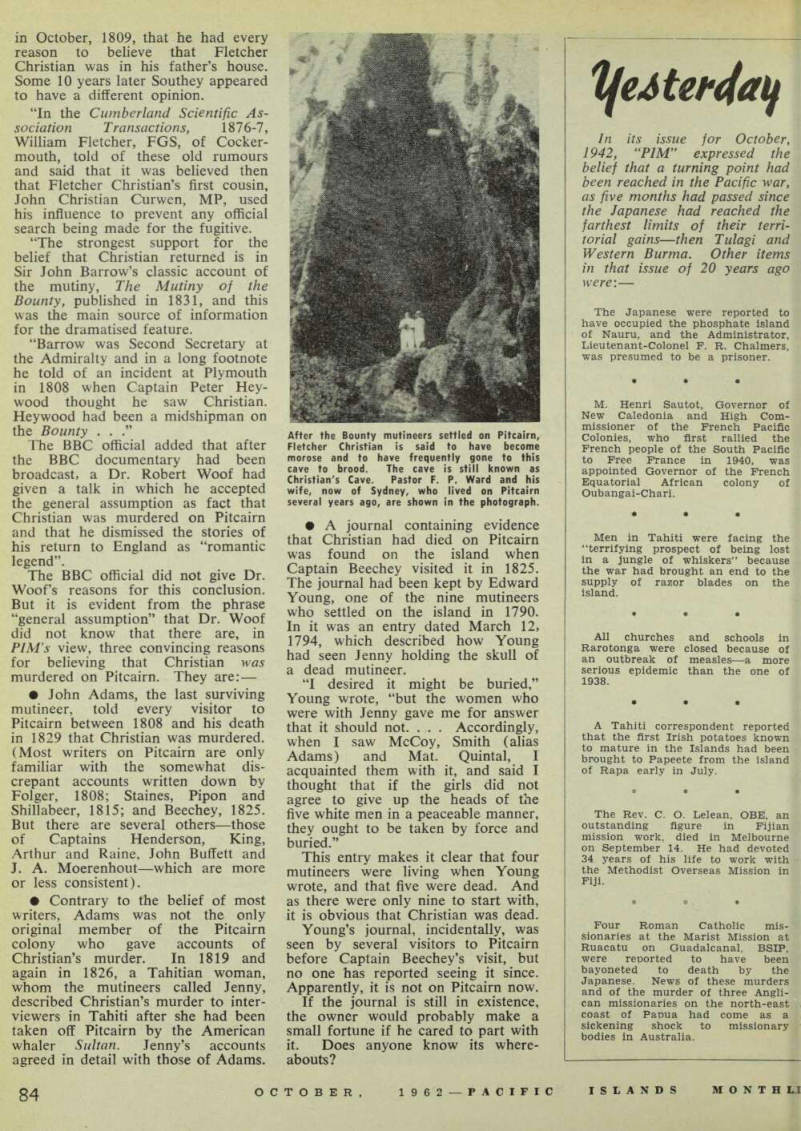
After the Bounty mutineers settled on Pitcairn, Fletcher Christian is said to have become morose and to have frequently gone to this cave to brood. The cave is still known as Christian's Cave. Pastor F. P. Ward and his wife, now of Sydney, who lived on Pitcairn several years ago, are shown in the photograph.