Two Decades Have Brought Big
pp. 81-83 · Read in the full issue
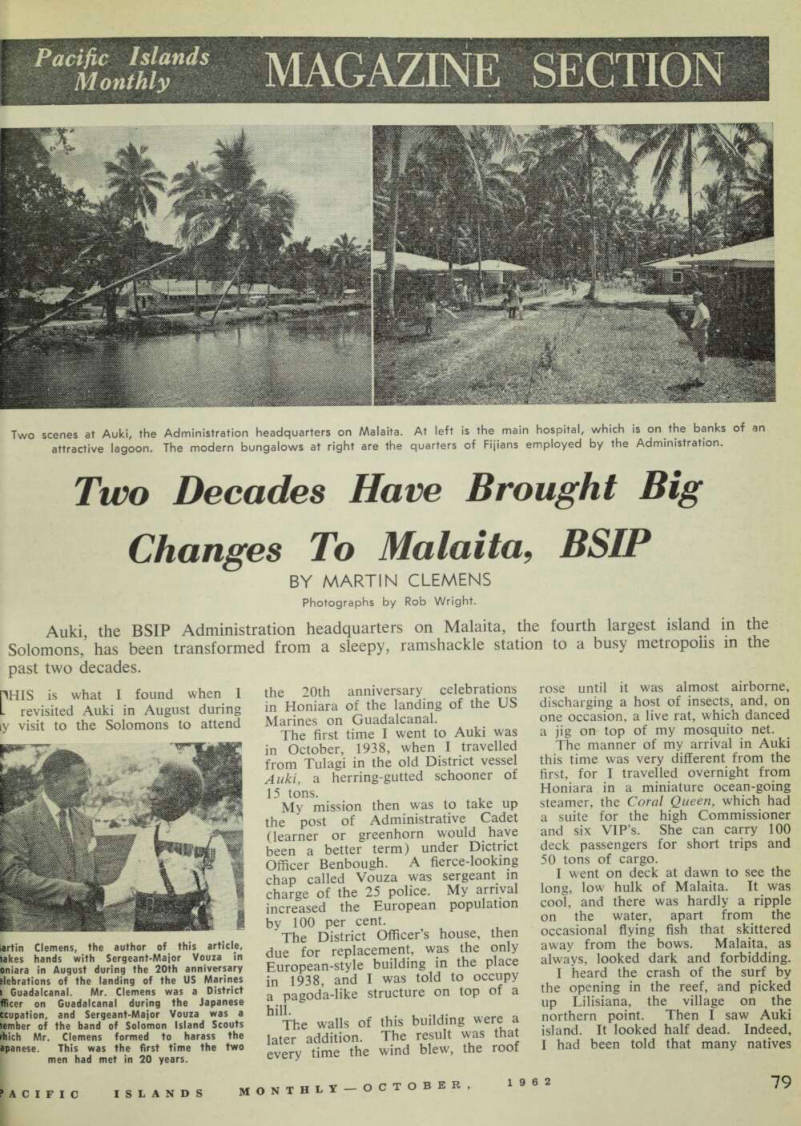
Changes To M alaita, BSIP
By Martin Clemens
Photographs by Rob Wright.
Auki, the BSIP Administration headquarters on Malaita, the fourth largest island in the Solomons, has been transformed from a sleepy, ramshackle station to a busy metropolis in the past two decades.
HHIS is what I found when I L revisited Auki in August during ly visit to the Solomons to attend
the 20th anniversary celebrations in Honiara of the landing of the US Marines on Guadalcanal.
The first time I went to Auki was in October, 1938, when I travelled from Tulagi in the old District vessel Auki, a herring-gutted schooner of 15 tons.
My mission then was to take up the post of Administrative Cadet (learner or greenhorn would have been a better term) under Dictrict Officer Benbough. A fierce-lookmg chap called Vouza was sergeant m charge of the 25 police. My arrival increased the European population by 100 per cent.
The District Officer’s house, then due for replacement, was the only European-style building m the place in 1938, and I was told to occupy a pagoda-like structure on top of a The walls of this building were a later addition. The result was that every time the wind blew, the roof
rose until it was almost airborne, discharging a host of insects, and, on one occasion, a live rat, which danced a jig on top of my mosquito net.
The manner of my arrival in Auki this time was very different from the first, for I travelled overnight from Honiara in a miniature ocean-going steamer, the Coral Queen, which had a suite for the high Commissioner and six VlP’s. She can carry 100 deck passengers for short trips and 50 tons of cargo.
I went on deck at dawn to see the long, low hulk of Malaita. It was cool, and there was hardly a ripple on the water, apart from the occasional flying fish that skittered away from the bows. Malaita, as always, looked dark and forbidding.
I heard the crash of the surf by the opening in the reef, and picked up Lilisiana, the village on the northern point. Then I saw Auki island. It looked half dead. Indeed, I had been told that many natives
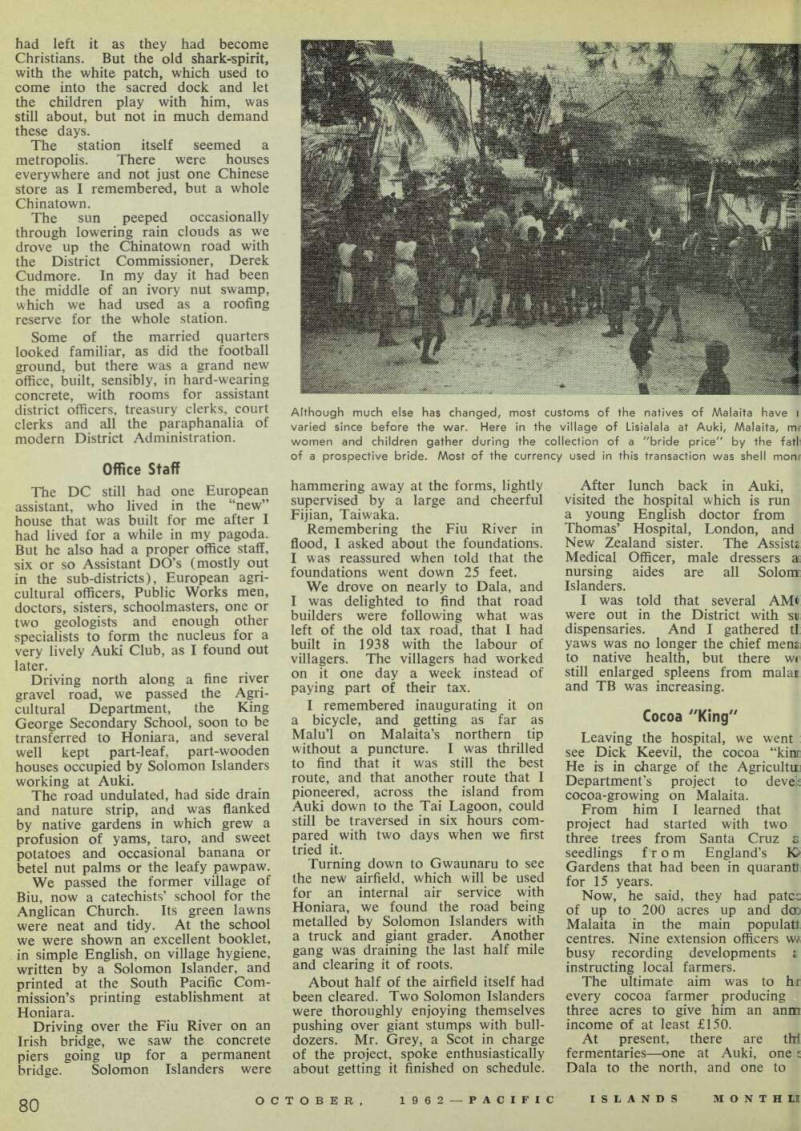
[?]artin Clemens, the author of this article, [?]akes hands with Sergeant-Major Vouza in [?]oniara in August during the 20th anniversary [?]elebrations of the landing of the US Marines [?] Guadalcanal. Mr. Clemens was a District [?]fficer on Guadalcanal during the Japanese [?]ccupation, and Sergeant-Major Vouza was a [?]ember of the band of Solomon Island Scouts [?]hich Mr. Clemens formed to harass the [?]apanese. This was the first time the two men had met in 20 years.
had left it as they had become Christians. But the old shark-spirit, with the white patch, which used to come into the sacred dock and let the children play with him, was still about, but not in much demand these days.
The station itself seemed a metropolis. There were houses everywhere and not just one Chinese store as I remembered, but a whole Chinatown.
The sun peeped occasionally through lowering rain clouds as we drove up the Chinatown road with the District Commissioner, Derek Cudmore. In my day it had been the middle of an ivory nut swamp, which we had used as a roofing reserve for the whole station.
Some of the married quarters looked familiar, as did the football ground, but there was a grand new office, built, sensibly, in hard-wearing concrete, with rooms for assistant district officers, treasury clerks, court clerks and all the paraphanalia of modern District Administration.
Office Staff The DC still had one European assistant, who lived in the “new” house that was built for me after I had lived for a while in my pagoda.
But he also had a proper office staff, six or so Assistant DO’s (mostly out in the sub-districts), European agri cultural officers, Public Works men, doctors, sisters, schoolmasters, one or two geologists and enough other specialists to form the nucleus for a very lively Auki Club, as I found out later.
Driving north along a fine river gravel road, we passed the Agri cultural Department, the King George Secondary School, soon to be transferred to Honiara, and several
well kept part-leaf, part-wooden
houses occupied by Solomon Islanders working at Auki.
The road undulated, had side drain and nature strip, and was flanked by native gardens in which grew a profusion of yams, taro, and sweet potatoes and occasional banana or betel nut palms or the leafy pawpaw.
We passed the former village of Biu, now a catechists’ school for the Anglican Church. Its green lawns were neat and tidy. At the school we were shown an excellent booklet, in simple English, on village hygiene, written by a Solomon Islander, and printed at the South Pacific Com mission’s printing establishment at Honiara.
Driving over the Fiu River on an Irish bridge, we saw the concrete piers going up for a permanent bridge. Solomon Islanders were
hammering away at the forms, lightly supervised by a large and cheerful Fijian, Taiwaka.
Remembering the Fiu River in flood, I asked about the foundations.
I was reassured when told that the foundations went down 25 feet.
We drove on nearly to Dala, and I was delighted to find that road builders were following what was left of the old tax road, that I had built in 1938 with the labour of villagers. The villagers had worked on it one day a week instead of paying part of their tax.
I remembered inaugurating it on a bicycle, and getting as far as Malu’l on Malaita’s northern tip without a puncture. I was thrilled to find that it was still the best route, and that another route that I pioneered, across the island from Auki down to the Tai Lagoon, could still be traversed in six hours com pared with two days when we first tried it.
Turning down to Gwaunaru to see the new airfield, which will be used for an internal air service with Honiara, we found the road being metalled by Solomon Islanders with a truck and giant grader. Another gang was draining the last half mile and clearing it of roots.
About half of the airfield itself had been cleared. Two Solomon Islanders were thoroughly enjoying themselves pushing over giant stumps with bull dozers. Mr. Grey, a Scot in charge of the project, spoke enthusiastically about getting it finished on schedule.
After lunch back in Auki, visited the hospital which is run a young English doctor from Thomas’ Hospital, London, and New Zealand sister. The Assists: Medical Officer, male dressers ae nursing aides are all Solonr Islanders.
I was told that several AM* were out in the District with su dispensaries. And I gathered tl yaws was no longer the chief mensj to native health, but there w»' still enlarged spleens from malai and TB was increasing.
Cocoa "King"
Leaving the hospital, we went see Dick Keevil, the cocoa “kinc He is in charge of the Agricultuj Department’s project to deveie cocoa-growing on Malaita.
From him I learned that project had started with two three trees from Santa Cruz 2 seedlings from England’s K> Gardens that had been in quarantt for 15 years.
Now, he said, they had patcc of up to 200 acres up and doD Malaita in the main populatt, centres. Nine extension officers w* busy recording developments z instructing local farmers.
The ultimate aim was to hr every cocoa farmer producing three acres to give him an anm income of at least £l5O.
At present, there are tM fermentaries —one at Auki, one e Dala to the north, and one to
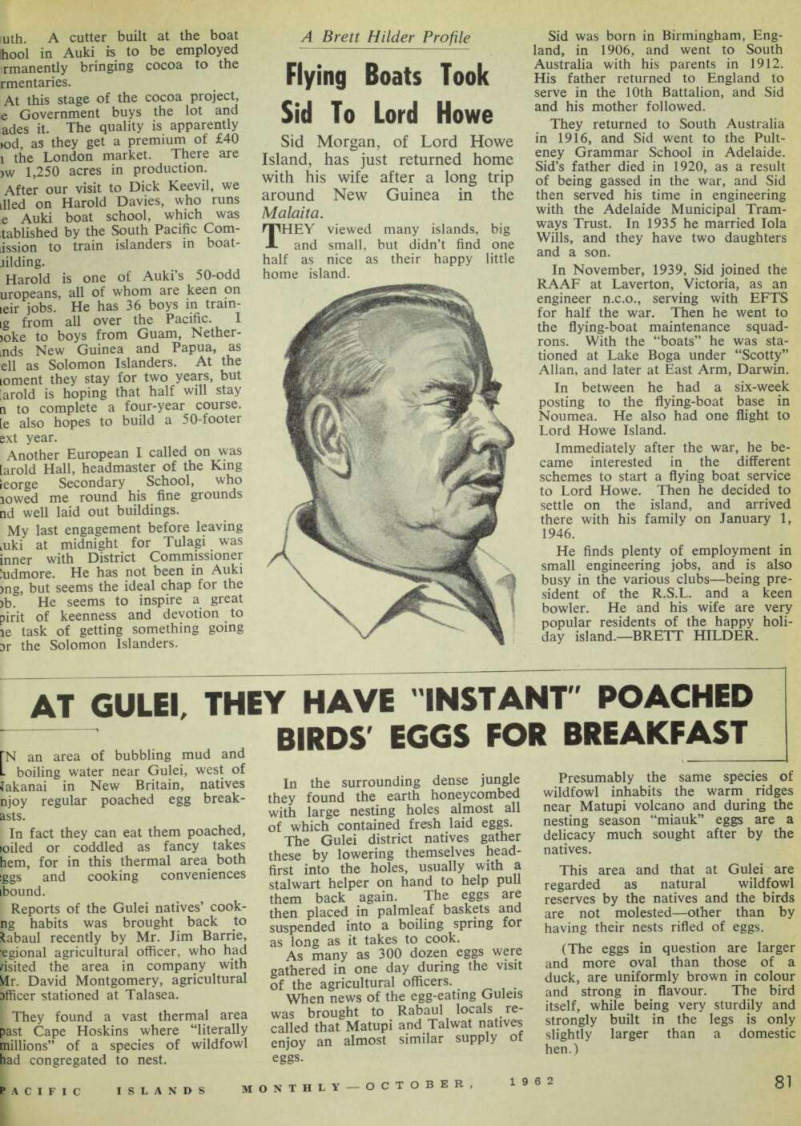
Although much else has changed, most customs of the natives of Malaita have [?] varied since before the war. Here in the village of Lisialala at Auki, Malaita, m[?] women and children gather during the collection of a "bride price" by the fat[?] of a prospective bride. Most of the currency used in this transaction was shell mon
iuth. A cutter built at the boat Ihool in Auki is to be employed rmanently bringing cocoa to the rmentaries.
At this stage of the cocoa project, e Government buys the lot and ades it. The quality is apparently >od, as they get a premium of £4O i the London market. There are jw 1,250 acres in production.
After our visit to Dick Keevil, we died on Harold Davies, who runs e Auki boat school, which was tablished by the South Pacific Com ission to train islanders in boat lilding.
Harold is one of Auki’s 50-odd uropeans, all of whom are keen on ieir jobs. He has 36 boys in tram ig from all over the Pacific. I >oke to boys from Guam, Nether inds New Guinea and Papua, as ell as Solomon Islanders. At the loment they stay for two years, but Harold is hoping that half will stay n to complete a four-year course, [e also hopes to build a 50-footer ext year.
Another European I called on was [arold Hall, headmaster of the King leorge Secondary School, who lowed me round his fine grounds nd well laid out buildings.
My last engagement before leaving mki at midnight for Tulagi was inner with District Commissioner ludmore. He has not been in Auki mg, but seems the ideal chap for the )b. He seems to inspire a great pirit of keenness and devotion to le task of getting something going ir the Solomon Islanders.