New Guinea's
pp. 75-77 · Read in the full issue

Education on the Go
From a Rabaul Correspondent The all-out campaign to edu :e, at least to literate standard,
w Guinea’s rapidly increasing
Live populace is gaining new
petus.
CHOOLS and teachers have be come the young nation’s most jent needs and these are being sd as rapidly as the machinery of ining and construction can be npleted.
At the head of the movement and using it with a new idea of its im rtance is newly-appointed Director Education, Mr. Leslie W. Johnson, A.
Mr. Johnson comes to New Guinea :h wide experience of primary and ondary teaching and teacher train ; with the Western Australian De rtment of Education.
At his first official function as ucation head, Mr. Johnson pre ited graduation certificates to out ing “E” Course teachers at haul’s Malaguna Teachers’ Train -5 College. (Last month 21 “E” Course ichers took to the field bringing ilaguna’s graduates to 154 since the urse’s inception in November, 1960. [ this “crash” system of teacher lining applicants whose minimum
qualification is the Intermediate Cer tificate, are put through an intensive six-months’ training in primary teaching).
Addressing last month’s graduates, Mr. Johnson emphasised the major importance of the job they would be doing.
“Yours is the most important job in the Territory today,” he said.
“Schools are the key to this Terri tory’s future. Without them there is little prospect of progress in other fields.”
In following up with some wise counselling on the young teachers roles in isolated native communities, the director advised them to relate their teaching methods to the needs of the people, to study primitive backgrounds and while attempting to break down superstition and sorcery
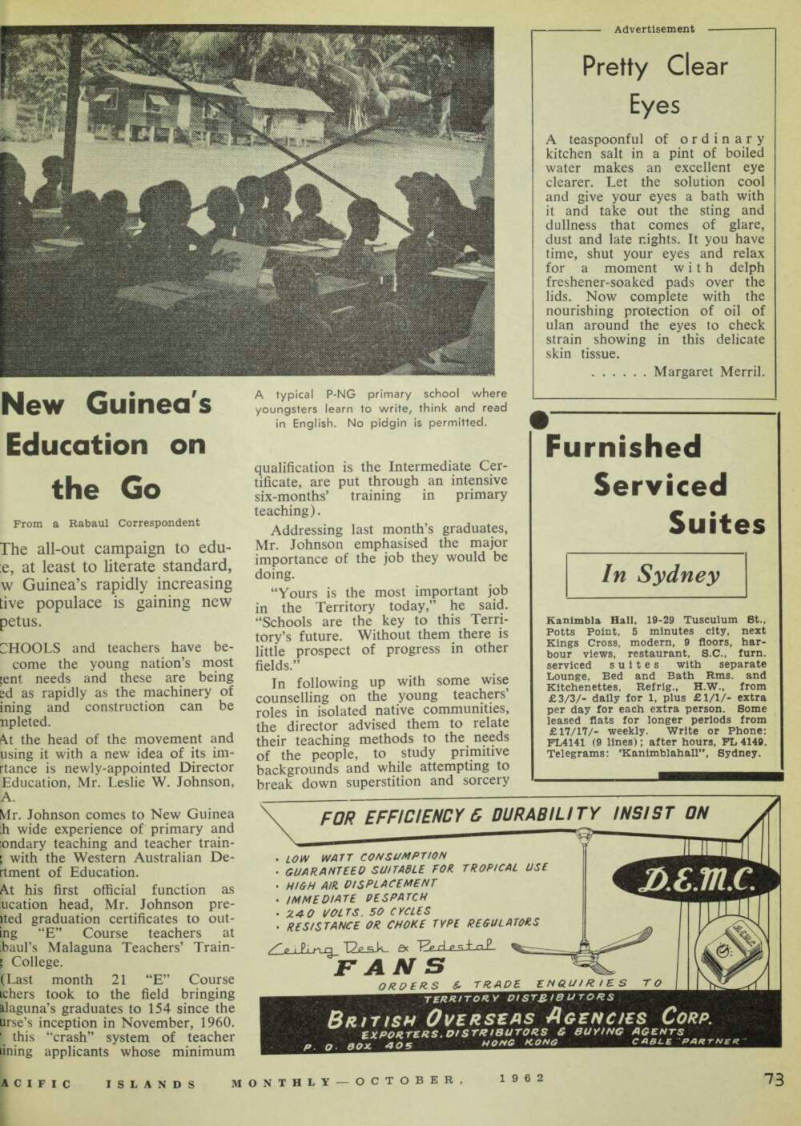
A typical P-NG primary school where youngsters learn to write, think and read in English. No pidgin is permitted.
encourage preservation of import t traditional practices.
Many outpost teachers have prob iy worked to these methods in the st, but it was good to hear the new ector advocating publicly the ention of traditional culture as • as is possible. Sympathetic in est in the best that is traditional ly be expected to result in the >wth of a national pride which so ■ are words beyond the indigenes’ derstanding.
While in Rabaul Director Johnson veiled to Kambubu on New Brit i’s south coast to open an imposing v Teachers’ Training College at the fenth-day Adventist Mission. Here un he expressed the urgent need teachers.
'There are 320,000 children not ; in schools,” he said. “We need least 2,000 new teachers to cope :h the Territory’s needs.”
Miracles Mr. Johnson’s awareness of his jartment’s needs does not neces ily make it a miracle-working de -tment, yet miracles are expected it.
Speaking to a PIM representative, Johnson said, “The key to educa n in the Territory lies with the in ;enous teacher. There are no bud restrictions on the training of in ;enes to teach, but we have a prob i in trying to withhold a certain •centage from primary teaching so it they may be trained to secondary ndard. ‘Now that children are beginning start school at the right age, we i getting secondary school growing hs. Two thousand five hundred ondary school enrolments are ex :ted next year—we must have chers ready for them.” \ teacher training college able to n out teachers of a standard equal that obtaining in Australia is one the department’s targets—possibly see the light of foundation in 1966- By those years it is hoped to have 3,000 primary school enrolments — 3 by 1970 to see every child of ligenous parents within reach of a look rhis decade then should see a tre mdous advancement in education the Territory.
Hie Summer Institute of Linguis s in New Guinea has taken de cry of its first aircraft, a Cessna 5. The Institute, with its Territory adquarters at Ukarumpa, near yura, Eastern Highlands District, w has almost 100 linguists working the field and the aircraft will fad ite the Institute’s language studies Papua and New Guinea.
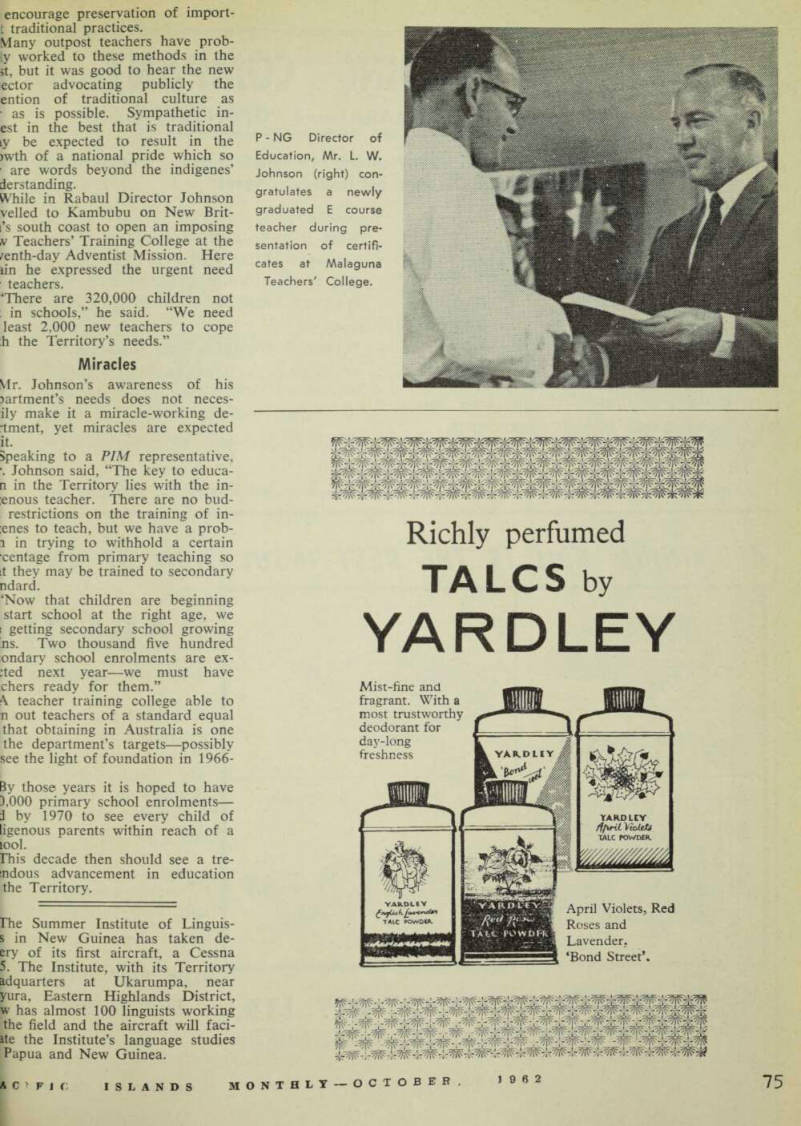
P- NG Director of Education, Mr. L. W.
Johnson (right) con
gratulates a newly
graduated E course teacher during pre sentation of certifi cates at Malaguna Teachers' College.