A Land With A Strange Past
pp. 46-50 · Read in the full issue

Possible New Missile Base Is A Land With A Strange Past
By Robert Langdon
The Gambier Archipelago of French Polynesia, which maj soon play an important role in the atom age, is nowadays onr of the sleepiest and least known island groups in the SoutJ Pacific. A century ago, however, it was a feverishly busy plac where the natives toiled long hours in the hot sun to buill churches and other ecclesiastical buildings to the glory of th white man’s god.
THE buildings, all of stone and coral blocks, included a massive cathedral—still the largest in French Polynesia—capable of seating 1,200 people.
Most of the churches are today in ruins. They are tragic monuments to a band of over-zealous Roman Catholic missionaries whose enthusi asm for their faith destroyed the cul ture of the native people and virtually wiped them out.
The Roman Catholic missionaries were members of the Society of Picus, which, in 1833, was entrusted by the Pope with catholicising all the islands of the North and South Pacific.
The society was free to choose where to start. The Gambiers were decided on on the advice of a French sea captain who had frequently visited the group from Tahiti for pearls and shell.
The first missionaries to arrive were Fathers Louis Jacques Laval and Francois d’Assise Caret, and an Irish catechist, Colomban Murphy. With a Polynesian interpreter from Rapa, they landed on Aukena, one of the four main islands in the archipelago, on July 16, 1834.
Baptisms Galore
The Polynesian population of the whole group was then about 4,000.
By the end of that year they began to make converts.
More missionaries, including Bishop Etienne Rochouse, arrived the next year and from then on there were mass baptisms and a wholesale des truction of pagan idols.
Towards the end of 1836, the most influential chief in the archipelago submitted to baptism. Soon after wards, Bishop Rochouse had a law drawn up which gave land conces sions in perpetuity to families who had become Christians.
This made it desirable for all the natives to become Christians.
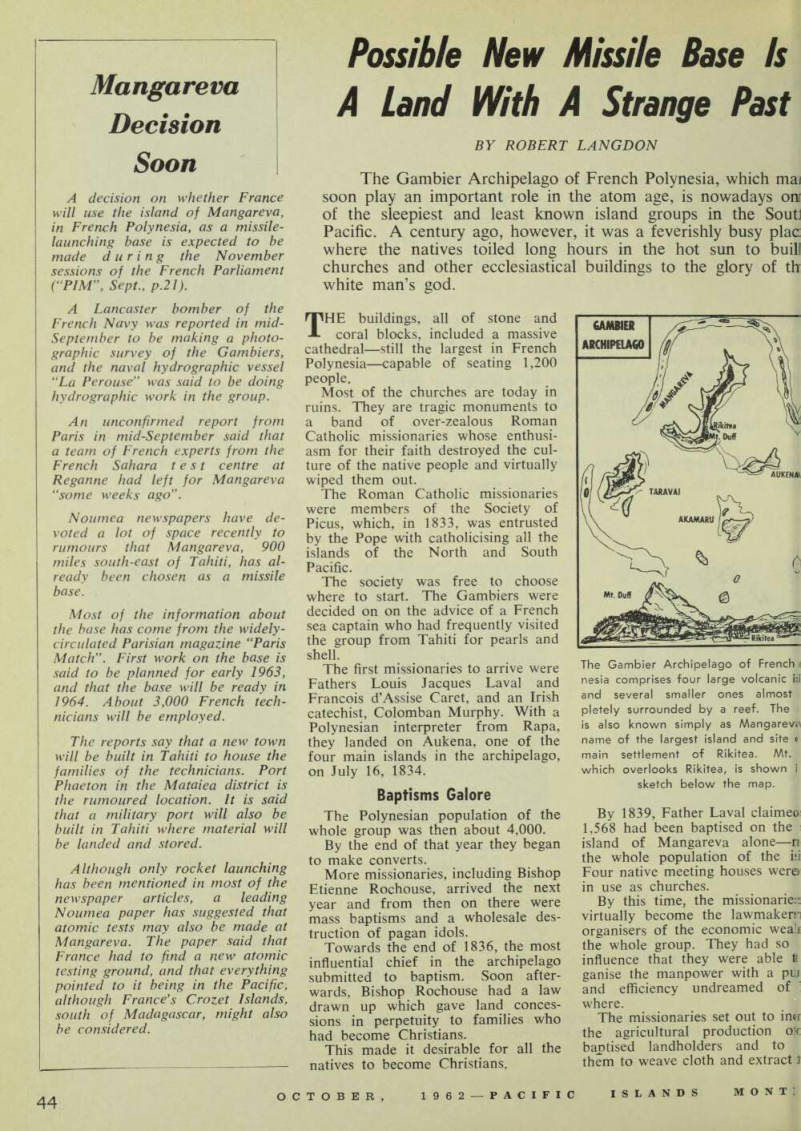
The Gambler Archipelago of French i nesia comprises four large volcanic hi and several smaller ones almost pletely surrounded by a reef. The is also known simply as AAangarev<\ name of the largest island and site « main settlement of Rikitea. Mt. which overlooks Rikitea, is shown i sketch below the map.
By 1839, Father Laval claimeo 1,568 had been baptised on the island of Mangareva alone —n the whole population of the id Four native meeting houses were in use as churches.
By this time, the missionaries virtually become the lawmakern organisers of the economic wealr the whole group. They had so influence that they were able tr ganise the manpower with a pm and efficiency undreamed of where.
The missionaries set out to inor the agricultural production oic baptised landholders and to them to weave cloth and extract J
oil with a press that they im ted.
Tiey also organised the diving for rls and pearl shell and began :hing the natives masonry so they Id build the numerous churches / dreamed of, lowever, instead of creating an of plenty for the natives, the sionaries brought disaster. Their rference with older, trusted hods of soil conservation and crop duction created a food shortage.
Tien a drought came followed by hurricane. The population was aged by dysentery and the annual th rate rose from 18 in 1841 to 79 1845.
'o ease the food shortage, the mis laries began importing flour from paraiso. This started a regular le in pearls and pearl shell between opean traders and Maputeoa, the icipal chief, and a handful of srters and vagabonds settled in the Dds. lie new settlers played havoc with le of the natives’ morals and sed them to disobey their priestly ts. The missionaries promptly ex imunicated the apostates.
Meanwhile, the faithful performed digious feats of stone cutting and Iding work. They quarried massive al blocks and carried them as the isionaries directed. They sweated long slopes of the mountainsides lay rock pavements in the roads I: they had graded, fhey built dikes into the lagoon to ke elaborate mazes for fish traps, ey built schools and a special Jse for the makers of tapa cloth i weavers of matting.
Most important, they built the massive cathedral at Rikitea, numerous smaller churches, a con vent where the life-loving Polynesian women took solemn vows of chastity and lived as nuns. And also some grim dungeons where those who disobeyed the missionaries were im prisoned.
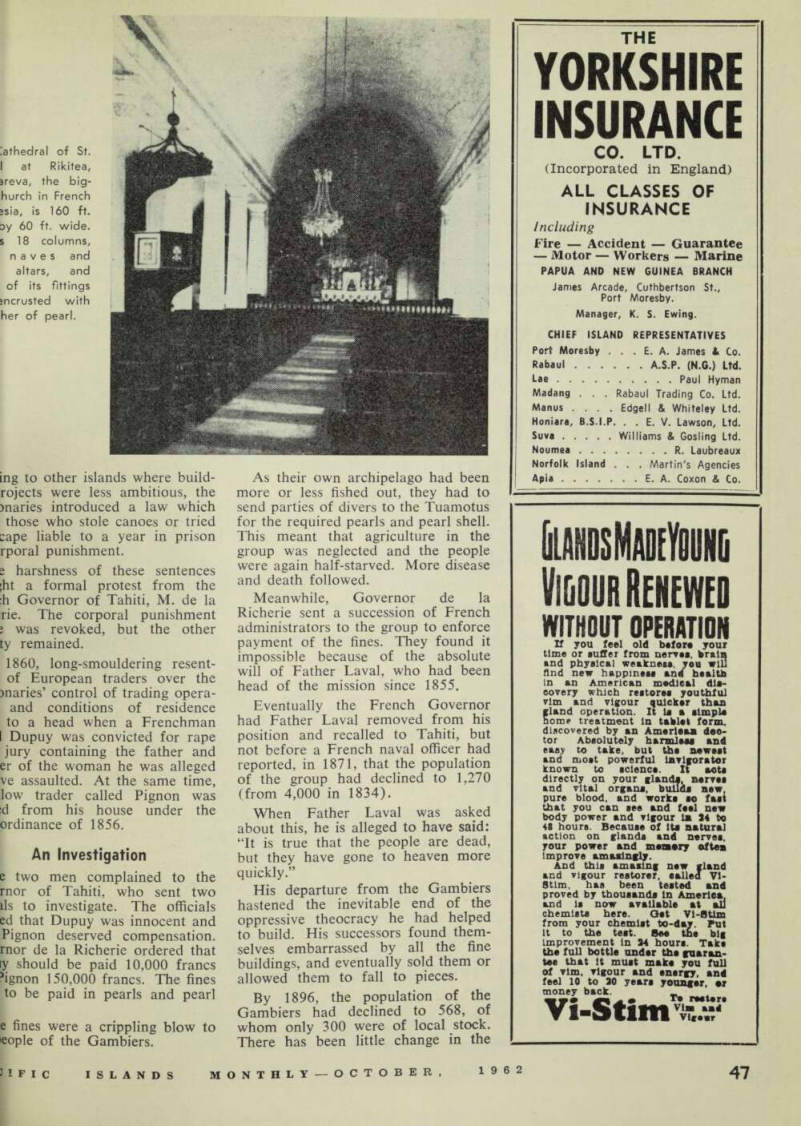
The cathedral at Rikitea, the main settlement on Mangareva, measured 160 ft. x 60 ft. Much of the inside was beautifully encrusted with mother of pearl—to the amazement and ad miration of visitors.
To combat the influence of Euro pean traders who gradually became more troublesome to them, the mis sionaries organised a department of ecclesiastical police whose duties in cluded syping on lovers when they wandered off at night.
Reaction!
In 1856, they introduced a law which prohibited the sale, donation or lease of native land without the per mission of Maputeoa or themselves.
The penalty was immediate confis cation and a fine.
This law also prescribed the trans fer of all plantations, houses or other improvements to the original land holder without compensation on the departure of a European leaseholder from the group.
Meanwhile, there was a growing native reaction against the mis sionaries. In 1849, no fewer than 36 women deserted from the convent; and in 1850, more than two dozen young men were in the dungeons for “chasing women”.
To try to deter the natives from
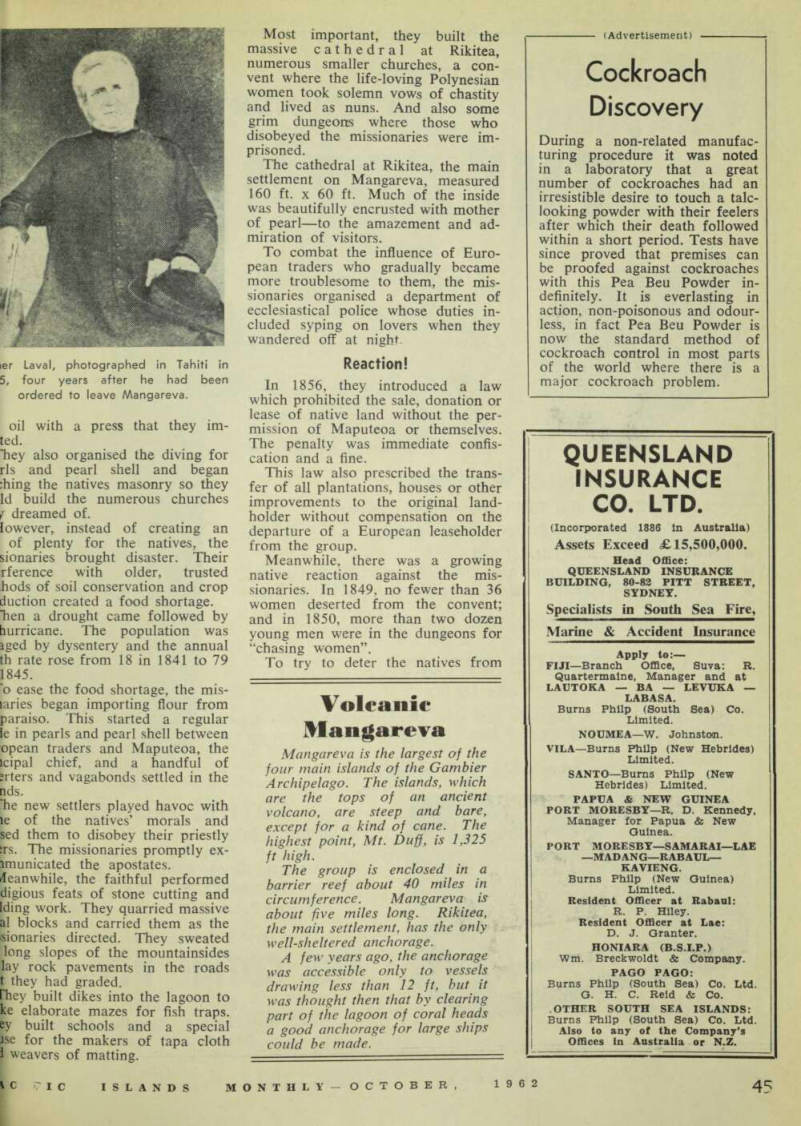
[?]er Laval, photographed in Tahiti in 5, four years after he had been ordered to leave Mangareva.
ing to other islands where build rojects were less ambitious, the maries introduced a law which those who stole canoes or tried cape liable to a year in prison rporal punishment. c harshness of these sentences ;ht a formal protest from the :h Governor of Tahiti, M. de la rie. The corporal punishment i was revoked, but the other ty remained. 1860, long-smouldering resent of European traders over the rnaries’ control of trading opera and conditions of residence to a head when a Frenchman 1 Dupuy was convicted for rape jury containing the father and er of the woman he was alleged ve assaulted. At the same time, low trader called Pignon was d from his house under the ordinance of 1856.
An Investigation
e two men complained to the rnor of Tahiti, who sent two ds to investigate. The officials ed that Dupuy was innocent and Pignon deserved compensation, rnor de la Richerie ordered that ly should be paid 10,000 francs *ignon 150,000 francs. The fines to be paid in pearls and pearl e fines were a crippling blow to cople of the Gambiers.
As their own archipelago had been more or less fished out, they had to send parties of divers to the Tuamotus for the required pearls and pearl shell.
This meant that agriculture in the group was neglected and the people were again half-starved. More disease and death followed.
Meanwhile, Governor de la Richerie sent a succession of French administrators to the group to enforce payment of the fines. They found it impossible because of the absolute will of Father Laval, who had been head of the mission since 1855.
Eventually the French Governor had Father Laval removed from his position and recalled to Tahiti, but not before a French naval officer had reported, in 1871, that the population of the group had declined to 1,270 (from 4,000 in 1834).
When Father Laval was asked about this, he is alleged to have said: “It is true that the people are dead, but they have gone to heaven more quickly.”
His departure from the Gambiers hastened the inevitable end of the oppressive theocracy he had helped to build. His successors found them selves embarrassed by all the fine buildings, and eventually sold them or allowed them to fall to pieces.
By 1896, the population of the Gambiers had declined to 568, of whom only 300 were of local stock.
There has been little change in the
[?]athedral of St. [?] at Rikitea, [?]reva, the big hurch in French [?]esia, is 160 ft. by 60 ft. wide, [?]s 18 columns, naves and altars, and of its fittings [?]encrusted with [?]her of pearl.
figures in the 60-odd years since then.
At the 1956 census, the population was 622—the only non-Polynesians being six Frenchmen and four Chinese.
Father Laval, who has received most of the blame for decimating the Gambier population, has, on the other hand, earned the gratitude of anthropologists for leaving a fine record of native traditions and early history, even though the traditions themselves were destroyed.
After the natives were taught to write, Father Laval had induced the
native priests and chiefs to record their traditional history, mythology, rituals and customs, Laval then trans lated the text into French, adding his own observations. His manuscript was published in 1937.
But the story of Father Laval and the Gambiers does not end at this point. For Father Laval also played an important, though unwitting role, in the history of the South Pacific and of France.
In 1836 he and Father Caret had gone from Mangareva to Tahiti to establish a Catholic mission. At that time, the only missionaries on Tahiti
were Protestant members of London Missionary Society, who been there since 1797.
The LMS missionaries objected the arrival of the Catholics and J Queen Pomare to order themr leave. When Laval and Caret refiu the Queen had them ignominkx seized and removed bodily.
A Belgian merchant, J. A. Moe hout, who was a Catholic American Consul in Tahiti, o plained about this treatment to ( French Consul-General in Chile.
The result was that the Frr Government sent a gunboat to TT to demand reparations and an apoc from Queen Pomare. Although] apology and the reparations ’ made, French warships began T ing Tahiti with increasing frequi —each time making pin-pricking o plaints about the ill-treatment!
Frenchmen.
In 1842, Admiral Du Petit-Tho used several flimsy pretexts abouu alleged ill-treatment of Frenchme proclaim a French protectorate Tahiti.
Enter Pritchard George Pritchard, the Bi Consul and a former LMS sionary, continually resisted Fn rule. In 1844, the French seized imprisoned him in a dungeon then deported him.
When news of this reached Fuji it brought France and England U: brink of war. To ease the tern the French Government offeree apologise to Pritchard and pay l an indemnity.
This satisfied the British Goc ment, but brought furious howls members of the French Oppose who declared that they would i vote in favour of the indenr France’s King Louis Phillipe offered to pay the indemnity him But the French Government sisted on holding a debate on the French Parliament. Although indemnity was voted through narrow majority, the Pritchard J dent helped to make the Goverm so unpopular that it was overthd by revolution in 1848. King I Phillipe lost his crown at the time.
The new French Government! tinued the protectorate over Tab!
This led in 1887 to the annexe; by France of almost all the islam the eastern South Pacific, incll the Gambier Archipelago, the ing point of all the trouble-; possibly now to be in the news after more than a century.